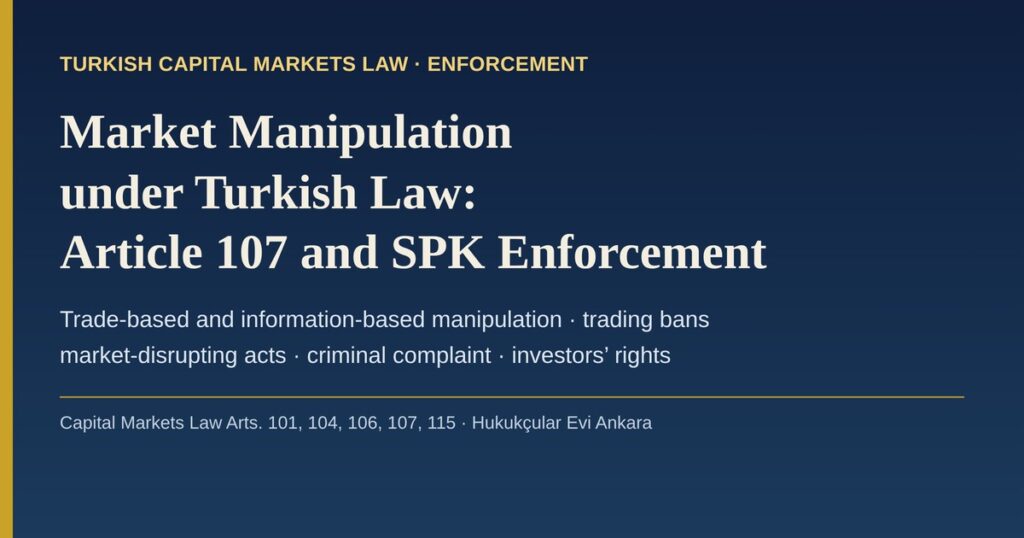
Turkish law treats market manipulation (“piyasa dolandırıcılığı”, literally “market fraud”) as a serious crime. Under Article 107 of Capital Markets Law No. 6362, anyone who trades, places, cancels or changes orders or carries out account movements to create a false or misleading impression about the price, supply or demand of capital market instruments faces three to five years’ imprisonment and a judicial fine of 5,000 to 10,000 days, which may not be less than the benefit obtained; spreading false or misleading information to influence prices and thereby obtaining a benefit carries three to five years’ imprisonment and a judicial fine of up to 5,000 days. Prosecution depends on a written application by the Capital Markets Board (SPK), which before that point can impose trading bans and other measures on persons reasonably suspected of manipulation, insider dealing or market-disrupting acts. Conduct that falls short of a crime can still be fined as a market-disrupting act. This guide explains the offences, the exceptions, effective repentance, SPK’s enforcement toolkit and the path from an SPK finding to a criminal trial, and what each stage means for investors who lost money in the 2026 manipulation cases. It reflects the legislation in force on 25 October 2026.
- The 2026 context
- Three tiers of market misconduct
- Trade-based manipulation: Article 107(1)
- Information-based manipulation: Article 107(2)
- Insider dealing: Article 106
- What is not manipulation: Article 108
- Effective repentance: Article 107(3)
- SPK’s measures: trading bans and more (Article 101)
- Market-disrupting acts: Article 104
- General administrative fines and abuse of trust: Articles 103 and 110
- Suspicious transaction reporting by intermediaries: Article 102
- From SPK finding to criminal trial
- What each stage means for investors
- Points for foreign institutions
- Common mistakes
- Frequently asked questions
The 2026 context
In September 2026 several Turkish investment funds failed to meet redemption requests and SPK ordered the liquidation of 131 funds run by seven portfolio management companies. Prosecutors are investigating allegations that funds were used to buy shares in little-known listed companies to push their prices up, and SPK has used its weekly bulletins to announce criminal complaints and trading bans against dozens of individuals in connection with specific shares. Foreign institutions have been affected too: on 22 October 2026 Norway’s sovereign wealth fund said it was among the investors harmed, as discussed in our analysis Norway’s Wealth Fund and Turkey’s Market Manipulation Crisis.
For investors, understanding the offence itself is not an academic exercise. The elements of Article 107 define what prosecutors must prove, what SPK’s experts will analyse and what evidence will eventually be available in the criminal file to support civil claims for damages.
Three tiers of market misconduct
The Capital Markets Law deals with abusive conduct on three levels, each with its own consequences.
Market misconduct under Capital Markets Law No. 6362
| Conduct | Nature | Sanction | Article |
|---|---|---|---|
| Market-disrupting acts | Acts and transactions that cannot be explained by a reasonable economic or financial reason and that disrupt the confident, transparent and stable functioning of the markets, where they do not amount to a crime | Administrative fine imposed by SPK; at least twice any benefit obtained | Art. 104 |
| Insider dealing | Trading, or changing or cancelling orders, on the basis of non-public information capable of affecting prices or investors’ decisions, thereby obtaining a benefit, by insiders and others who know or should know the nature of the information | Three to five years’ imprisonment or a judicial fine of at least twice the benefit | Art. 106 |
| Market manipulation | Trade-based or information-based conduct aimed at creating a false or misleading impression or influencing prices, values or investors’ decisions | Three to five years’ imprisonment and a judicial fine | Art. 107 |
The tiers are connected. SPK’s measures under Article 101 can be imposed on persons reasonably suspected of any of the three. A legal person in whose interest insider dealing or manipulation is committed is subject to the security measures specific to legal persons (Art. 114). And conduct investigated as manipulation may end up being sanctioned administratively as a market-disrupting act if the criminal elements cannot be proved.
Trade-based manipulation: Article 107(1)
Article 107(1) punishes those who buy or sell, place orders, cancel orders, change orders or carry out account movements in order to create a false or misleading impression about the prices, price changes, supply or demand of capital market instruments. The penalty is three to five years’ imprisonment and a judicial fine of 5,000 to 10,000 days, and the judicial fine may not be less than the benefit obtained by committing the offence.
Three features of the offence matter in practice:
- Intent is the core element. The trades must be made “in order to create a false or misleading impression”. Ordinary trading that happens to move the price is not manipulation; the prosecution must show the purpose, usually from patterns such as trading between related accounts, orders placed and cancelled to create apparent demand, or concentrated buying at the close.
- Account movements count. The offence expressly covers account movements, which captures transfers of instruments between related accounts used to create the appearance of trading activity.
- No benefit requirement. Unlike Article 107(2), trade-based manipulation does not require proof that the offender obtained a benefit; the benefit matters for the minimum judicial fine and for effective repentance.
In the 2026 cases the allegations focus on investment funds being used to accumulate shares in small listed companies. Trades placed through funds are trades “by” the persons who control the orders, and the analysis looks through the fund structure to the decision makers. Draft amendments reported in November 2025 would expressly provide that transactions through investment funds can constitute market manipulation and would raise the penalties; as at the date of writing the official consolidated text of the law shows the penalties stated above.
Information-based manipulation: Article 107(2)
Article 107(2), as amended by Law No. 6637 in 2015, punishes those who give false, wrong or misleading information, start rumours, publish news, make comments or prepare reports, or spread them, in order to influence the prices or values of capital market instruments or investors’ decisions, and thereby obtain a benefit. The penalty is three to five years’ imprisonment and a judicial fine of up to 5,000 days.
The provision reaches well beyond formal company disclosures. Social media posts, messaging-app groups, “research reports” and comments in the media can all fall within it if the information is false, wrong or misleading, the purpose is to influence prices or decisions, and a benefit is obtained. Where the false information appears in a company’s own public disclosure documents, the same facts also ground civil liability under Article 32, which we explain in Prospectus and Disclosure Liability in Turkey.
SPK also has a direct power over online content. In examinations under Articles 104, 106 and 107, it may decide to remove content or block access to publications made over the internet, and the decision is sent to the Association of Access Providers for implementation (Art. 101(3)).
The two forms of manipulation compared
| Feature | Trade-based (Art. 107(1)) | Information-based (Art. 107(2)) |
|---|---|---|
| Conduct | Buying, selling, placing, cancelling or changing orders; account movements | Giving false, wrong or misleading information; rumours, news, comments, reports; spreading them |
| Purpose | Creating a false or misleading impression about prices, price changes, supply or demand | Influencing prices, values or investors’ decisions |
| Benefit | Not an element of the offence | Required: “and thereby obtain a benefit” |
| Imprisonment | Three to five years | Three to five years |
| Judicial fine | 5,000 to 10,000 days; not less than the benefit | Up to 5,000 days |
| Effective repentance | Available under Art. 107(3) | Not covered by Art. 107(3), which refers to the first paragraph |
Insider dealing: Article 106
Insider dealing often travels with manipulation: those who organise a price run frequently also know of corporate events before they are announced. Under Article 106, a person who, directly or indirectly, gives, changes or cancels buy or sell orders for capital market instruments on the basis of information about the instruments or the issuer that is capable of affecting their prices, values or investors’ decisions and has not yet been made public, and thereby obtains a benefit for himself or another, commits insider dealing if he is:
- a manager of the issuer or of its subsidiaries or parent;
- a person who has the information because he is a shareholder of the issuer or of its subsidiaries or parent;
- a person who has the information through the exercise of his work, profession or duties;
- a person who obtained the information by committing a crime; or
- a person who knows, or, if this is proven, should know, that the information he holds is of this nature.
The penalty is three to five years’ imprisonment or a judicial fine; where a judicial fine is imposed, it may not be less than twice the benefit obtained (Art. 106). Separately, and without the need to prove inside information, board members and managers of issuers who make a profit by trading the issuer’s instruments within a period set by SPK, except where SPK allows it, must hand the net gain over to the issuer; if they fail to do so within thirty days, SPK fines them twice the benefit (Art. 103(4)).
What is not manipulation: Article 108
Article 108 lists conduct that does not constitute insider dealing or market manipulation:
- transactions by the Central Bank of the Republic of Türkiye or another authorised official body, or persons acting on their behalf, to implement monetary, exchange-rate or public debt management policies or to ensure financial stability;
- buyback programmes, employee share schemes and other share allocations to employees of the issuer or its subsidiaries carried out under SPK’s rules;
- purchases or sales of capital market instruments, or placing or cancelling orders, solely to support the market price for a predetermined period, provided they are carried out in accordance with SPK’s rules on price stabilisation and market making.
The exceptions are conditional. A buyback programme that does not follow SPK’s rules, or “stabilisation” outside the permitted framework, does not benefit from Article 108. Defendants in manipulation cases often argue that trading was market making or price support; the answer lies in whether SPK’s rules were followed.
Contact Hukukçular Evi Ankara
For questions on the 2026 market-manipulation cases, SPK measures and investors’ position in the criminal proceedings, you can reach our office by phone or WhatsApp. We correspond in English. Hukukçular Evi Ankara: +90 554 648 37 15
Effective repentance: Article 107(3)
A person who committed trade-based manipulation under Article 107(1) can reduce or avoid punishment by showing remorse and paying to the Treasury twice the benefit he obtained or caused to be obtained, and not less than TL 500,000. The effect depends on timing:
Effective repentance in trade-based manipulation
| When the payment is made | Effect | Article |
|---|---|---|
| Before an investigation starts | No penalty is imposed | Art. 107(3)(a) |
| During the investigation | The penalty is reduced by half | Art. 107(3)(b) |
| During the prosecution, before judgment | The penalty is reduced by one third | Art. 107(3)(c) |
Two points matter for investors. The payment goes to the Treasury, not to the persons who suffered losses, so it does not satisfy any civil claim. And because the amount is calculated by reference to the benefit obtained, an effective-repentance payment puts on the record a figure for the benefit, which is useful evidence in a later damages claim against the same person.
SPK’s measures: trading bans and more (Article 101)
Before any criminal case, SPK can act directly against persons it reasonably suspects of market-disrupting acts, insider dealing or manipulation. Under Article 101(1), as amended by Law No. 7518 in 2024 to include market-disrupting acts, SPK may take, in relation to such natural or legal persons, the authorised officers of legal persons and the capital market instruments concerned, any measure necessary for the effective and sound functioning of the market, including:
- a temporary or permanent ban on trading on the exchanges;
- changes to settlement methods;
- restrictions on margin trading, short selling and securities lending and borrowing;
- imposing or changing collateral requirements;
- trading in different markets or under different trading rules;
- limiting the distribution of market data;
- trading or position limits.
In the 2026 cases SPK has repeatedly combined two-year trading bans on named individuals with decisions to file criminal complaints, and has applied measures to the shares concerned. These decisions are published in SPK’s weekly bulletins, which makes them the most important public source for anyone mapping who is alleged to have done what, in which shares and over which period. A trading ban is an administrative measure based on reasonable suspicion; it is not a finding of guilt, and the persons concerned can challenge it before the administrative courts.
Under Article 101(2), when an issuer launches a programme to buy back its own shares, SPK may also restrict trading in its shares by persons connected with it through management, supervision or capital and other related persons.
Market-disrupting acts: Article 104
Article 104 catches conduct that harms the market without amounting to a crime. Acts and transactions that cannot be explained by a reasonable economic or financial reason and that disrupt the confident, transparent and stable functioning of exchanges and other organised markets are market-disrupting acts where they do not constitute an offence. SPK may impose administrative fines on persons who commit the market-disrupting acts it has defined. The statute sets the range at TL 20,000 to TL 500,000, and where a benefit has been obtained the fine may not be less than twice the benefit. Under Article 17(7) of the Misdemeanours Law No. 5326, fixed-amount administrative fines are increased each calendar year by the revaluation rate announced under the Tax Procedure Law; the increase does not apply to proportional fines.
The procedure is set out in Article 105. The person concerned must be asked for a defence before a fine is imposed; if no defence is submitted within thirty days of service of the request, the right is deemed waived (Art. 105(1)). Where the same misdemeanour is committed more than once before a decision, one fine is imposed and doubled, and if a benefit was obtained or a loss caused, the fine may not be less than three times that benefit or loss (Art. 105(2)). Half of the fines collected is recorded as budget revenue and half is transferred to the Investor Compensation Center (Art. 105(3)). The fines can be challenged before the administrative courts (Art. 105(4)).
Why Article 104 matters to claimants: an SPK decision that a person committed a market-disrupting act is not a criminal conviction, but it is an administrative finding by the regulator about specific conduct in specific instruments. For a civil claimant, such a finding is evidence of unlawful conduct that can support a tort claim under Article 49 of the Turkish Code of Obligations.
General administrative fines and abuse of trust: Articles 103 and 110
Beyond market-disrupting acts, SPK fines persons who breach the regulations, standards and forms adopted under the Capital Markets Law and its general and specific decisions. The statutory range is TL 20,000 to TL 250,000, and where a benefit was obtained the fine may not be less than twice that benefit. For legal persons, taking into account the gravity of the breach and the number of persons harmed, the fine can reach the higher of 1% of gross sales revenue and 20% of pre-tax profit in the last audited annual financial statements before the breach (Art. 103(1)). Where the breach is committed by an organ or representative of a private legal person, or by someone acting within its activities, the legal person is fined as well, unless the breach was to its detriment (Art. 103(2)). Public companies and collective investment schemes that, by failing to act as a prudent and honest merchant, allow the profits or assets of related persons to increase are fined on the same basis (Art. 103(6)).
Article 110 turns certain conduct into an aggravated form of the crime of abuse of trust, for which the penalty under Article 155(2) of the Turkish Criminal Code, normally one to seven years’ imprisonment and a judicial fine of up to 3,000 days, may not be less than three years. The conduct includes selling, using, pledging, concealing or denying capital market instruments, cash and other assets entrusted to an investment firm, a fund board or a collateral manager in any capacity; reducing the profits or assets of public companies through hidden transactions with related persons at prices, fees or values clearly different from comparable ones; and reducing, or preventing the increase of, the profits or assets of public companies and collective investment schemes through related-party agreements or practices contrary to arm’s-length terms, market practice and the principles of prudent and honest business, or by generating trading volume (Art. 110(1)). Destroying, altering or making inaccessible the records kept within an investment firm, fund board or collateral manager is punished with two to five years’ imprisonment and a judicial fine of 5,000 to 10,000 days (Art. 110(2)). In fund cases, Article 110 is often as relevant as Article 107, because it addresses what happened to the money inside the vehicle rather than to the price on the screen.
Suspicious transaction reporting by intermediaries: Article 102
Investment firms and other capital markets institutions designated by SPK must report to SPK, or to the bodies SPK designates, any information or suspicion that a transaction may constitute insider dealing or manipulation; SPK sets the procedure (Art. 102(1)). Those who report may not inform third parties, including the parties to the transaction, about the report or the persons reported, except courts, prosecutors and the Financial Crimes Investigation Board (MASAK), even where special laws provide otherwise (Art. 102(2)).
The reporting duty explains why many manipulation files start with an intermediary’s report rather than with a complaint by an investor, and why an investor’s broker may be unable to explain why a transaction or account has drawn attention.
From SPK finding to criminal trial
Capital markets offences follow a special procedure. An investigation into any offence defined in the Capital Markets Law requires a written application by SPK to the Chief Public Prosecutor’s Office; the application is a procedural condition (Art. 115(1)). If a public prosecution is brought on that application, a copy of the indictment is served on SPK when it is accepted and SPK becomes a participating party (Art. 115(2)). The prosecutor may draw on SPK’s professional staff, who may also be present when suspects or witnesses are questioned (Art. 115(3)), and SPK may object to a decision not to prosecute (Art. 115(4)).
The life of a manipulation case
| Stage | What happens | Legal basis | Public trace |
|---|---|---|---|
| 1. Detection | Market surveillance or a suspicious transaction report by an intermediary | Capital Markets Law Art. 102 | None; reports are confidential |
| 2. Examination and measures | SPK examination; trading bans and other measures on suspected persons and instruments | Art. 101 | SPK weekly bulletin |
| 3. Written application | SPK decides to file a criminal complaint with the prosecutor | Art. 115(1) | SPK weekly bulletin |
| 4. Investigation | Prosecutor investigates with SPK staff; seizure of assets and trustees for companies may be ordered | Art. 115(3); Criminal Procedure Code Arts. 128 and 133 | Press reports; trustee appointments are announced in the trade registry gazette |
| 5. Indictment and trial | SPK becomes a participating party; persons harmed by the offence may apply to join | Art. 115(2); Criminal Procedure Code Art. 237 | Court file; hearings |
| 6. Judgment | Conviction or acquittal; confiscation only where proceeds cannot be returned to victims | Art. 107; Turkish Criminal Code Art. 55(1) | Judgment |
The limitation period for prosecuting manipulation is eight years, because the offence carries imprisonment of up to five years (Turkish Criminal Code Art. 66(1)(e)). The same eight-year period becomes relevant to civil claims: under Article 72(1) of the Code of Obligations, where a damages claim arises from an act that is a crime with a longer limitation period, that period applies.
What each stage means for investors
An investor who lost money in shares affected by manipulation is not a bystander to the criminal process. The procedure is explained step by step in Joining a Criminal Case in Turkey as a Foreign Investor. Each stage creates either evidence or rights:
- SPK bulletins identify the shares, the periods and the persons concerned, and start the clock for knowledge-based limitation periods such as the two years in Article 72 of the Code of Obligations.
- The investigation gives victims and complainants the right to ask for evidence to be collected and, within the limits of confidentiality, to request copies of documents (Criminal Procedure Code Art. 234).
- The trial allows persons harmed by the offence to join as participating parties until judgment at first instance (Art. 237). Whether an exchange investor qualifies is decided by the court; SPK’s participation does not replace the investor’s own.
- Seizures of suspects’ assets (Art. 128) and the rule that proceeds are confiscated only where they cannot be returned to the victim (Turkish Criminal Code Art. 55(1)) make the criminal file a potential source of recovery.
- Civil claims do not wait for the criminal judgment. Claims based on false or misleading disclosures are barred six months after the loss (Capital Markets Law Art. 32(6)); tort claims against the manipulators are barred two years after knowledge, ten years after the act, or later where the criminal period is longer (Code of Obligations Art. 72).
The Law on Certain Investment Funds Ordered into Liquidation (Law No. 7596), approved by parliament on 22 October 2026 and awaiting publication in the Official Gazette as at the date of writing, adds a further consequence for persons whom SPK finds to have committed market-disrupting acts, insider dealing or manipulation together with the liquidated funds, or to have acted with them: according to the reported text, no payment is made to them from the funds’ liquidation or recovery accounts.
Points for foreign institutions
Foreign institutional investors meet the manipulation regime from three directions. As victims, they have the same rights as Turkish investors to join the criminal case and to bring civil claims, subject to the procedural points for foreign claimants explained in Representing Foreign Institutional Investors in Turkish Capital Markets Disputes. As market participants, their own trading in affected shares may be examined; SPK and those it appoints may request information, documents and records, and failure to provide them in time or in the requested form, or providing incomplete, untrue or misleading information, is subject to an administrative fine (Capital Markets Law Art. 103(7)). And as principals of external managers, they have an interest in how their managers traded in the affected shares, which is why reviews of external managers should be coordinated with Turkish counsel from the start.
Foreign institution checklist in a manipulation case
| Question | Where to look | Legal relevance |
|---|---|---|
| Were any of our holdings named in SPK bulletins? | SPK weekly bulletins since 2025 | Trading bans and criminal complaints (Arts. 101 and 115) |
| Did we buy in an IPO or after company announcements? | Allocation notices; KAP archive | Disclosure liability and the six-month period (Art. 32) |
| Did our managers trade in the affected shares? | Manager trade records | Information requests (Art. 103(7)); mandate claims |
| Has an indictment been accepted? | Court records through Turkish counsel | Application to join (Criminal Procedure Code Art. 237) |
| Have assets been seized or trustees appointed? | Court decisions; trade registry gazette | Recovery (Criminal Procedure Code Arts. 128 and 133; Criminal Code Art. 55) |
Hukukçular Evi Ankara
Ankara-based law office, Av. Fatma Öztürk. Telephone and WhatsApp: +90 554 648 37 15. We correspond in English.
Common mistakes
- Treating an SPK trading ban as the end of the matter. It is a provisional measure; the criminal case and civil claims follow separate rules and timetables.
- Waiting for a conviction before claiming. Disclosure claims are barred six months after the loss; tort claims run from knowledge of the loss and the liable person.
- Expecting effective-repentance payments to reach investors. They are paid to the Treasury.
- Ignoring the fund level. Where funds were the vehicle, abuse of trust under Article 110 and the liability of portfolio management companies may matter as much as manipulation under Article 107.
- Not joining the criminal case in time. Participation cannot be requested for the first time on appeal (Criminal Procedure Code Art. 237(2)).
Frequently asked questions
What is the penalty for market manipulation in Turkey?
Three to five years’ imprisonment and a judicial fine. For trade-based manipulation the fine is 5,000 to 10,000 days and not less than the benefit obtained (Capital Markets Law Art. 107(1)); for information-based manipulation it is up to 5,000 days (Art. 107(2)).
Does information-based manipulation require a benefit?
Yes. Article 107(2) applies to those who spread false, wrong or misleading information to influence prices, values or investors’ decisions “and thereby obtain a benefit”. Trade-based manipulation under Article 107(1) has no such requirement.
Can a prosecutor investigate manipulation without SPK?
No. An investigation into offences under the Capital Markets Law requires a written application by SPK to the prosecutor, which is a procedural condition (Art. 115(1)).
Is an SPK trading ban a finding of guilt?
No. Measures under Article 101 are based on reasonable suspicion and can be challenged before the administrative courts. They are, however, an important public indication of which persons and shares SPK considers involved.
What is a market-disrupting act?
An act or transaction that cannot be explained by a reasonable economic or financial reason and disrupts the confident, transparent and stable functioning of the markets, where it does not amount to a crime. SPK may impose administrative fines for it (Art. 104).
Does effective repentance compensate investors?
No. Under Article 107(3) the payment of twice the benefit, and not less than TL 500,000, is made to the Treasury. It reduces or removes the penalty but does not satisfy investors’ civil claims.
Are price stabilisation and buybacks manipulation?
Not when carried out in accordance with SPK’s rules. Article 108 excludes buyback programmes, employee share schemes and price stabilisation or market making that comply with those rules, as well as official transactions by the Central Bank or other authorised bodies.
How long can manipulation be prosecuted?
Eight years, because the offence carries imprisonment of up to five years (Turkish Criminal Code Art. 66(1)(e)). Civil claims arising from the offence benefit from the same period under Article 72(1) of the Code of Obligations.
Can investors join the criminal case?
Persons harmed by the offence may apply to join a public prosecution as participating parties until judgment at first instance (Criminal Procedure Code Art. 237). The court decides whether an investor qualifies.
How does insider dealing differ from manipulation?
Insider dealing under Article 106 is trading on non-public information capable of affecting prices or investors’ decisions, by insiders and others who know or should know its nature, with a benefit obtained; it carries three to five years’ imprisonment or a judicial fine of at least twice the benefit. Manipulation under Article 107 is creating a false impression through trading or spreading false information, and carries imprisonment and a judicial fine together.
Can fund managers be prosecuted for what happened inside a fund?
Yes. Article 110 makes the misuse of assets entrusted to investment firms and fund boards, and certain related-party transactions that drain public companies or collective investment schemes, an aggravated form of abuse of trust, with a minimum penalty of three years’ imprisonment.
Related guides
- Turkey’s 2026 Fund and Market Manipulation Crisis: Legal Guide for Foreign Institutional Investors — the entry point to this series: which route fits which exposure, liable parties and deadlines
- Turkish Bond Defaults: Bondholders’ Boards and Enforcement
- Continuous Disclosure in Turkey: Inside Information and Delayed Disclosure
- How a Securities Lawsuit Proceeds in Turkey
- Limitation Periods for Investor Claims in Turkey
- Concealed Profit Transfers and Controlling Shareholder Liability
- Claims Against Brokers, Custodians and Portfolio Managers in Turkey
- When a Turkish Issuer or Broker Becomes Insolvent
- Obtaining and Preserving Evidence in Turkey for Securities Claims — preservation, document production and the criminal file
- Shareholder Rights in Turkish Listed Companies after the 2026 Crisis — general meetings, release, annulment and exit rights
- Insider Dealing in Turkey: Capital Markets Law Article 106 — trading on non-public information
- Calculating Damages in Turkish Securities Claims — loss, interest and currency
- Suing in Turkey or Abroad: Jurisdiction and Enforcement — forum choice and enforcement of foreign judgments and awards
- Suing Turkey’s Capital Markets Board (SPK) — challenging SPK decisions and supervisory failure claims
- Suing Directors and Auditors of Turkish Listed Companies — board members, managers and audit firms
- Can Foreign Investors Bring a Class Action in Turkey? — joint claims, consolidation, association actions and assignment
- Freezing Assets in Turkey for Investor Claims — precautionary attachment, interim injunctions and criminal seizure
- Norway’s Wealth Fund and Turkey’s Market Manipulation Crisis — all routes available to institutional shareholders in the 2026 cases
- Joining a Criminal Case in Turkey as a Foreign Investor — complaints, file access, objections and joining the prosecution
- Prospectus and Disclosure Liability in Turkey — Capital Markets Law Arts. 10 and 32 and the six-month limitation period
- Representing Foreign Institutional Investors in Turkish Capital Markets Disputes — who may act, powers of attorney, fees and confidentiality
- Legal Guide for Foreign Investors in Turkey (Türkiye) 2026 — the full English-language guide
- Turkey’s 2026 Fund Liquidation: Legal Guide for Foreign Investors and Companies — for holders of units in the liquidated funds
- Norveç Varlık Fonu “Mağduruz” Dedi — Turkish-language analysis for investors (in Turkish)
- Piyasa Dolandırıcılığı (Manipülasyon) Suçu — the offence in detail (in Turkish)
- Sermaye Piyasası Suçları ve Kurul Başvurusu — SPK’s written application (in Turkish)
- SPK Bülteni Kararları Rehberi — reading SPK’s weekly bulletins (in Turkish)
Important note: This guide is for general information only and does not constitute legal advice on any matter. It reflects the legislation in force on 25 October 2026. Investigations into the 2026 cases are ongoing; a criminal complaint, trading ban or arrest is not a conviction and the presumption of innocence applies. Law No. 7596 had been approved by the Turkish Grand National Assembly but not yet published in the Official Gazette; its description is based on the reported text. Legislation relied on: Capital Markets Law No. 6362, Arts. 32, 101 (as amended by Law No. 7518), 102, 103, 104, 105, 106, 107 (as amended by Laws No. 6637 and 7222), 108, 110, 114 and 115; Misdemeanours Law No. 5326, Art. 17(7); Turkish Criminal Code No. 5237, Arts. 55, 66 and 155; Criminal Procedure Code No. 5271, Arts. 128, 133, 234 and 237; Turkish Code of Obligations No. 6098, Arts. 49 and 72.