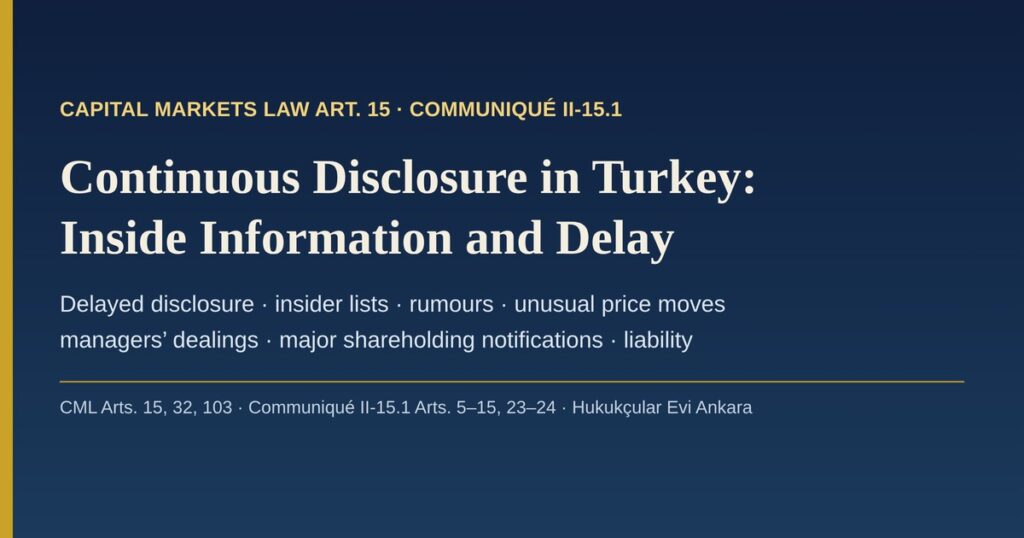
Most securities claims against Turkish listed companies turn on a disclosure: an announcement on the Public Disclosure Platform (KAP) that was false or incomplete, or information that should have been announced and was not. Turkish law requires issuers and other relevant parties to disclose information, events and developments that could affect the value or price of capital market instruments or investors’ decisions (Capital Markets Law Art. 15(1)). The detailed rules are in the Capital Markets Board’s Communiqué on Special Situations (Material Events) No. II-15.1. It requires inside information to be disclosed when it arises or becomes known, and allows disclosure to be delayed only to protect legitimate interests, without misleading investors and with confidentiality assured, by a board decision that must later be explained (Arts. 5 and 6). Issuers must answer market rumours without waiting to be asked, explain unusual price movements at the exchange’s request, keep lists of persons with access to inside information, and include in every disclosure a statement of responsibility (Arts. 7–9 and 23). Shareholders crossing 5, 10, 15, 20, 25, 33, 50, 67 or 95 per cent must also disclose (Art. 12). This guide explains these duties, how breaches give rise to liability under Capital Markets Law Art. 32, what evidence they generate for investors, and the obligations that large foreign holders themselves must meet. It reflects the legislation in force as at 25 October 2026, including Communiqué II-15.1 as last amended in 2018.
- Why disclosure rules decide investor claims
- The legal framework
- Key concepts
- Disclosing inside information
- Delaying disclosure
- Lists of persons with access to inside information
- Unusual price and volume movements
- Rumours and media reports
- Forward-looking statements
- Dealings by managers and parent companies
- Major shareholding notifications
- Other mandatory disclosures
- Form and quality of disclosures
- When disclosure goes wrong: liability and sanctions
- Evidence the rules create
- Points for foreign institutions
- Time limits
- Frequently asked questions
- Related guides
Why disclosure rules decide investor claims
Under Capital Markets Law No. 6362 Art. 32(1), issuers and the persons who sign public disclosure documents, or on whose behalf they are signed, are jointly liable for losses caused by false, misleading or incomplete information in them. The documents listed include the prospectus, the information form in tender offers, the special-situation disclosure (özel durum açıklaması), announcements in mergers and demergers, and financial reports. Liability for special-situation disclosures therefore sits at the centre of most claims arising from the 2026 market manipulation cases.
Whether a disclosure was false, misleading or incomplete is judged against what the rules required the issuer to say and when. That is why the detail of Communiqué II-15.1 matters to an investor: it defines when information had to be disclosed, when delay was allowed, what a disclosure must contain and who is responsible for it. The liability regime itself, including the presumption of causation and the six-month limitation period, is explained in Prospectus and Disclosure Liability in Turkey.
Key point: An omission can be as actionable as a false statement. If inside information should have been disclosed and was not, or a disclosure left out facts needed to avoid a misleading impression, the issuer’s announcements in the meantime may be “incomplete” or “misleading” within Capital Markets Law Art. 32(1).
The legal framework
Article 15 of the Capital Markets Law contains the basic duty: information, events and developments that could affect the value or price of capital market instruments or investors’ decisions are disclosed to the public by issuers or relevant parties (Art. 15(1)). SPK sets the rules on disclosure, notification to the issuer, delay in exceptional cases and non-disclosure (Art. 15(2)). Financial statements and reports are governed separately by Art. 14, which makes the issuer and, according to their fault, its board members responsible for their accuracy and requires a separate board resolution and statements of accuracy (Art. 14(2)).
SPK exercised its power in the Communiqué on Special Situations No. II-15.1, published in the Official Gazette of 23 January 2014 and amended by Communiqués II-15.1.a (2017), II-15.1.b (2018) and II-15.1.c (2018). The Communiqué applies to issuers, including those whose shares are traded on the exchange and those whose trading has been temporarily suspended, and to relevant parties, from SPK’s approval of the prospectus or issue document (Communiqué Art. 2(1)). Issuers that have offered debt instruments to the public without listing their shares are covered until the instruments are redeemed (Art. 2(2)), with lighter rules for certain issuers that do not offer to the public (Art. 2(3)).
Key concepts
Definitions in Communiqué II-15.1
| Term | Meaning | Article |
|---|---|---|
| Inside information (içsel bilgi) | Information, events and developments not yet disclosed that could affect the value or price of capital market instruments or investors’ decisions | Art. 4(1)(e) |
| Continuous information (sürekli bilgi) | All information, events and developments other than inside information; the Communiqué’s rules on continuous information cover, for example, changes in shareholding and management control | Art. 4(1)(p) |
| Special situations (özel durumlar) | Inside or continuous information that could affect value, price or investment decisions | Art. 4(1)(n) |
| Persons with managerial responsibility | Board members, and others with regular access to inside information and power to take managerial decisions affecting the issuer’s future | Art. 4(1)(f) |
| Closely associated persons | Spouses, children and household members; entities they manage, control or benefit from; and managerial persons of large subsidiaries | Art. 4(1)(g) |
| Persons acting in concert | Persons cooperating under an express or tacit, oral or written agreement to change an issuer’s capital structure or management control | Art. 4(1)(c) |
| Relevant party (ilgili taraf) | Persons other than the issuer that must make disclosures under the Communiqué | Art. 4(1)(h) |
Disclosing inside information
The core rule is timing. Inside information, and changes to matters already disclosed, must be disclosed by the issuer when they arise or become known (Communiqué Art. 5(1)). Disclosures are, unless the Communiqué provides otherwise, to be made immediately (Art. 23(2)).
The duty extends beyond the issuer in two situations. If inside information becomes known, without the issuer’s knowledge, to persons holding directly or indirectly 10 per cent or more of the issuer’s voting rights or capital, or 10 per cent or more of privileged shares carrying the right to elect or nominate board members, those persons must disclose it (Art. 5(2)). And if the issuer, or a person acting in its name or on its account, discloses inside information to a third party in the normal course of business or duties, the issuer must disclose it to the public (Art. 5(3)). These two rules do not apply where the person with access is bound to keep the information confidential by law, the articles or a specific contract (Art. 5(4)).
Developments in the issuer’s parent or subsidiaries are covered where a change in their activities, finances or management or capital relations causes a significant change in the issuer’s own activities, finances or management and capital structure (Art. 5(5)). In group structures, as in many of the companies involved in the 2026 cases, this brings group transactions within the disclosure duty.
Delaying disclosure
An issuer may delay disclosure of inside information, on its own responsibility, to avoid harm to its legitimate interests, provided the delay does not mislead investors and the issuer can keep the information confidential (Communiqué Art. 6(1)). All three conditions must be met throughout the delay.
- ▸ Decision. The effect of the delay on the protection of the issuer’s legitimate interests, the absence of a risk of misleading investors, and the measures taken to keep the information confidential must be recorded in a board decision, or in the written approval of a person authorised by the board (Art. 6(4)).
- ▸ Confidentiality measures. The issuer must take effective steps to prevent access by persons not on the insider list, ensure those with access acknowledge their legal obligations and the sanctions for misuse, and disclose the information if confidentiality cannot be maintained (Art. 6(3)).
- ▸ Ending the delay. As soon as the reasons for delay cease, the issuer must disclose the information, stating the decision to delay and the reasons for it. SPK may examine whether the reasons were justified. If the event to which the delayed information relates does not occur, disclosure may be omitted (Art. 6(2)).
- ▸ Rumours end the delay. If news or rumours concern information whose disclosure was delayed, the reasons for delay are deemed to have ceased and the issuer must disclose (Art. 9(2)).
- ▸ Large holders. Holders of 10 per cent or more who must disclose under Art. 5(2) may also use the delay mechanism, notifying the issuer (Art. 6(5)).
Key point: Delay is on the issuer’s own responsibility and must be documented. In a claim, the board decision or written approval under Art. 6(4) shows when the issuer knew the information and why it chose not to disclose. If no such decision exists, the issuer cannot rely on the delay mechanism; if it exists, its reasoning can be tested against the three statutory conditions.
Model outline: request to SPK to examine a delayed or missing disclosure
- 1. Applicant: the institution, its holdings in the issuer’s instruments during the relevant period, and its Turkish lawyer.
- 2. The issuer and the information concerned: what it was, when the applicant believes it arose or became known, and when, if at all, it was disclosed on KAP.
- 3. Why disclosure was due: Capital Markets Law Art. 15(1) and Communiqué Arts. 5(1), 5(5) and 23(2).
- 4. If delay was invoked, why the conditions of Art. 6(1) were not met, for example rumours circulating (Art. 9(2)), trading by insiders, or misleading interim statements.
- 5. Request that SPK examine the justification for any delay (Art. 6(2)), obtain the board decision under Art. 6(4) and the insider list held by the Central Registry (Art. 7(1)), and take the measures within its powers.
- 6. Request to be informed of the outcome, and reservation of all civil claims.
Lists of persons with access to inside information
Issuers must notify the Central Registry Agency (MKK) of persons who work for them under employment or other arrangements and have regular access to inside information, and update the notification within two business days of any change. MKK keeps the lists for each issuer and sends them to SPK and the exchange on request (Communiqué Art. 7(1)). Persons with managerial responsibility are deemed to have access to inside information (Art. 7(2)). Each entry must state the person’s name and identification number, the reason for inclusion, the date of the list and its updates, and whether the person has managerial responsibility (Art. 7(3)); lists are updated when the reason for inclusion changes, a new person must be added or a person’s access ends (Art. 7(4)). Issuers must ensure listed persons are aware of their obligations and of the sanctions for misuse, and the burden of proving this lies on the issuer (Art. 7(5)).
For investors, the list is a map of who knew what. It identifies the persons whose trading should be compared with the timing of disclosures, a central step in any insider dealing analysis, as explained in Insider Dealing in Turkey: Capital Markets Law Article 106.
Unusual price and volume movements
When the price or trading volume of an issuer’s instruments moves in a way that ordinary market conditions cannot explain, the issuer must, at the exchange’s request, make a public disclosure. The disclosure must state whether there are special situations not yet disclosed and, subject to the delay rules, set out all of them (Communiqué Art. 8(1)).
In manipulation cases this rule is significant. Statements by issuers that “there is no undisclosed information that could explain the price movement” are themselves special-situation disclosures. If, at the time, there was undisclosed inside information, or the issuer knew of matters that explained the movement, such a statement may be false or misleading within Capital Markets Law Art. 32(1), and may also bear on the information-based manipulation offence in Art. 107(2), discussed in Market Manipulation under Turkish Law.
Rumours and media reports
Where news or rumours about an issuer appear in the media or other channels for the first time, or differ in content from information previously disclosed, and are significant enough to affect value, price or investment decisions, the issuer must disclose whether they are accurate or sufficient. It must do so without waiting for any warning, notification or request from SPK or the exchange (Communiqué Art. 9(1)). Comments, analyses, assessments and forecasts based on publicly disclosed information are outside this duty (Art. 9(3)).
The rule works in both directions. An issuer cannot stay silent in the face of rumours that it knows to be true, and if it intends to announce special situations, including forward-looking assessments, through the media or other channels, it must make the KAP disclosure before or at the same time; if such matters are mentioned inadvertently at a public meeting, it must disclose them on KAP immediately (Art. 9(4)). Selective briefings to analysts or journalists ahead of KAP therefore breach the rules.
Key point: Market rumours are often the first sign of a problem. Where significant rumours circulated and the issuer said nothing, or issued a denial later shown to be wrong, Art. 9 provides a clear benchmark for what it should have done and when.
Forward-looking statements
Issuers are not obliged to publish forward-looking assessments, such as plans and forecasts that give an idea of future activities, financial position and performance (Communiqué Arts. 4(1)(d) and 10(1)). If they choose to do so, they must follow set rules: the assessment must be approved by a board decision or by the written approval of a person authorised by the board; it may be published at most four times a year, by special-situation disclosure, annual report or investor presentation published on KAP, but any material change to a published assessment must be disclosed regardless of that limit; and where results differ significantly from earlier assessments, the reasons must be explained (Art. 10(1)(a)–(c)). The principles for forward-looking statements must be set out in the issuer’s disclosure policy (Art. 10(2)).
For investors, the obligation to update and to explain deviations is the important part. Optimistic projections maintained after the issuer knew they would not be met can be misleading disclosures in their own right.
Contact Hukukçular Evi Ankara
For questions on disclosure duties of Turkish listed companies and claims arising from misleading or delayed announcements in the 2026 fund and manipulation cases, you can reach our office by phone or WhatsApp. We correspond in English. Hukukçular Evi Ankara: +90 554 648 37 15
Dealings by managers and parent companies
Persons with managerial responsibility, persons closely associated with them and the issuer’s parent, whether a natural or legal person, must publicly disclose all their transactions in the issuer’s shares and instruments based on them (Communiqué Art. 11(1)). No disclosure is needed until the total of each person’s transactions in a calendar year reaches the threshold in Art. 11(2), set in the Communiqué at TRY 250,000; once it is reached, that transaction and all later ones must be disclosed (Art. 11(2) and (4)). A similar rule applies to transactions in the issuer’s instruments other than publicly offered shares (Art. 11(3)). Amounts in the Communiqué may be revised annually by reference to the revaluation rate (Art. 28), so the current threshold should be checked.
Two statutory rules reinforce this. Board members and managers who make a profit from trading in the issuer’s instruments within a period set by SPK must pay the net profit to the issuer, whether or not they had inside information, unless SPK permits the trading; failure to pay within thirty days leads to an administrative fine of twice the benefit (Capital Markets Law Art. 103(4)). And trading on inside information is a crime (Art. 106). Managers’ dealings disclosures are therefore an essential data source when reconstructing who traded around key announcements.
Major shareholding notifications
A person, alone or with persons acting in concert, whose direct or indirect share of the capital or voting rights of an exchange-traded issuer reaches or falls below 5, 10, 15, 20, 25, 33, 50, 67 or 95 per cent must disclose this; the founder of investment funds must do the same for the funds’ combined holdings (Communiqué Art. 12(1)). For direct holdings in exchange-traded issuers, the disclosure that the holder would otherwise make is made by the Central Registry Agency; where the threshold is reached or crossed through acting in concert, indirectly or by reference to voting rights, the obligation remains with the person concerned (Art. 12(4)).
Voting rights are calculated broadly. All voting rights attaching to shares count, including frozen ones (Art. 12(3)), and the calculation includes voting rights under voting agreements, temporary transfers, pledged shares where the pledgee intends to vote, usufruct, controlled undertakings, deposited shares that may be voted at discretion, and proxies that may be exercised at discretion (Art. 13). Holding instruments that give a right to acquire listed shares also triggers disclosure when the related voting rights reach or cross the thresholds (Art. 14). The disclosure must identify the person, any indirect holding structure, persons acting in concert, the issuer, the transaction date, nominal values and amounts, and the percentages before and after (Art. 15(1)). It must be made using the prescribed form by 09:00 on the third business day after the transaction (Art. 23(3)).
The Commercial Code has a parallel rule. An undertaking that acquires or falls below 5, 10, 20, 25, 33, 50, 67 or 100 per cent of a capital company must notify the company and the competent authorities within ten days; until notification, registration and announcement are made, the voting and other rights attaching to the shares are frozen (Commercial Code Art. 198(1)–(2)).
Shareholding disclosure duties that may apply to a foreign institution
| Rule | Thresholds | Who discloses | Time limit |
|---|---|---|---|
| Communiqué II-15.1 Art. 12 | 5, 10, 15, 20, 25, 33, 50, 67, 95 per cent of capital or votes | MKK for direct holdings; the holder for indirect, concert or voting-right based holdings | By 09:00 on the third business day after the transaction (Art. 23(3)) |
| Communiqué II-15.1 Art. 14 | Same thresholds, counting rights to acquire shares | The holder | As above |
| Commercial Code Art. 198 | 5, 10, 20, 25, 33, 50, 67, 100 per cent of capital | The undertaking, to the company and authorities | Ten days; rights frozen until notified, registered and announced |
| Communiqué II-15.1 Art. 5(2) | 10 per cent or more of capital or votes | The holder, for inside information learned outside the issuer, unless bound to confidentiality | When the information becomes known |
For a large foreign holder, three questions arise: whether holdings across its funds and mandates must be aggregated, whether holdings through custodians and nominees are “direct” for the purposes of the MKK disclosure in Art. 12(4) or must be disclosed by the holder, and how the Commercial Code notification interacts with the Communiqué. The answers depend on the holding structure and should be settled before thresholds are approached, because the Commercial Code sanction, freezing of rights, can affect votes at a critical general meeting. Using those votes is discussed in Shareholder Rights in Turkish Listed Companies.
Other mandatory disclosures
Exchange-traded issuers must keep general information on KAP up to date, with changes made within two business days (Communiqué Art. 16(1) and (4)); MKK updates the table of direct holders of 5 per cent or more (Art. 16(2)). They must adopt and publish a disclosure policy covering at least how presentations can be accessed, how media and internet rumours are monitored and answered, how persons with managerial responsibility are identified, measures to keep special situations confidential until disclosure, and the principles for forward-looking statements (Art. 17).
General meetings and capital increases generate specific disclosures: board decisions on meeting date and agenda, information on voting rights, dividend decisions, minutes and attendance lists, failure to hold a meeting, and new share issues (Art. 18). Issuers of debt instruments must disclose, among other things, defaults in principal, interest or coupon payments, changes affecting holders’ rights, rating changes and changes in guarantees and collateral (Art. 19(1)). For bondholders facing default, these disclosures are often the starting point for the steps described in When a Turkish Issuer or Broker Becomes Insolvent.
Form and quality of disclosures
Disclosures are made in Turkish; SPK may require other languages as well (Communiqué Art. 23(1)). Exchange-traded issuers disclose through KAP using the relevant form, and disclosures are, as a rule, to be made immediately (Art. 23(2)). Each disclosure must state that it complies with the Communiqué, fully reflects the information that reached the issuer, is consistent with its books, records and documents, that all efforts were made to obtain the information fully and accurately, and that the issuer is responsible for it (Art. 23(2)). Developments and changes in matters previously disclosed must be continuously updated (Art. 23(7)). Before disclosure, the issuer may ask the exchange to suspend trading temporarily (Art. 23(6)).
The content standard is demanding. Disclosures must be timely, accurate, complete, direct, understandable and sufficient to help investors decide; where needed, the counterparty is named, and where effects can be quantified, amounts are given (Art. 24(1)). Matters still uncertain must be disclosed with that uncertainty stated, together with the expected date and conditions for resolving it, and a further disclosure must follow on whether it was resolved (Art. 24(2)). Disclosures may not be false, misleading, unfounded, exaggerated or incomplete, must not lead investors to a wrong view of the issuer’s current position, and may not be used for marketing or advertising (Art. 24(3)). Exchange-traded issuers must post their special-situation disclosures on their website by the next business day and keep them there for five years (Art. 24(5)). If the issuer’s instruments also trade on a foreign exchange, any disclosure made there that the Communiqué does not otherwise require must also be made in Turkey (Art. 24(7)).
Key point: The words of Art. 24(3), “false, misleading, unfounded, exaggerated or incomplete”, map closely onto Capital Markets Law Art. 32(1). A disclosure that markets the company’s prospects, omits the counterparty or the amount when they matter, or states as certain what was still uncertain, can be measured against these specific requirements.
When disclosure goes wrong: liability and sanctions
Consequences of disclosure failures
| Consequence | Who | Basis |
|---|---|---|
| Civil liability for false, misleading or incomplete disclosures, with a presumption of causation and a six-month limitation period | Issuer, signatories, those on whose behalf documents are signed; persons named in Art. 10; report preparers | Capital Markets Law Arts. 10 and 32 |
| Liability for financial statements and reports | Issuer and, according to their fault, board members | Art. 14(2) |
| Administrative fines for breach of SPK regulations, at least twice any benefit obtained; turnover-based fines for legal persons | The person in breach and the legal person on whose behalf they acted | Art. 103(1)–(2) |
| Disgorgement of short-term trading profits | Board members and managers | Art. 103(4) |
| Information-based manipulation: three to five years’ imprisonment | Those who give false or misleading information to influence prices or decisions and benefit | Art. 107(2) |
| Insider dealing: three to five years’ imprisonment or a judicial fine | Those who trade on undisclosed information and benefit | Art. 106 |
| Directors’ liability to the company, shareholders and creditors | Board members and managers | Commercial Code Art. 553 |
Under Art. 32(3), a person is not liable if it proves that it did not know the information was false, misleading or incomplete and that this lack of knowledge was not due to its intent or gross negligence. The statement of responsibility required in every disclosure by Communiqué Art. 23(2), that all efforts were made to obtain the information fully and accurately, makes that defence harder for signatories who did not check. The criminal offences are explained in Market Manipulation under Turkish Law, and claims against directors in Suing Directors and Auditors of Turkish Listed Companies.
Evidence the rules create
The disclosure regime generates a documentary trail. Much of it is public; the rest can be obtained through SPK, the criminal file or a court order for production of documents.
- ▸ The KAP archive of special-situation disclosures, with timestamps, and the issuer’s website archive kept for five years (Communiqué Art. 24(5)).
- ▸ Board decisions on delay and written approvals under Art. 6(4), showing when inside information was known and how delay was justified.
- ▸ Insider lists held by MKK and available to SPK and the exchange (Art. 7(1)).
- ▸ Exchange requests and issuer responses on unusual price movements (Art. 8).
- ▸ Managers’ and parent company dealings disclosures (Art. 11) and shareholding notifications (Arts. 12–15).
- ▸ The disclosure policy (Art. 17), against which the issuer’s actual practice on rumours and confidentiality can be compared.
- ▸ Board resolutions approving financial statements and statements of accuracy (Capital Markets Law Art. 14(2)).
How to obtain non-public material, including by pre-action preservation and production orders, is explained in Obtaining and Preserving Evidence in Turkey.
Model outline: request in a lawsuit for production of disclosure records (Code of Civil Procedure Arts. 220–221)
- 1. The fact to be proved: for example, the date on which the issuer knew the information, and whether delay conditions were met.
- 2. The documents sought: board decisions or written approvals under Communiqué Art. 6(4); the issuer’s disclosure policy (Art. 17); exchange requests and responses (Art. 8).
- 3. From third parties: the insider list held by the Central Registry Agency for the relevant period (Art. 7(1)); SPK’s examination file.
- 4. Why the documents exist and are held by the respondent: the legal obligation to adopt, keep or notify them.
- 5. Why they are necessary for proof, and the consequence sought if the issuer fails to produce them without excuse (Art. 220).
Hukukçular Evi Ankara
Ankara-based law office, Av. Fatma Öztürk. Telephone and WhatsApp: +90 554 648 37 15. We correspond in English.
Points for foreign institutions
- ▸ The Turkish text governs. Disclosures are made in Turkish (Communiqué Art. 23(1)). English versions on KAP or websites are useful, but in a claim the Turkish disclosure is the document whose accuracy is judged; analysis should be based on it.
- ▸ Dual listings. Where an issuer also trades abroad, disclosures made on the foreign exchange must also be made in Turkey (Art. 24(7)). Inconsistencies between foreign and Turkish disclosures can be evidence.
- ▸ Timestamps matter. Because liability and causation depend on when the truth emerged, institutions should preserve KAP timestamps and intraday trading data around each disclosure.
- ▸ Your own duties. Large holders must comply with shareholding notifications (Arts. 12–15; Commercial Code Art. 198), and holders of 10 per cent or more may have to disclose inside information learned outside the issuer (Communiqué Art. 5(2)). Compliance protects voting rights and avoids administrative fines.
- ▸ Engagement and confidentiality. Information received in private meetings with management may be inside information; the issuer must disclose information it gives to third parties in the normal course of business unless they are bound to confidentiality (Art. 5(3)–(4)), and trading on it is prohibited (Capital Markets Law Art. 106).
Time limits
Time limits in the disclosure regime and related claims
| Step | Time limit | Provision |
|---|---|---|
| Disclosure of inside information and special situations | Immediately, unless the Communiqué provides otherwise | Communiqué Arts. 5(1) and 23(2) |
| Updating insider lists at MKK | Within two business days of a change | Art. 7(1) |
| Updating general information on KAP | Within two business days | Art. 16(4) |
| Shareholding threshold disclosures | By 09:00 on the third business day after the transaction | Art. 23(3) |
| Posting disclosures on the issuer’s website | By the next business day; kept for five years | Art. 24(5) |
| Forward-looking assessments | At most four times a year, plus updates for material changes | Art. 10(1)(b) |
| Commercial Code shareholding notification | Ten days | Commercial Code Art. 198(1) |
| Paying short-term trading profits to the issuer | Thirty days | Capital Markets Law Art. 103(4) |
| Investor’s claim for misleading disclosures | Six months from the loss | Art. 32(6) |
All limitation periods for investor claims are collected in Limitation Periods for Investor Claims in Turkey.
Frequently asked questions
What must a Turkish listed company disclose?
Information, events and developments that could affect the value or price of its instruments or investors’ decisions (Capital Markets Law Art. 15(1)), under the detailed rules of Communiqué II-15.1.
When must inside information be disclosed?
When it arises or becomes known, and as a rule immediately (Communiqué Arts. 5(1) and 23(2)).
Can a Turkish issuer delay disclosure of inside information?
Yes, on its own responsibility, to protect legitimate interests, provided investors are not misled and confidentiality is assured; the delay must be documented by a board decision or authorised written approval and explained when disclosure is made (Art. 6).
What happens to a delay if rumours appear?
The reasons for delay are deemed to have ceased and the issuer must disclose (Art. 9(2)).
Must an issuer respond to market rumours?
Yes, where significant rumours appear for the first time or differ from earlier disclosures, without waiting for SPK or the exchange to ask (Art. 9(1)).
What is an insider list in Turkey?
A list of persons with regular access to inside information, notified by the issuer to the Central Registry Agency and updated within two business days; MKK provides it to SPK and the exchange on request (Art. 7).
Must issuers explain unusual price movements?
Yes, at the exchange’s request, stating whether there are undisclosed special situations and disclosing them subject to the delay rules (Art. 8).
Are forward-looking statements regulated?
They are optional, but if made must be approved by the board or an authorised person, published at most four times a year, updated for material changes and explained if results differ significantly (Art. 10).
Must directors disclose their share dealings?
Yes, once their annual transactions reach the threshold in the Communiqué, as must closely associated persons and the parent company (Art. 11).
Which shareholding thresholds trigger disclosure?
5, 10, 15, 20, 25, 33, 50, 67 and 95 per cent of capital or voting rights in an exchange-traded issuer (Art. 12(1)), disclosed by 09:00 on the third business day (Art. 23(3)); the Commercial Code adds notifications at 5, 10, 20, 25, 33, 50, 67 and 100 per cent within ten days (Art. 198).
Who makes the shareholding disclosure for direct holdings?
The Central Registry Agency, for direct holdings in exchange-traded issuers; for indirect, concert or voting-right based holdings, the holder remains responsible (Art. 12(4)).
Is a misleading special-situation disclosure actionable?
Yes. Special-situation disclosures are public disclosure documents, and issuers and signatories are jointly liable for losses from false, misleading or incomplete information in them (Capital Markets Law Art. 32(1)).
In which language are disclosures made?
Turkish; SPK may require other languages too (Communiqué Art. 23(1)).
Related guides
- Turkey’s 2026 Fund and Market Manipulation Crisis: Legal Guide for Foreign Institutional Investors — the entry point to this series
- Trading Halts, Watchlist Market and Delisting on Borsa Istanbul
- Social Media Manipulation and Unlicensed Investment Advice in Turkey
- Turkish Bond Defaults: Bondholders’ Boards and Enforcement
- Prospectus and Disclosure Liability in Turkey
- Insider Dealing in Turkey: Capital Markets Law Article 106
- Market Manipulation under Turkish Law: Article 107
- Suing Directors and Auditors of Turkish Listed Companies
- Obtaining and Preserving Evidence in Turkey for Securities Claims
- Shareholder Rights in Turkish Listed Companies
- Limitation Periods for Investor Claims in Turkey
- When a Turkish Issuer or Broker Becomes Insolvent
- How a Securities Lawsuit Proceeds in Turkey
Important note: This guide is for general information only and does not constitute legal advice on any matter. It does not suggest that any issuer, director or person connected with the 2026 cases has breached disclosure duties or committed an offence; investigations are ongoing and the presumption of innocence applies. Amounts in Communiqué II-15.1 may be revised annually and should be checked. It reflects the legislation in force as at 25 October 2026, including Communiqué II-15.1 as amended by Communiqués II-15.1.a, II-15.1.b and II-15.1.c. Legislation relied on: Capital Markets Law No. 6362, Arts. 10, 14, 15, 32, 103, 106 and 107; Communiqué on Special Situations No. II-15.1, Arts. 2, 4–19 and 23–28; Turkish Commercial Code No. 6102, Arts. 198 and 553; Code of Civil Procedure No. 6100, Arts. 220 and 221.