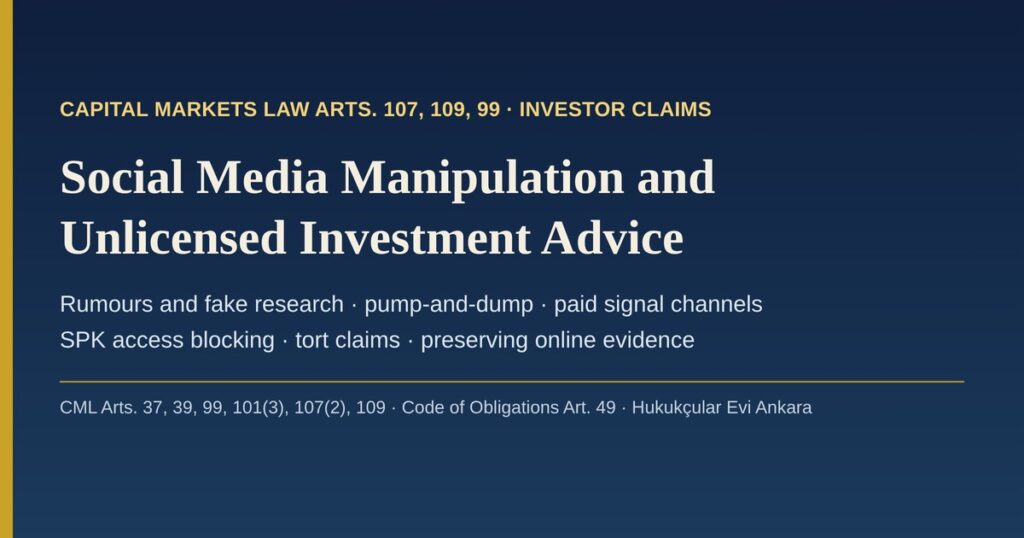
Modern market manipulation rarely relies on trading alone. Prices are pushed up by messages in chat groups, paid “signal” channels, social media posts, fabricated news and reports dressed up as research, and then the promoters sell. Turkish law treats several elements of this as crimes. Giving false or misleading information, starting rumours, publishing news, comments or reports, or spreading them, in order to influence prices, values or investors’ decisions, and thereby obtaining a benefit, is information-based market manipulation punishable by three to five years’ imprisonment (Capital Markets Law Art. 107(2)). Providing investment advice or portfolio management as a business without SPK authorisation is unauthorised capital markets activity punishable by two to five years (Arts. 37, 39 and 109(2)). SPK can order online content removed and access blocked through the Association of Access Providers, stop unauthorised activity and sue to reverse its effects and return assets to their owners (Arts. 99, 100 and 101(3)). For an institutional investor whose holdings were caught up in such a scheme, these rules identify additional defendants, generate evidence and support damages claims in tort. This guide explains them, together with the steps to preserve online evidence before it disappears. It reflects the legislation in force as at 25 October 2026.
- How online manipulation schemes work
- The legal map
- Information-based manipulation
- Pump-and-dump: trading and promotion together
- Unlicensed investment advice and portfolio management
- Unauthorised offerings
- SPK’s online powers: removal and access blocking
- Stopping unauthorised activity and reversing its effects
- Market measures and market-disrupting acts
- How prosecution starts
- Following the proceeds
- Civil claims against promoters
- Preserving online evidence
- Issuers and rumours
- Points for institutional investors
- Action plan
- Time limits
- Frequently asked questions
- Related guides
How online manipulation schemes work
Online schemes vary, but their elements recur. A group accumulates a thinly traded share. Messages appear in chat groups, social media accounts and “premium” channels predicting a sharp rise, often hinting at undisclosed corporate news. Accounts controlled by the group trade among themselves to create the appearance of demand. Reports styled as analysis set unrealistic price targets. When retail and momentum buying lifts the price, the organisers sell, and the price falls back, often below where it started. In other variants, unlicensed “advisers” sell subscriptions or manage accounts for followers and direct them into the same shares.
Institutional investors are affected in several ways: holdings in the same issuer are distorted by artificial prices; index and liquidity calculations are skewed; and when the scheme collapses, the issuer’s reputation and governance may come into question. Turkish law gives tools against each element: the people who spread misleading information, those who trade to create false impressions, those who provide investment services without authorisation, and the online content itself.
The legal map
Rules relevant to online manipulation and unlicensed advice
| Conduct | Rule | Consequence | Article |
|---|---|---|---|
| False or misleading information, rumours, news, comments or reports to influence prices, with a benefit obtained | Information-based manipulation | Three to five years’ imprisonment and a judicial fine | Capital Markets Law Art. 107(2) |
| Trading or orders to create a false or misleading impression of price, supply or demand | Trade-based manipulation | Three to five years’ imprisonment and a judicial fine not less than the benefit | Art. 107(1) |
| Investment advice, portfolio management or other investment services as a business without authorisation | Unauthorised capital markets activity | Two to five years’ imprisonment and a judicial fine | Arts. 37, 39 and 109(2) |
| Public offering without an approved prospectus, or sale without an approved issue document | Unauthorised offering | Two to five years’ imprisonment and a judicial fine | Art. 109(1) |
| Acts disrupting the market without a reasonable economic reason, where not a crime | Market-disrupting acts | Administrative fine | Art. 104 |
| Online content connected with unauthorised activity or under investigation | SPK removal and access-blocking decisions | Content removed or access blocked via the Association of Access Providers | Arts. 99(3) and 101(3) |
Information-based manipulation
Article 107(2) of the Capital Markets Law No. 6362 punishes those who give false, untrue or misleading information, start rumours, give news, make comments or prepare reports, or spread them, in order to influence the prices or values of capital market instruments or investors’ decisions, and thereby obtain a benefit, with three to five years’ imprisonment and a judicial fine of up to five thousand days.
- ▸ The conduct is broad. It covers creating content and spreading it. Forwarding or reposting a fabricated message can fall within “spreading”, and comments and reports are expressly included, so pseudo-research and “target price” posts are covered.
- ▸ The intent is specific. The aim must be to influence prices, values or investors’ decisions. Genuine opinions honestly held, or analysis based on public information, are different from deliberate falsehoods.
- ▸ A benefit is required. The offence is complete when the person obtains a benefit by that means. Proceeds from selling into the price rise, subscription fees or payments for promotion can be relevant.
- ▸ No statutory repentance discount. The effective repentance rule in Art. 107(3) refers to the trade-based offence in Art. 107(1), not to Art. 107(2).
Certain transactions are not manipulation, such as those by the Central Bank or authorised public bodies for monetary, exchange-rate, debt-management or financial-stability purposes, buy-back programmes and employee share schemes under SPK rules, and price stabilisation and market making in line with SPK regulations (Art. 108(1)). These exceptions do not cover private promotion campaigns. The offences are explained in more detail in Market Manipulation under Turkish Law.
Pump-and-dump: trading and promotion together
A pump-and-dump typically combines two offences. The trading that creates the appearance of demand, through buying, selling, placing, cancelling or changing orders or account movements, in order to create a false or misleading impression about price, price changes, supply or demand, is trade-based manipulation, punishable by three to five years’ imprisonment and a judicial fine of five to ten thousand days, which may not be less than the benefit obtained (Capital Markets Law Art. 107(1)). The promotion is information-based manipulation under Art. 107(2).
For the trade-based offence, a person who shows remorse by paying to the Treasury twice the benefit obtained or caused, and at least five hundred thousand Turkish lira, receives no penalty if payment is made before an investigation starts; the penalty is halved if payment is made during the investigation and reduced by one third if made during prosecution before judgment (Art. 107(3)). For investors, this matters because it can lead to large payments being made early, although to the Treasury rather than to victims.
Key point: The promoters and the traders are often the same people, or act together. Identifying the accounts that sold into the rise, from SPK bulletins, trading bans and the criminal file, is usually the route to identifying the authors of the online campaign, and vice versa.
Unlicensed investment advice and portfolio management
Investment advice and portfolio management are investment services under the Capital Markets Law (Art. 37(1)(ç)–(d)). Carrying out investment services and activities as a regular occupation, or as a commercial or professional activity, requires SPK authorisation, and they may be performed only by investment firms; the rules on portfolio management companies are reserved (Art. 39(1)). Persons not authorised, or whose authorisation was cancelled, may not provide these services, nor use any word or expression in their articles, trade name, advertisements or announcements that gives the impression that they do (Art. 40(2)). SPK sets the principles to be followed by persons and institutions giving investment recommendations to investors (Art. 128(1)(g)).
Those who carry on capital markets activity without authorisation are punished with two to five years’ imprisonment and a judicial fine of five to ten thousand days. Where, in the course of that activity, they also commit the unauthorised offering offence, they are punished only for unauthorised activity, with the penalty increased by half (Art. 109(2)).
The test is regularity and business character. A person who sells subscriptions to a channel offering buy and sell calls on specific shares, or who manages followers’ accounts or trades on their behalf for a fee, is in a very different position from someone posting occasional personal opinions. Paid “signal” services and account-management arrangements are the typical targets of SPK’s actions against unauthorised activity.
Online activity and authorisation
| Activity | Legal characterisation | Provision |
|---|---|---|
| Paid channel giving buy and sell recommendations on specific instruments | Likely investment advice as a business; requires authorisation | Arts. 37(1)(d) and 39(1) |
| Managing followers’ brokerage accounts or trading for them | Portfolio management or order execution; requires authorisation | Arts. 37(1)(b)–(ç) and 39(1) |
| Using names or slogans suggesting a licensed investment business | Prohibited for unauthorised persons | Arts. 40(2) and 100(1) |
| Fabricated news or reports to move a price, with a benefit | Information-based manipulation | Art. 107(2) |
| Honest comment or analysis based on public information | Not, by itself, an offence | Compare Arts. 107(2) and 37(1)(d) |
Unauthorised offerings
Some schemes go further and sell investment products directly: shares in unlisted companies, “guaranteed” return schemes or tokens promoted as investments. Offering capital market instruments to the public without publishing an approved prospectus, or selling them without an approved issue document, is punishable by two to five years’ imprisonment and a judicial fine (Capital Markets Law Art. 109(1)). Advertisements and announcements of an offering must be consistent with the prospectus and not misleading, and SPK may require non-compliant advertisements to be stopped and removed (Arts. 7(3) and 100(2)).
Contact Hukukçular Evi Ankara
For questions on online manipulation campaigns, unlicensed advice and claims connected with the 2026 fund and manipulation cases, you can reach our office by phone or WhatsApp. We correspond in English. Hukukçular Evi Ankara: +90 554 648 37 15
SPK’s online powers: removal and access blocking
SPK has direct powers over online content, strengthened by Law No. 7518 in 2024:
- ▸ Unauthorised activity. Where unauthorised capital markets activity is found to be carried out over the internet, SPK decides on removal of content and/or blocking of access for the publications concerned, and sends the decision to the Association of Access Providers for implementation (Capital Markets Law Art. 99(3)).
- ▸ Crowdfunding and foreign leveraged trading. The same applies where money is raised from the public through crowdfunding platforms without SPK permission, or where leveraged transactions abroad are offered over the internet to persons resident in Turkey (Art. 99(4)).
- ▸ Investigations into manipulation. In examinations and inspections under Arts. 104, 106 and 107, SPK may decide on removal of online content and/or blocking of access, implemented through the Association of Access Providers (Art. 101(3)).
- ▸ Catalogue offence for court-ordered blocking. Article 8 of Law No. 5651 on internet publications applies also to the offences in Art. 109 (Art. 115(5)).
Access-blocking and removal decisions are evidence in their own right. They show that SPK regarded specific accounts, channels or sites as connected with unauthorised activity or with conduct under investigation, and they identify the content concerned.
Stopping unauthorised activity and reversing its effects
SPK may take any measure needed to stop unauthorised capital markets activity. Without prejudice to civil and criminal liability, it may sue to annul the consequences of unauthorised activities and transactions and to have cash or capital market instruments returned to their owners, within one year of its finding and in any case within five years of the activity (Capital Markets Law Art. 99(1)). SPK may also apply the measures in Art. 96(2), such as cancelling licences and restricting signing powers, to persons carrying out unauthorised activity and to partners and managers whose responsibility it establishes, without waiting for the loss to become final (Art. 99(2)).
Where unauthorised persons, or persons whose licences were cancelled or activities suspended, use words or expressions in their trade names, advertisements or announcements suggesting they are active in the capital markets, criminal proceedings are brought and, where delay would be harmful, their advertisements may be stopped, unlawful documents and advertisements collected, and their premises temporarily closed by the highest local administrative authority at SPK’s request (Art. 100(1)).
Market measures and market-disrupting acts
Where there is reasonable suspicion that a person has committed market-disrupting acts, insider dealing or manipulation, SPK may impose temporary or permanent trading bans, change settlement methods, restrict margin trading, short selling and securities lending, impose collateral requirements, move instruments to different markets, restrict market data and set trading or position limits (Capital Markets Law Art. 101(1)). Acts and transactions that cannot be explained by a reasonable economic or financial reason and disrupt the confidence, transparency and stability of the market are market-disrupting acts if they do not constitute a crime, and SPK may impose administrative fines for them, not less than twice any benefit obtained (Art. 104(1)).
SPK’s trading bans name the persons concerned and are published in its weekly bulletins. For investors, a list of persons banned from trading in a particular share is often the first public identification of potential defendants. These measures are discussed in Market Manipulation under Turkish Law.
How prosecution starts
Investigation of offences defined in the Capital Markets Law, including Arts. 107 and 109, requires a written application by SPK to the chief public prosecutor; this is a procedural precondition (Capital Markets Law Art. 115(1)). If a public prosecution is brought, SPK is served with the indictment and becomes a participating party (Art. 115(2)). Prosecutors may use SPK experts, and SPK may object to a decision not to prosecute (Art. 115(3)–(4)).
An investor who identifies an online campaign should therefore bring the evidence to SPK as well as to the prosecutor. Once proceedings are under way, a person harmed by the offence can follow the investigation through its lawyer and join the prosecution until the first-instance judgment (Criminal Procedure Code Art. 237(1)), as explained in Joining a Criminal Case in Turkey as a Foreign Investor.
Model outline: complaint to SPK about an online manipulation campaign or unlicensed advice
- 1. Complainant: the institution and its legal interest, such as holdings in the issuer during the period.
- 2. The content: channels, accounts, sites and reports, with links, dates and preserved copies; the instrument concerned.
- 3. The pattern: how the content coincided with price and volume movements, with charts and trading data.
- 4. Legal characterisation: Capital Markets Law Art. 107(2), and where fees or account management were involved, Arts. 37, 39 and 109(2).
- 5. Requests: examination; removal and access-blocking decisions under Arts. 99(3) and 101(3); trading measures under Art. 101(1); a written application to the prosecutor under Art. 115(1).
- 6. Reservation of the complainant’s civil claims and its right to participate in criminal proceedings.
Following the proceeds
Online manipulation is profitable only if the proceeds can be kept, so the law on proceeds matters to investors. Under the Turkish Penal Code No. 5237, material benefits obtained through an offence, and economic gains derived from investing or converting them, are confiscated; but confiscation can be ordered only where the benefit cannot be returned to the victim of the offence (Art. 55(1)). Where the benefits cannot be seized, their equivalent value is confiscated (Art. 55(2)), and confiscation from a later acquirer requires that the acquirer cannot rely on good-faith protection (Art. 55(3)).
The offences in Capital Markets Law Arts. 107 and 109 carry minimum penalties of two or three years’ imprisonment, so their proceeds are proceeds of a predicate offence for money laundering. A person who takes such proceeds abroad, or puts them through transactions to hide their illegitimate source or create the impression that they were lawfully obtained, commits laundering, punishable by three to seven years’ imprisonment (Penal Code Art. 282(1)); a person who knowingly acquires, accepts, holds or uses them is punishable by two to five years (Art. 282(2)). Where the offence is committed in the course of a profession, the penalty is increased by half (Art. 282(3)).
For investors, the practical tools are seizure in the criminal investigation and precautionary attachment in civil proceedings, explained in Freezing Assets in Turkey for Investor Claims. Because confiscation gives way to return to the victim under Art. 55(1), an investor that can show it was harmed by the offence should make its position known in the criminal file at an early stage.
Civil claims against promoters
Criminal proceedings do not compensate investors. Damages are claimed in the civil courts in tort: a person who causes loss to another by a culpable and unlawful act must compensate it, and a person who intentionally causes loss by an immoral act must do so even without a specific prohibiting rule (Code of Obligations No. 6098 Art. 49). Manipulation and unauthorised activity breach statutory rules designed to protect investors, which supports unlawfulness. The claimant must prove its loss and the defendant’s fault; where the amount cannot be proved exactly, the judge assesses it equitably (Art. 50). Where several persons, such as promoters and the accounts that traded with them, caused the same loss, they are jointly and severally liable (Art. 61).
The challenges are identification and causation. Online promoters often use pseudonyms, and their link to specific trades must be shown. An institution’s loss usually arises not from buying on a tip but from the effect of the manipulation on the price of shares it held or traded, so the loss analysis must isolate that effect. The approach to quantification is explained in Calculating Damages in Turkish Securities Claims, and the limitation periods in Limitation Periods for Investor Claims in Turkey. Where the promoters have assets that may disappear, pre-judgment attachment is discussed in Freezing Assets in Turkey for Investor Claims.
Preserving online evidence
Online content is the most fragile evidence in these cases. Channels are deleted, posts edited and accounts closed once an investigation becomes known. Turkish procedure offers two formal tools in addition to the investor’s own records.
- ▸ Court preservation of evidence. A party may ask the court, before or during proceedings, to establish a fact by inspection, expert examination or witness evidence; legal interest is presumed where evidence would otherwise be lost or become much harder to present (Code of Civil Procedure Art. 400). Before a lawsuit, the application is made to the court that will hear the main case or to the civil court of peace where the inspection is to take place (Art. 401(1)).
- ▸ Notarial determination. The rules on factual determinations by notaries under the Notaries Law are preserved (Art. 401(2)). A notarial record of web pages and channel content is a common, quick way to fix what was published at a given time.
- ▸ Own records. Screenshots with full URLs and timestamps, exported chat histories, archived web pages and the institution’s intraday trading data should be collected and kept with a record of how and when they were obtained.
Material obtained by SPK and in the criminal investigation, including trading data and account ownership, becomes available through the criminal file. The general tools are discussed in Obtaining and Preserving Evidence in Turkey.
Model outline: application to preserve online evidence before a lawsuit (Code of Civil Procedure Arts. 400–401)
- 1. Court: the court that will hear the damages action, or the civil court of peace where the inspection is to be carried out.
- 2. The intended lawsuit: claimant, prospective defendants where known, and the legal basis, such as Code of Obligations Art. 49 with Capital Markets Law Art. 107.
- 3. The facts to be established: the existence and content of specified channels, accounts and posts on specified dates.
- 4. Legal interest: the risk that the content will be deleted or edited (Art. 400(2)), supported by examples of deletions already observed.
- 5. Method: inspection with an IT expert, recording of content and metadata, and, where urgent, a request to proceed without first notifying the other side.
Hukukçular Evi Ankara
Ankara-based law office, Av. Fatma Öztürk. Telephone and WhatsApp: +90 554 648 37 15. We correspond in English.
Issuers and rumours
Online campaigns often claim to reveal undisclosed corporate news. The issuer then has its own duties. Where significant news or rumours appear for the first time, or differ from what was previously disclosed, the issuer must disclose whether they are accurate or sufficient, without waiting to be asked by SPK or the exchange (Communiqué II-15.1 Art. 9(1)). Where the rumour concerns information whose disclosure was delayed, the reasons for delay are deemed to have ceased and the issuer must disclose (Art. 9(2)). And when prices or volumes move in a way ordinary market conditions cannot explain, the issuer must, at the exchange’s request, state whether there are undisclosed special situations (Art. 8(1)).
An issuer’s silence in the face of a campaign it knew to be based on true leaks, or a denial that was false, may expose it to liability for misleading or incomplete disclosures, as explained in Continuous Disclosure in Turkey. Leaks of genuine inside information also raise insider dealing questions, discussed in Insider Dealing in Turkey.
Points for institutional investors
- ▸ Monitoring. For Turkish holdings in small and mid-cap issuers, monitoring social media and messaging channels alongside price and volume data can give early warning of a campaign.
- ▸ Your own communications. Statements by portfolio managers or in investor letters about Turkish issuers should be accurate and based on public information; Art. 107(2) applies to anyone, and research and comments are expressly covered.
- ▸ Brokers’ research. Reports prepared by intermediaries are within Art. 107(2) if prepared to mislead. Where a Turkish broker promoted a share through misleading reports while trading in it, claims against the broker may also arise, as discussed in Claims Against Brokers, Custodians and Portfolio Managers.
- ▸ Cooperation. SPK may exchange information with foreign regulators under memoranda of understanding (Capital Markets Law Art. 128(1)(d)); where an institution’s home regulator is involved, coordination can help.
- ▸ Speed. Content disappears quickly. Preservation, by notarial record or court order, should start as soon as a campaign is identified.
Action plan
- 1. Preserve. Capture channels, posts, reports and metadata; arrange a notarial record; consider court preservation (Code of Civil Procedure Arts. 400–401).
- 2. Correlate. Match the timing of content with price, volume and order-book data.
- 3. Identify. Use SPK bulletins, trading bans and access-blocking decisions to link accounts to persons.
- 4. Report. Complain to SPK and the prosecutor, asking for content measures under Capital Markets Law Arts. 99(3) and 101(3) and a written application under Art. 115(1).
- 5. Participate. Follow the investigation through a lawyer and join any prosecution before the first-instance judgment.
- 6. Claim. Quantify the price effect on holdings; bring a tort claim against identified promoters and traders within the limitation periods; seek attachment where assets may disappear.
- 7. Look at the issuer. Assess whether the issuer responded to rumours as required and whether its disclosures were accurate.
Time limits
Time limits relevant to online manipulation cases
| Step | Time limit | Provision |
|---|---|---|
| SPK lawsuit to annul unauthorised activity and return assets | One year from SPK’s finding; five years from the activity | Capital Markets Law Art. 99(1) |
| Tort claim against promoters and traders | Two years from knowledge of the loss and the liable person; ten years from the act; or the longer criminal period | Code of Obligations Art. 72(1) |
| Prosecution limitation for Arts. 107 and 109 offences | Eight years, extendable by interruptions up to half | Penal Code Arts. 66(1)(e) and 67(4) |
| Objection to a decision not to prosecute | Two weeks from service | Criminal Procedure Code Art. 173(1) |
| Joining the prosecution | Until the first-instance judgment | Art. 237(1) |
| Claim against an issuer for misleading disclosures | Six months from the loss | Capital Markets Law Art. 32(6) |
Frequently asked questions
Is spreading stock rumours on social media a crime in Turkey?
Yes, where false or misleading information, rumours, news, comments or reports are given or spread to influence prices or investors’ decisions and a benefit is obtained; the penalty is three to five years’ imprisonment (Capital Markets Law Art. 107(2)).
Does reposting a misleading message count?
Article 107(2) covers those who spread such information as well as those who create it, provided the intent and benefit elements are met.
Is a pump-and-dump scheme illegal in Turkey?
Yes. The trading is trade-based manipulation under Art. 107(1) and the promotion is information-based manipulation under Art. 107(2).
Can someone run a paid stock-tips channel in Turkey without a licence?
Investment advice as a regular or commercial activity requires SPK authorisation (Arts. 37(1)(d) and 39(1)); providing it without authorisation is punishable by two to five years’ imprisonment (Art. 109(2)).
Can SPK block websites and social media accounts?
Yes. SPK decides on removal of content and blocking of access for unauthorised activity carried out online and in manipulation investigations, implemented through the Association of Access Providers (Arts. 99(3) and 101(3)).
Can SPK recover money for investors from unauthorised operators?
SPK may sue to annul the consequences of unauthorised activity and have cash or instruments returned to their owners within one year of its finding and five years of the activity (Art. 99(1)).
Who starts a prosecution for these offences?
The prosecutor, on SPK’s written application, which is a procedural precondition (Art. 115(1)); SPK then becomes a participating party (Art. 115(2)).
Is effective repentance available for information-based manipulation?
The statutory effective repentance rule in Art. 107(3) refers to trade-based manipulation under Art. 107(1).
Can I sue online promoters for damages?
Yes, in tort under Code of Obligations Art. 49, proving the loss, fault and causation; several persons causing the same loss are jointly liable (Art. 61).
How can I preserve deleted or changing online content as evidence?
By notarial determination of facts (Code of Civil Procedure Art. 401(2)) and by court preservation of evidence, which may be ordered where evidence would otherwise be lost (Art. 400).
Must a listed company respond to rumours spread online?
Yes, where significant rumours appear, without waiting for SPK or the exchange to ask (Communiqué II-15.1 Art. 9(1)).
Can the proceeds of an online manipulation scheme be confiscated?
Yes, but only where they cannot be returned to the victim of the offence (Penal Code Art. 55(1)); their equivalent value may be confiscated if they cannot be seized (Art. 55(2)).
Is moving manipulation proceeds money laundering?
Taking such proceeds abroad or processing them to hide their source is laundering under Penal Code Art. 282(1), punishable by three to seven years’ imprisonment, because the Capital Markets Law offences are predicate offences.
What is a market-disrupting act?
An act that cannot be explained by a reasonable economic or financial reason and disrupts the market’s confidence, transparency and stability, where it is not a crime; SPK may impose administrative fines (Art. 104(1)).
Related guides
- Turkey’s 2026 Fund and Market Manipulation Crisis: Legal Guide for Foreign Institutional Investors — the entry point to this series
- Trading Halts, Watchlist Market and Delisting on Borsa Istanbul
- Market Manipulation under Turkish Law: Article 107
- Insider Dealing in Turkey: Capital Markets Law Article 106
- Continuous Disclosure in Turkey: Communiqué II-15.1
- Joining a Criminal Case in Turkey as a Foreign Investor
- Obtaining and Preserving Evidence in Turkey for Securities Claims
- Calculating Damages in Turkish Securities Claims
- Freezing Assets in Turkey for Investor Claims
- Claims Against Brokers, Custodians and Portfolio Managers in Turkey
- Limitation Periods for Investor Claims in Turkey
Important note: This guide is for general information only and does not constitute legal advice on any matter. It does not suggest that any person, channel or platform connected with the 2026 cases has committed an offence or carried out unauthorised activity; investigations are ongoing and the presumption of innocence applies. It reflects the legislation in force as at 25 October 2026. Legislation relied on: Capital Markets Law No. 6362, Arts. 7, 32, 37, 39, 40, 96, 99, 100, 101, 104, 107, 108, 109, 115 and 128; Communiqué on Special Situations No. II-15.1, Arts. 8 and 9; Turkish Code of Obligations No. 6098, Arts. 49, 50, 61 and 72; Code of Civil Procedure No. 6100, Arts. 400 and 401; Turkish Penal Code No. 5237, Arts. 55, 66, 67 and 282; Criminal Procedure Code No. 5271, Arts. 173 and 237; Law No. 5651 on internet publications, Art. 8.