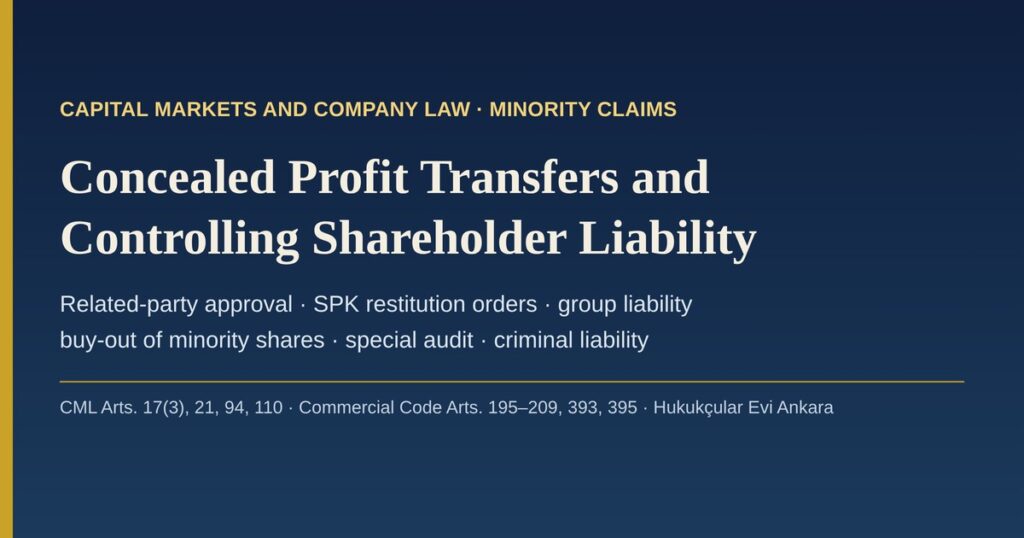
When a listed company loses value in a market scandal, the question for a minority investor is often not only who manipulated the price, but where the company’s assets went. Turkish law has two sets of rules aimed at value leaking from a company to the people who control it. The Capital Markets Law prohibits public companies and funds from transferring profit or assets to related persons through transactions on terms that depart from arm’s-length terms, market practice and the principles of prudence and honesty, or through artificial trading volume (Art. 21(1)). Once the Capital Markets Board (SPK) establishes such a transfer, the company must claim the amount back with statutory interest, and the recipients must repay it (Art. 21(4)). Related-party transactions require board approval with a majority of independent directors, failing which they go to a general meeting in which the interested parties cannot vote (Art. 17(3)). The Commercial Code adds the group-of-companies rules: a controlling company may not use its control to cause loss to a subsidiary unless it compensates the loss within the same financial year, and if it does not, every shareholder can sue the controlling company and its responsible directors for the company’s loss (Art. 202(1)). This guide explains these rules, the claims available to a foreign minority investor, how to uncover the transfers, and the time limits. It reflects the legislation in force as at 25 October 2026.
- How value leaves a listed company
- The prohibition of concealed profit transfer
- Approval of related-party transactions
- SPK’s powers: restitution, lawsuits and measures
- Groups of companies under the Commercial Code
- Liability of the controlling company
- Structural decisions: damages or buy-out
- Wholly owned subsidiaries and creditors
- Directors: conflicts, self-dealing and loans
- Sham and void transactions
- Claims available to a minority investor
- The company’s loss or your own loss
- Uncovering the transfers
- Criminal liability
- If the company is insolvent
- Controllers abroad
- Action plan
- Deadlines
- Frequently asked questions
- Related guides
How value leaves a listed company
Transfers of value to controlling shareholders and their associates, often called tunnelling, rarely take the form of an open payment. They are usually ordinary-looking transactions on terms no independent company would accept. The table maps common patterns to the Turkish rules that address them.
Common forms of value transfer and the rules that apply
| Pattern | Example | Main rules |
|---|---|---|
| Asset sales and purchases at off-market prices | Selling property to a group company below value, or buying a related company’s assets above value | Capital Markets Law Art. 21(1); Commercial Code Art. 202(1)(a) |
| Service, licence and management fees | Paying a controller’s company for services that are not provided or are overpriced | Art. 21(1); Commercial Code Arts. 202 and 553 |
| Loans, guarantees and security for related parties | Lending company cash to a controller’s vehicle, or pledging company assets for its debts | Commercial Code Arts. 202(1)(a) and 395(2)–(3); Capital Markets Law Art. 21(1) |
| Diverted opportunities | Leaving a profitable project to a related company instead of pursuing it | Capital Markets Law Art. 21(2); Commercial Code Art. 202(1)(a) |
| Artificial trading volume | Trades with related parties to generate turnover or move the share price | Capital Markets Law Arts. 21(1) and 107; Art. 110(1)(c) |
| Structural transactions without a business reason | A merger, demerger or share issue that favours the controller | Commercial Code Art. 202(2); Capital Markets Law Arts. 23 and 24 |
| Directors dealing with the company | A director buying company assets or borrowing from the company | Commercial Code Arts. 393 and 395 |
These patterns frequently appear alongside market manipulation. Money taken out of a listed company may fund trading in its shares, and artificial volume generated with related parties is expressly listed as a form of concealed profit transfer. The manipulation side is covered in Market Manipulation under Turkish Law.
The prohibition of concealed profit transfer
Article 21 of the Capital Markets Law No. 6362 is the central rule. Public companies and collective investment institutions, and their affiliates and subsidiaries, may not transfer profit to natural or legal persons with which they are related, directly or indirectly, in management, supervision or capital. The prohibited means are agreements or commercial practices with prices, fees, considerations or terms that depart from arm’s-length terms, market practice and the principles of prudence and honesty in commercial life, or transactions such as generating trading volume, which reduce the company’s profit or assets or prevent them from increasing (Art. 21(1)).
The prohibition also covers omissions. If a company fails to carry out activities that a prudent and honest merchant, acting within its articles or fund rules or in line with market practice, would be expected to carry out to protect or increase its profit or assets, and thereby increases the profit or assets of related persons, that is also a concealed profit transfer (Art. 21(2)).
The burden of documentation lies with the company. Public companies and collective investment institutions must document that their related-party transactions were carried out on arm’s-length terms, in line with market practice and the principles of prudence and honesty, and keep the supporting information and documents for at least eight years (Art. 21(3)). The procedure for establishing a breach is set by SPK (Art. 21(3)).
Elements of a concealed profit transfer under Capital Markets Law Art. 21
| Element | Content |
|---|---|
| Who is bound | Public companies, collective investment institutions, and their affiliates and subsidiaries |
| Counterparty | Natural or legal persons related to them, directly or indirectly, in management, supervision or capital |
| Conduct | Agreements, commercial practices or transactions such as generating trading volume, on terms departing from arm’s-length terms, market practice and prudence and honesty; or failing to act as a prudent and honest merchant would |
| Effect | The company’s profit or assets are reduced or prevented from increasing, or the related person’s profit or assets are increased |
| Documentation | The company must document arm’s-length terms and keep records for at least eight years |
Approval of related-party transactions
For related-party transactions of the kind specified by SPK, a public company must, before entering into them, adopt a board resolution setting out the principles of the transaction. The resolution can be implemented only with the approval of a majority of the independent board members. If a majority of the independent members does not approve, this must be disclosed to the public with sufficient information about the transaction, and the transaction must be submitted to the general meeting. At that meeting, the parties to the transaction and persons related to them cannot vote; no meeting quorum applies and the decision is taken by a simple majority of those entitled to vote. Board and general meeting resolutions not adopted in accordance with these rules are not valid (Capital Markets Law Art. 17(3)).
The rule gives minority investors two practical levers. First, a transaction that was never approved as Art. 17(3) requires is open to challenge as invalid. Second, where the independent directors did not approve and the matter goes to the general meeting, the minority’s vote counts for more, because the controller and its related persons are excluded from voting. SPK may also require listed companies to comply with corporate governance principles, take decisions to secure compliance and seek interim measures or bring lawsuits, exempt from any security, to establish the unlawfulness of non-compliant transactions or have them annulled (Art. 17(2)).
Key point: In a related-party vote at the general meeting under Art. 17(3), the controller and its related persons cannot vote. Foreign institutions holding even modest stakes can be decisive in such votes, and should make sure their custodians and proxy agents vote and record any opposition in the minutes.
SPK’s powers: restitution, lawsuits and measures
Where SPK establishes a concealed profit transfer, the public company, collective investment institution or subsidiary must, within a period set by SPK, demand from the recipients that the amount transferred be returned to it with statutory interest; the recipients must repay it within the period SPK sets (Capital Markets Law Art. 21(4)). Civil, criminal and administrative sanctions under Arts. 94 and 110 are preserved (Art. 21(4)).
SPK may require the company to announce the results of its examination to shareholders in the manner it determines, and may sue for the return of the amount it has determined within the period it has set (Art. 94(1)). Article 92 applies in this context as well: where SPK finds that an issuer’s unlawful situation or transactions have reduced or caused the loss of its capital or assets, it may require measures to remedy the breach, refer the matter to the competent authorities, bring an annulment action within three months of its finding and in any case within three years of the transaction, or an action for nullity or non-existence within five years, and, where the situation is established by a first-instance judgment or a court so decides on SPK’s request without waiting for one, remove the signing powers of those responsible and, where a criminal complaint is filed, remove them from office until the trial ends and appoint replacement directors until the next general meeting (Art. 92(1)). In these lawsuits and in applications for interim measures and attachments, SPK is exempt from all fees and security (Art. 92(3); Art. 94(2)).
For fundamental transactions such as mergers, demergers, conversions and the creation of privileges, SPK sets mandatory procedures. If a transaction carried out in breach of them is not reversed within thirty days of SPK’s decision, SPK may impose an administrative fine and sue for annulment under the Commercial Code rules on annulment of general meeting resolutions (Art. 23(2)).
These public powers matter to private investors in two ways. An SPK finding under Art. 21 is strong evidence in any civil claim. And the restitution mechanism of Art. 21(4) brings money back into the company, which benefits all shareholders without each having to sue. A foreign institution can bring the facts to SPK’s attention and, if SPK declines to act, consider the routes described in Suing Turkey’s Capital Markets Board (SPK).
Groups of companies under the Commercial Code
The Turkish Commercial Code No. 6102 has a full chapter on groups of companies (Arts. 195–209). A commercial company is the controlling company if it directly or indirectly holds the majority of voting rights in another, has the right to appoint enough board members to form a decision-making majority, controls a majority of votes together with others under an agreement, or can otherwise keep the other company under its control by contract or other means (Art. 195(1)). Holding a majority of shares, or enough shares to take decisions that can direct the company, creates a presumption of control (Art. 195(2)). Control through subsidiaries is indirect control (Art. 195(3)). Importantly, the group rules apply where the controller is any undertaking whose seat or residence is in Turkey or abroad, and a controlling undertaking is treated as a merchant (Art. 195(5)).
Transparency rules support the regime. An undertaking that acquires or falls below 5, 10, 20, 25, 33, 50, 67 or 100 per cent of a capital company’s share capital must notify the company and the competent authorities within ten days; until the notification is made, registered and announced, the voting and other rights attaching to those shares are frozen (Art. 198(1)–(2)).
The board of a controlled company must prepare, within the first three months of each financial year, a report on its relations with the controlling company and other group companies. It must describe all legal transactions with them or for their benefit at their direction, and all measures taken or avoided for their benefit, with the consideration given and received and the reasons and effects of the measures (Art. 199(1)). The report must be accurate and fair (Art. 199(2)). At its end the board states whether adequate consideration was received for each transaction, whether the company suffered loss from measures taken or avoided, and whether any loss was compensated; this statement appears in the annual report (Art. 199(3)). Shareholders of a controlling company may ask at the general meeting for satisfactory information about subsidiaries and group dealings (Art. 200).
Key point: The dependency report and its conclusion in the annual report (Commercial Code Art. 199) are among the first documents a minority investor should read. A conclusion that loss was suffered and not compensated is close to an admission for a claim under Art. 202; a conclusion that everything was at arm’s length, contradicted by the facts, raises the question of the board’s own liability.
Liability of the controlling company
Article 202 is the core liability rule. A controlling company may not use its control in a way that causes loss to the controlled company. In particular, it may not cause the subsidiary to transfer business, assets, funds, staff, receivables or debts; to reduce or transfer its profit; to encumber its assets with real or personal rights; to assume liabilities such as guarantees, sureties or avals; to make payments; or, without a justified reason, to take decisions or measures that impair its productivity or activity, such as not renewing facilities or restricting or stopping investment, or to refrain from measures that would develop it. The exception is where the loss is actually compensated within the same financial year, or where by the end of that year the subsidiary is given a claim of equivalent value specifying how and when the loss will be compensated (Commercial Code Art. 202(1)(a)).
If the loss is not compensated in time and no equivalent claim is granted, every shareholder of the controlled company may claim from the controlling company, and from those of its directors who caused the loss, compensation of the company’s loss. On request or of its own motion, where equity requires, the court may instead order the controlling company to buy the claimant shareholders’ shares under the valuation rules of Art. 202(2), or another appropriate and acceptable solution (Art. 202(1)(b)). Creditors may also claim payment of the company’s loss to the company, even if the company is not bankrupt (Art. 202(1)(c)).
The defence is an objective one. No compensation is awarded if it is proved that the board of an independent company, acting in good faith in the company’s interests and with the care of a prudent manager, would also have carried out or refrained from the transaction in the same or similar circumstances (Art. 202(1)(d)). Articles 553 and 555–557 on directors’ liability, Art. 560 on limitation and Art. 561 on jurisdiction apply by analogy to the actions of shareholders and creditors. Where the controlling undertaking’s seat is abroad, the action is brought before the commercial court at the subsidiary’s seat (Art. 202(1)(e)).
Commercial Code Art. 202(1): the claim against the controlling company
| Question | Answer | Provision |
|---|---|---|
| Who may sue | Every shareholder of the controlled company; also its creditors | Art. 202(1)(b)–(c) |
| Who is liable | The controlling company and its directors who caused the loss | Art. 202(1)(b) |
| What is claimed | The company’s loss, paid to the company; or, where equitable, purchase of the claimant’s shares or another solution | Art. 202(1)(b); Art. 555(1) by analogy |
| Condition | Loss not compensated within the financial year, and no equivalent claim granted by year-end | Art. 202(1)(a)–(b) |
| Defence | An independent, prudent board would have acted the same way | Art. 202(1)(d) |
| Limitation | Two years from knowledge of the loss and the liable person, five years from the act; longer criminal limitation where applicable | Art. 560 by analogy |
| Court | Commercial court at the company’s seat; for controllers abroad, the subsidiary’s seat | Arts. 202(1)(e) and 561 |
Article 202 has a decisive advantage over a general claim against directors. The investor need not prove the controller’s fault in the abstract: it must show that control was used, that the subsidiary suffered loss and that the loss was not compensated in the year. The controller must then prove that an independent board would have done the same. Courts may also order costs and lawyer’s fees to be borne in a fair proportion between the claimant shareholder and the company where the case was justified but costs cannot be imposed on the defendant (Art. 555(2), applied by analogy).
Structural decisions: damages or buy-out
A separate remedy applies to structural decisions. Where control is used to carry out transactions such as a merger, demerger, change of legal form, dissolution, issue of securities or a significant amendment of the articles, without a justified reason clearly understandable from the subsidiary’s point of view, shareholders who voted against the general meeting resolution and had their opposition recorded in the minutes, or who objected in writing to the board’s decision, may ask the court to order the controlling undertaking to compensate their loss or to buy their shares. The price is at least the stock exchange value where there is one; where there is none, or it is not fair, the real value or a value determined by a generally accepted method, using data as close as possible to the date of the court’s decision (Commercial Code Art. 202(2)). This action is time-barred two years from the general meeting resolution or the announcement of the board decision (Art. 202(2)).
When the action is filed, the court orders the deposit of an amount covering the claimants’ probable loss or the purchase price with a bank designated by it, and until the deposit is made no step may be taken to implement the resolution. Bad-faith claimants may in turn be ordered to compensate the defendant and to provide security (Art. 202(3)). Other rights of shareholders in mergers, demergers and conversions are preserved (Art. 202(4)).
For listed companies, the Capital Markets Law adds its own rules on fundamental transactions and the exit right of shareholders who vote against them (Arts. 23 and 24). These are explained in Shareholder Rights in Turkish Listed Companies. The two regimes can be used together: the exit right gives a statutory price, while Art. 202(2) allows the court to look at real value and to award damages.
Model outline: claim against a controlling company under Commercial Code Art. 202(1)(b)
- 1. Commercial court of first instance at the subsidiary’s registered seat (Arts. 202(1)(e) and 561), after mediation where the claim is for a sum of money (Art. 5/A).
- 2. Claimant: the shareholder, with evidence of its shareholding from Central Registry records; defendants: the controlling company and the directors who caused the loss.
- 3. Control: the facts establishing control under Art. 195, including any presumption under Art. 195(2).
- 4. Use of control and loss: each transaction or measure, its terms, why it departs from arm’s-length terms, and the resulting loss to the company.
- 5. Absence of compensation: the dependency report and annual report for the year, showing no compensation and no equivalent claim (Art. 199).
- 6. Evidence: SPK findings under Capital Markets Law Art. 21, special audit reports, KAP disclosures, expert valuation; requests for production of the company’s documentation kept under Art. 21(3).
- 7. Relief: payment of the company’s loss to the company with interest; alternatively, purchase of the claimant’s shares at a value determined under Art. 202(2).
- 8. Interim measures where assets may be moved, and security for costs if the claimant is foreign (Law No. 5718 Art. 48).
Contact Hukukçular Evi Ankara
For questions on related-party transfers, controlling-shareholder liability and minority claims arising from the 2026 fund and manipulation cases, you can reach our office by phone or WhatsApp. We correspond in English. Hukukçular Evi Ankara: +90 554 648 37 15
Wholly owned subsidiaries and creditors
Where a company holds directly or indirectly all the shares and votes of a capital company, its board may give instructions for the management of the subsidiary even if they may cause loss, provided they are required by the group’s defined and concrete policies; the subsidiary’s organs must follow them (Commercial Code Art. 203). Instructions that clearly exceed the subsidiary’s ability to pay, endanger its existence or would lead to the loss of significant assets may not be given (Art. 204). The subsidiary’s directors are not liable to the company and shareholders for following permitted instructions (Art. 205). If losses caused by such instructions are not compensated in the financial year and no equivalent claim is granted, creditors who suffer loss may sue the controlling company and its responsible directors, subject to the same defence (Art. 206).
These rules concern wholly owned subsidiaries and are therefore relevant to investors mainly as creditors, for example bondholders of a subsidiary within a listed group, or where a listed company itself has wholly owned subsidiaries through which value was moved. A listed company with a free float is not wholly owned, so the full Art. 202 regime applies to it.
Two further group rules are worth noting. Where a controlling company holds at least 90 per cent of the shares and votes of a capital company and the minority obstructs the company’s work, acts in bad faith, causes noticeable difficulty or acts recklessly, the controller may buy the minority’s shares at the stock exchange value or a value determined under Art. 202(2) (Art. 208). And a controlling company is liable for the trust created by the use of the group’s reputation where that reputation has reached a level that inspires confidence in the public or consumers (Art. 209).
Directors: conflicts, self-dealing and loans
The Commercial Code also targets the individuals who carry out transfers.
- ▸ Conflicts of interest. A board member may not take part in deliberations on matters where the company’s interest conflicts with the personal interest, outside the company, of the member or of close relatives up to the third degree. The member must disclose the conflict even if the board is unaware of it. A member who breaches this, and members who do not object to his participation despite an objectively existing and known conflict or who decide to let him participate, must compensate the company’s resulting loss (Art. 393(1)–(2)).
- ▸ Dealing with the company. Without general meeting permission, a board member may not enter into any transaction with the company for himself or for another. If he does, the company may assert that the transaction is void; the other party may not (Art. 395(1)).
- ▸ Loans and guarantees. Board members who are not shareholders, and their non-shareholder relatives listed in Art. 393, may not borrow cash from the company, and the company may not give sureties, guarantees or security for them, assume liabilities or take over their debts. Otherwise, company creditors can pursue them directly for company debts up to the amount concerned (Art. 395(2)). Group companies may guarantee one another, subject to Art. 202 (Art. 395(3)).
- ▸ General liability. Founders, board members, managers and liquidators who culpably breach duties under the law or the articles are liable to the company, the shareholders and the company’s creditors (Art. 553(1)). The company and each shareholder may claim the company’s loss; shareholders may claim payment only to the company (Art. 555(1)). Several persons liable for the same loss are jointly liable to the extent the loss is attributable to them (Art. 557).
Directors’ liability is discussed in detail in Suing Directors and Auditors of Turkish Listed Companies. In a tunnelling case, the directors of the listed company, the directors of the controlling company under Art. 202(1)(b) and the company’s auditors under Art. 554 may all be defendants.
Sham and void transactions
Transactions used to move value are sometimes disguised. Under the Code of Obligations No. 6098, the type and content of a contract are determined by the parties’ real and common intention, whatever words they used by mistake or to conceal their true purpose (Art. 19(1)). A contract that contravenes mandatory provisions of law, morality or public order is absolutely void (Art. 27(1)).
Several corporate rules point the same way. Board and general meeting resolutions on related-party transactions that do not follow Capital Markets Law Art. 17(3) are not valid. General meeting resolutions that breach the rules on protection of capital are null (Commercial Code Art. 447(1)(c)); other unlawful resolutions may be annulled on the application of shareholders who voted against them and recorded their opposition, within three months of the resolution (Arts. 445 and 446). And a transaction between a board member and the company without general meeting permission may be invalidated at the company’s option (Art. 395(1)).
Avoiding a transaction and claiming damages are complementary. Where the asset is still held by a related party, recovery in kind may be possible; where it has passed to a good-faith third party, the remedy is usually a damages claim against those responsible.
Claims available to a minority investor
Routes for a minority investor in a tunnelling case
| Route | Against | Who receives the money | Basis and time limit |
|---|---|---|---|
| Restitution following an SPK finding | Recipients of the transfer | The company | Capital Markets Law Art. 21(4); period set by SPK |
| Claim for the company’s loss against directors | Board members, managers | The company | Commercial Code Arts. 553 and 555; two years from knowledge, five years from the act (Art. 560) |
| Claim against the controlling company | Controlling company and its responsible directors | The company; or a buy-out of the claimant’s shares | Art. 202(1)(b); Art. 560 by analogy |
| Damages or buy-out after a structural decision | Controlling undertaking | The claimant shareholder | Art. 202(2); two years from the resolution or announcement |
| Annulment or nullity of resolutions | The company | No payment; the resolution falls | Arts. 445–447; annulment within three months; Capital Markets Law Art. 17(3) |
| Direct claim for the investor’s own loss | Issuer, directors, others responsible for misleading information | The investor | Capital Markets Law Art. 32; Code of Obligations Art. 49 |
| Criminal complaint | Persons responsible | No direct payment; supports civil claims and may prompt repayment under Art. 110(3) | Capital Markets Law Art. 110(1)(b)–(c) |
Several of these routes lead to payment to the company rather than to the investor. That is not a weakness for an institution that still holds its shares: restoring the company’s assets restores the value of its holding. For an institution that has already sold, the structural buy-out and direct-loss routes, and in some cases a sale of claims or joint action with other investors, become more important. Group options are discussed in Can Foreign Investors Bring a Class Action in Turkey?
The company’s loss or your own loss
The Commercial Code channels the company’s loss back to the company. Shareholders may claim it, but only for payment to the company (Art. 555(1)), and the same applies to claims against the controlling company under Art. 202(1)(b). A fall in the share price that merely reflects assets taken from the company is, in this structure, recovered through the company’s claim.
The investor may, however, have its own loss distinct from the company’s. The clearest case is where the transfers were concealed or misrepresented in financial statements or public disclosures and the investor bought shares at a price inflated by that information. Liability for misleading public disclosures then runs directly to investors under Capital Markets Law Art. 32, as explained in Prospectus and Disclosure Liability in Turkey. Structural decisions under Art. 202(2) also give the shareholder a personal claim. Quantifying each type of loss is discussed in Calculating Damages in Turkish Securities Claims.
Key point: Separate the two losses at the outset. The company’s loss is claimed for the company under Commercial Code Arts. 202 and 555; the investor’s own loss from buying at a misleading price is claimed directly, typically under Capital Markets Law Art. 32. The limitation periods, defendants and evidence differ for each.
Uncovering the transfers
Tunnelling is concealed by definition, so the investigation is often the hardest part. Turkish law provides a sequence of tools.
Information tools for a minority investor
| Tool | What it gives | Provision |
|---|---|---|
| Dependency report and annual report statement | All transactions with the group and the board’s statement on consideration, loss and compensation | Commercial Code Art. 199 |
| Notifications of shareholdings | Who holds what, and when thresholds were crossed | Art. 198 |
| Information and inspection at the general meeting | Answers from the board on the company’s affairs | Art. 437 |
| Special audit approved by the general meeting | Court-appointed auditor examining specific events | Art. 438; application within thirty days of approval |
| Special audit after refusal | Same, on application by holders of one-twentieth of capital in a public company or shares with a nominal value of at least TRY 1 million | Art. 439(1); within three months |
| Special audit in a group | Any shareholder of a subsidiary may apply where the auditor, a special auditor or the early-risk committee has indicated fraud or deceit in group dealings | Art. 207 |
| The company’s arm’s-length documentation | Evidence of how related-party prices were set, kept for eight years | Capital Markets Law Art. 21(3) |
| SPK examination and findings | Regulatory determination of a transfer and its amount | Capital Markets Law Arts. 21(4) and 94(1) |
| The criminal file | Seized records, expert reports, statements | Criminal Procedure Code Art. 153 |
Special audit is particularly useful in group cases. Under Art. 207, a single shareholder of a subsidiary can apply to the commercial court at the company’s seat for a special auditor where the company’s auditor, a special auditor or the early-risk committee has expressed an opinion indicating fraud or deceit in the company’s relations with the controlling company or other group companies. No minimum shareholding is required for this route. The general special-audit rules, and court-ordered document production, are explained in Obtaining and Preserving Evidence in Turkey.
Model outline: special audit request at the general meeting (Commercial Code Art. 438)
- 1. Shareholder’s identification and shareholding, with the Central Registry record; representative’s authority for the meeting.
- 2. Confirmation that the right to information or inspection has already been exercised, with the questions asked and answers given (Art. 438(1)).
- 3. The specific events to be examined: named transactions, counterparties, dates and amounts; the related-party documentation kept under Capital Markets Law Art. 21(3).
- 4. Why the audit is necessary to exercise shareholder rights, such as deciding on release of directors or bringing claims under Arts. 202 and 555.
- 5. Request that the request and the vote be recorded in the minutes, with the shareholder’s vote in favour.
- 6. Follow-up: if approved, a court application within thirty days (Art. 438(2)); if refused, an application within three months by qualifying shareholders (Art. 439(1)).
Criminal liability
Concealed profit transfers can be crimes. Under the Capital Markets Law, two forms of conduct are qualified forms of breach of trust: applying prices, fees and considerations clearly different from comparable ones in covert transactions with an undertaking or person related in management, supervision or capital, thereby reducing a public company’s profit or assets; and entering into agreements or commercial practices, or generating trading volume, with related persons on terms contrary to arm’s-length terms, market practice and the principles of prudence and honesty, thereby reducing the profits or assets of public companies and collective investment institutions or their affiliates and subsidiaries, or preventing them from increasing (Art. 110(1)(b)–(c)). The penalty under Turkish Penal Code Art. 155(2), imprisonment of one to seven years and a judicial fine, may not be less than three years (Capital Markets Law Art. 110(1)).
Effective repentance has a particular structure here. A person who commits the offence under Art. 110(1)(b) or (c) and pays the amount required under Art. 21(4), plus twice that amount to the Treasury, receives no penalty if payment is made before an investigation starts; the penalty is halved if payment is made during the investigation and reduced by one third if made during prosecution before judgment (Art. 110(3)). This gives those responsible a strong incentive to restore the company’s assets early, which benefits minority shareholders.
A minority investor can file a complaint and follow the case, as explained in Joining a Criminal Case in Turkey as a Foreign Investor. This guide does not suggest that any company, controller or person connected with the 2026 cases has carried out a concealed profit transfer or committed an offence; investigations are ongoing and the presumption of innocence applies.
If the company is insolvent
Tunnelling often ends in insolvency. In a bankruptcy, the company’s claims against its directors are first for the bankruptcy administration to pursue; if it does not, any shareholder or creditor may sue, and the proceeds go first to the creditors who sued (Commercial Code Art. 556). Claims the estate decides not to pursue can be assigned to a creditor under the Enforcement and Bankruptcy Law (Art. 245), and transfers made in the period before insolvency may be set aside by avoidance actions, including transactions made with intent to harm creditors within five years (Arts. 277–284). Creditors may also claim under Commercial Code Art. 202(1)(c) even before bankruptcy. These procedures are explained in When a Turkish Issuer or Broker Becomes Insolvent.
Controllers abroad
Some Turkish listed companies are controlled through holding companies or individuals abroad, and value may be moved to foreign entities. The Commercial Code anticipates this. The group rules apply where the controlling undertaking’s seat or residence is in Turkey or abroad, and the controlling undertaking is treated as a merchant (Art. 195(5)). An action under Art. 202(1) against a controller abroad is brought before the commercial court at the Turkish subsidiary’s seat (Art. 202(1)(e)). A Turkish judgment then needs to be recognised and enforced where the controller’s assets are, and the investor may also consider proceedings abroad; the choices are discussed in Suing in Turkey or Abroad. Where assets may be moved, pre-judgment attachment and injunctions are explained in Freezing Assets in Turkey for Investor Claims.
Hukukçular Evi Ankara
Ankara-based law office, Av. Fatma Öztürk. Telephone and WhatsApp: +90 554 648 37 15. We correspond in English.
Action plan
- 1. Read the group disclosures. The dependency report conclusion in the annual report (Commercial Code Art. 199), related-party notes in the financial statements, shareholding notifications (Art. 198) and KAP announcements.
- 2. Map related parties. Identify the controlling undertaking, group companies and persons related in management, supervision or capital (Capital Markets Law Art. 21(1)).
- 3. Use the general meeting. Ask questions under Art. 437, vote against release of directors where transactions are in question, vote in related-party votes under Capital Markets Law Art. 17(3), and record opposition in the minutes.
- 4. Request a special audit. At the meeting under Art. 438, or by court application under Art. 439 or, in group cases, Art. 207.
- 5. Inform SPK. Provide the evidence and ask for an examination under Capital Markets Law Arts. 21 and 94.
- 6. Diarise time limits. Three months for annulment of resolutions, two years under Art. 202(2), two and five years under Art. 560.
- 7. Prepare the claim. Mediation, then an action under Arts. 202 and 555 against the controller and directors, with interim measures where assets may be moved; a separate direct claim for the investor’s own loss where disclosures were misleading.
Deadlines
Time limits in related-party and group cases
| Step or claim | Time limit | Provision |
|---|---|---|
| Annulment of a general meeting resolution | Three months from the resolution | Commercial Code Art. 445 |
| Court application for a special auditor after general meeting approval | Thirty days | Art. 438(2) |
| Court application for a special auditor after refusal | Three months | Art. 439(1) |
| Damages or buy-out after a structural decision | Two years from the resolution or announcement | Art. 202(2) |
| Claims against directors and the controlling company | Two years from knowledge of the loss and the liable person; five years from the act; longer criminal limitation where applicable | Arts. 560 and 202(1)(e) |
| Annulment action by SPK | Three months from SPK’s finding, and within three years of the transaction | Capital Markets Law Art. 92(1)(b) |
| Nullity or non-existence action by SPK | Five years | Art. 92(1)(b) |
| Notification of shareholding thresholds | Ten days from the transaction | Commercial Code Art. 198(1) |
| Retention of related-party documentation | At least eight years | Capital Markets Law Art. 21(3) |
Frequently asked questions
What is a concealed profit transfer under Turkish law?
A transfer by a public company, fund, or their affiliates and subsidiaries, to related persons through transactions on terms departing from arm’s-length terms, market practice and the principles of prudence and honesty, or through trading volume, that reduces the company’s profit or assets or prevents them from increasing (Capital Markets Law Art. 21(1)). Failing to act as a prudent merchant so that related persons benefit is also covered (Art. 21(2)).
What happens when SPK finds a concealed profit transfer?
The company must demand the amount back from the recipients with statutory interest within a period set by SPK, and the recipients must repay it (Art. 21(4)). SPK may also require disclosure of its findings to shareholders and sue for return of the amount (Art. 94(1)).
How must related-party transactions be approved in a Turkish listed company?
By a board resolution approved by a majority of the independent directors; if they do not approve, the matter is disclosed and put to the general meeting, where the interested parties cannot vote. Resolutions not adopted this way are not valid (Capital Markets Law Art. 17(3)).
Can a minority shareholder sue the controlling company?
Yes. If the controller used its control to cause loss to the company and did not compensate it within the financial year, every shareholder can sue the controlling company and its responsible directors for the company’s loss (Commercial Code Art. 202(1)(b)).
Is the compensation paid to the shareholder or to the company?
To the company, as with claims against directors (Commercial Code Arts. 202(1)(e) and 555(1)). The court may instead order the controller to buy the claimant’s shares where equity requires (Art. 202(1)(b)).
What defence does the controlling company have?
That the board of an independent company, acting in good faith and with the care of a prudent manager, would have done the same in the same or similar circumstances (Commercial Code Art. 202(1)(d)).
What can I do if the controller pushes through a merger or demerger against my vote?
If it lacks a justified reason clearly understandable from the company’s perspective, you can ask the court within two years to order the controller to compensate you or buy your shares at least at the stock exchange value or a fair value, provided you voted against and recorded your opposition (Commercial Code Art. 202(2)).
Does it matter that the controller is outside Turkey?
No. The group rules apply to controllers in Turkey or abroad, and the action is brought at the Turkish subsidiary’s seat (Commercial Code Arts. 195(5) and 202(1)(e)).
Can a board member do business with the company?
Only with general meeting permission; otherwise the company may claim the transaction is void (Commercial Code Art. 395(1)). Conflicted members must not take part in deliberations (Art. 393).
How can I obtain evidence of related-party transfers?
Through the dependency report (Commercial Code Art. 199), information rights (Art. 437), special audit (Arts. 438, 439 and, in groups, 207), the company’s arm’s-length documentation kept for eight years (Capital Markets Law Art. 21(3)) and the criminal file.
Is a concealed profit transfer a crime?
It can be a qualified form of breach of trust with a minimum penalty of three years’ imprisonment (Capital Markets Law Art. 110(1)(b)–(c)). Repaying the amount plus twice that amount to the Treasury removes or reduces the penalty depending on timing (Art. 110(3)).
What is the limitation period for claims against directors and controllers?
Two years from knowledge of the loss and the person liable, and five years from the act, unless a longer criminal limitation period applies (Commercial Code Art. 560, applied to controllers by Art. 202(1)(e)).
Can creditors use these rules?
Yes. Creditors may claim payment of the company’s loss to the company under Art. 202(1)(c) even before bankruptcy, and in a bankruptcy may pursue claims against directors under Art. 556.
Related guides
- Turkey’s 2026 Fund and Market Manipulation Crisis: Legal Guide for Foreign Institutional Investors — the entry point to this series
- Social Media Manipulation and Unlicensed Investment Advice in Turkey
- Turkish Bond Defaults: Bondholders’ Boards and Enforcement
- Continuous Disclosure in Turkey: Inside Information and Delayed Disclosure
- How a Securities Lawsuit Proceeds in Turkey
- Limitation Periods for Investor Claims in Turkey
- Suing Directors and Auditors of Turkish Listed Companies
- Shareholder Rights in Turkish Listed Companies
- Market Manipulation under Turkish Law: Article 107
- Prospectus and Disclosure Liability in Turkey
- Obtaining and Preserving Evidence in Turkey for Securities Claims
- When a Turkish Issuer or Broker Becomes Insolvent
- Freezing Assets in Turkey for Investor Claims
- Calculating Damages in Turkish Securities Claims
- Joining a Criminal Case in Turkey as a Foreign Investor
- Suing Turkey’s Capital Markets Board (SPK)
Important note: This guide is for general information only and does not constitute legal advice on any matter. It does not suggest that any company, controlling shareholder or person connected with the 2026 cases has carried out a concealed profit transfer, breached any duty or committed an offence; investigations are ongoing and the presumption of innocence applies. It reflects the legislation in force as at 25 October 2026. Legislation relied on: Capital Markets Law No. 6362, Arts. 17, 21, 23, 24, 32, 92, 94, 107 and 110; Turkish Commercial Code No. 6102, Arts. 195, 198–200, 202–209, 393, 395, 437–439, 445–447, 553–557, 560 and 561; Turkish Code of Obligations No. 6098, Arts. 19, 27 and 49; Turkish Penal Code No. 5237, Art. 155; Enforcement and Bankruptcy Law No. 2004, Arts. 245 and 277–284; Criminal Procedure Code No. 5271, Art. 153; Law No. 5718 on International Private and Procedural Law, Art. 48.