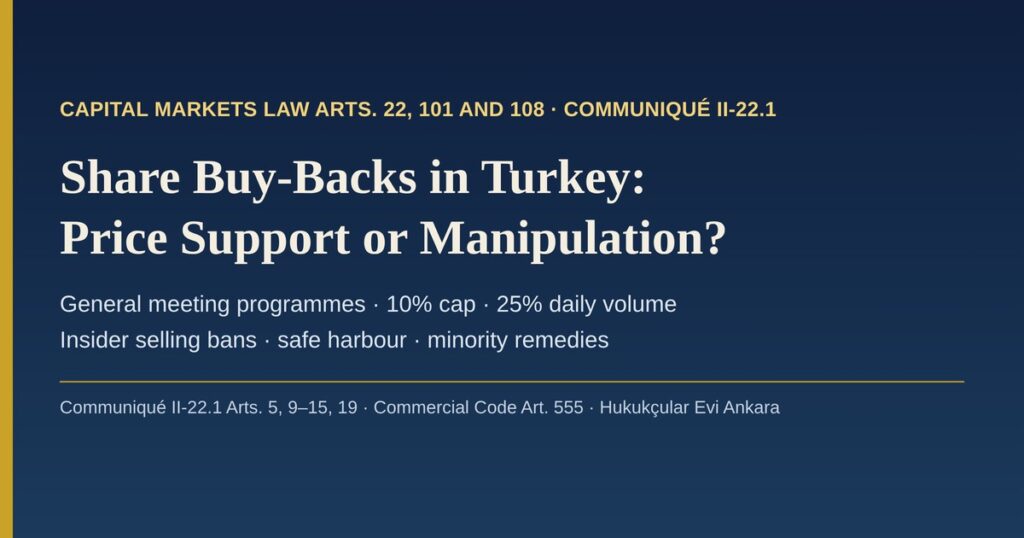
When share prices fall sharply, Turkish listed companies often announce share buy-backs. A buy-back spends the company’s money, and therefore all shareholders’ money, on the company’s own shares. The Capital Markets Law allows public companies to buy their own shares only within the conditions SPK sets (Art. 22(1)), and Communiqué II-22.1 sets those conditions: a buy-back programme approved by the general meeting, a cap of 10 per cent of capital, purchases only on the exchange, a total cost within distributable resources, daily volume limits, detailed disclosure of every trade, and a ban on sales by controlling shareholders while the programme runs (Arts. 5, 9, 11, 12 and 15). A board may buy back without a general meeting resolution only to avoid an imminent and serious loss, defined by reference to the share price in the previous month (Art. 5(4)–(5)). Only buy-backs that meet strict conditions, including a limited set of purposes and no sales during the programme, fall within the statutory exemption from the insider dealing and market manipulation offences (Capital Markets Law Art. 108(1)(b); Communiqué Art. 14). Other buy-backs remain subject to examination under Arts. 101, 106 and 107. This guide explains these rules, the warning signs of abuse, and the remedies open to a foreign institutional investor. It reflects the legislation in force as at 25 October 2026.
- Why buy-backs matter to minority holders
- The legal framework
- Authority: the general meeting programme
- What a programme must contain
- Board buy-backs to avoid a serious loss
- Size, venue and funding limits
- When buy-backs are prohibited
- Sales by controllers and managers
- Trading rules
- Disclosure of each step
- The safe harbour and its limits
- Rights attached to bought-back shares
- Disposal and cancellation
- Unlisted public companies and pledges
- Warning signs of abuse
- Remedies for minority shareholders
- Points for institutional investors
- Action plan
- Time limits
- Frequently asked questions
- Related guides
Why buy-backs matter to minority holders
A buy-back can be a sound use of surplus cash. It can also be used in ways that harm minority shareholders: to support a share price while insiders sell, to spend scarce cash in a crisis, to buy at prices inflated by manipulation, or to accumulate shares that are later sold to related persons on favourable terms. Each of these concerns is addressed by a specific rule in Communiqué II-22.1, and each rule produces documents that a holder can check.
In the 2026 fund and market manipulation cases, many listed companies faced sharp price falls, and buy-backs are a predictable response. Whether a particular programme protects all shareholders or benefits a few depends on how it is authorised, funded, executed and disclosed. The overview of the 2026 cases and the full series of guides is in the legal guide to Turkey’s 2026 fund and market manipulation crisis.
The legal framework
Public companies may buy their own shares and accept them as pledge within the conditions set by SPK, which regulates the conditions, trading limits, disposal or cancellation of bought-back shares and disclosure (Capital Markets Law Art. 22(1)). Purchases by companies included in the public company’s consolidated balance sheet are subject to the same rules (Art. 22(2)). SPK’s rules are in the Communiqué on Bought-Back Shares No. II-22.1 (Official Gazette 3 January 2014), issued under Arts. 22, 48, 101 and 108 of the Law (Communiqué Art. 3). The Communiqué also applies where a subsidiary buys the company’s shares, where a third party buys them in its own name but on the company’s or a subsidiary’s account, and to advances, loans and guarantees given to third parties for the purpose of buying the company’s shares (Art. 2(2)).
Main rules on share buy-backs in Turkish public companies
| Subject | Rule | Provision |
|---|---|---|
| Authority | General meeting approves a programme prepared by the board | Communiqué II-22.1 Art. 5(1) |
| Board-only buy-backs | Listed companies, to avoid an imminent and serious loss; otherwise SPK approval needed | Art. 5(4)–(6) |
| Programme duration | Up to three years for listed companies | Art. 7(1) |
| Size | Nominal value up to 10% of paid-in or issued capital, including earlier purchases | Art. 9(1) |
| Venue | Only in the exchange market where the shares trade | Art. 9(2) |
| Funding | Total cost within resources available for profit distribution | Art. 9(3) |
| Prohibited periods | While disclosure of inside information is delayed; during a capital increase | Art. 10 |
| Insider sales | Controlling shareholders and managers may not sell on the exchange in specified periods | Art. 11 |
| Trading limits | Timing, price and daily volume restrictions | Art. 15 |
| Safe harbour | Exemption from insider dealing and manipulation only if all conditions are met | Capital Markets Law Art. 108(1)(b); Communiqué Art. 14 |
| Responsibility | Board members are responsible for transactions under the Communiqué | Communiqué Art. 22 |
Authority: the general meeting programme
The rule is that the general meeting authorises the board. It does so by approving a buy-back programme prepared by the board; the authorised board may delegate the authority to persons it designates (Communiqué II-22.1 Art. 5(1)). Unless the articles set heavier majorities, the general meeting approves the programme with the ordinary quorum and majority of the Commercial Code (Art. 5(3)): a meeting quorum of shareholders representing at least one quarter of the capital, with no quorum at a second meeting, and decisions by a majority of the votes present (Commercial Code Art. 418).
For a subsidiary to buy the parent’s shares, the parent’s general meeting must approve the programme and the subsidiary’s board must decide to buy under it; if the subsidiary is itself a public company, its own general meeting must also approve (Communiqué Art. 5(2)).
A programme approved by the general meeting lasts at most three years for listed companies and one year for unlisted public companies. If no period is stated, the programme runs for the maximum period; after a fixed-term programme ends, a new general meeting resolution is required (Art. 7(1)). The three-year limit may be extended to five years for programmes aimed at employee share plans, and to the maturity of convertible or exchangeable instruments where shares are needed for them (Art. 7(2)).
The programme must be disclosed by a special situation disclosure at least three weeks before the general meeting, excluding the days of announcement and meeting, and published on the company’s website at the same time; any change made by the general meeting must be disclosed on the first business day after the meeting (Art. 12(1)–(2)). This gives shareholders time to read the programme and decide how to vote.
What a programme must contain
The programme submitted to the general meeting must state (Communiqué II-22.1 Art. 8(1)):
- ▸ Purpose of the buy-back (Art. 8(1)(a)).
- ▸ Duration, if any (Art. 8(1)(b)).
- ▸ Maximum number of shares and that the programme ends when it is reached (Art. 8(1)(c)–(ç)).
- ▸ Lower and upper price limits, fixed or indexed to an indicator, and how adjustments are handled (Art. 8(1)(d)).
- ▸ Rules for selling bought-back shares during the programme, if set (Art. 8(1)(e)).
- ▸ Total funds allocated and their source (Art. 8(1)(f)).
- ▸ Existing treasury shares not yet disposed of, their share of capital and the results of any previous programme (Art. 8(1)(g)).
- ▸ Likely effects on the company’s financial position and results (Art. 8(1)(ğ)).
- ▸ Subsidiaries that may buy under the programme (Art. 8(1)(h)).
- ▸ Price history: the highest, lowest and weighted average prices for the year and the last three months (Art. 8(1)(ı)).
- ▸ Benefits to related parties from the transaction, if any (Art. 8(1)(i)).
The last item deserves particular attention. A programme that benefits related parties, for example by giving them liquidity to sell or a buyer for later disposals, must say so. A statement that there are no such benefits becomes a reference point if related parties later sell or buy treasury shares.
Board buy-backs to avoid a serious loss
Listed companies may also buy back by board decision without a general meeting authorisation, in order to avoid an imminent and serious loss, provided they comply with the disclosure obligations in Art. 12 (Communiqué II-22.1 Art. 5(4)). An imminent and serious loss is deemed to exist where, in the month before the board decision, the share’s daily weighted average price (Art. 5(5)):
- 1. remained below its nominal value; or
- 2. lost more than 20 per cent of its value.
Outside these cases, a buy-back by board decision requires SPK’s approval before the transaction (Art. 5(6)). Subsidiaries cannot use this exception to buy the parent’s shares, and a board decision under it is valid only until the first general meeting (Art. 5(4)). Unlisted public companies cannot use it at all (Art. 6(1)).
The board must disclose, at least two business days before starting, that it will buy back, the purpose, the number of shares and the maximum amount to be paid; it must make the necessary disclosures during and on completion of the purchases; and it must present the purpose, the source of funds and a summary of the purchases to the first general meeting (Art. 12(8)).
Key point: A board buy-back after a sharp fall is lawful only within these limits. The test is objective and can be checked from price data: was the share below nominal value, or down more than 20 per cent, in the month before the board decision? If not, was SPK’s approval obtained? A board buy-back also triggers the selling bans on controllers and managers described below.
Size, venue and funding limits
Three quantitative limits apply to every programme (Communiqué II-22.1 Art. 9):
- ▸ 10 per cent cap. The nominal value of bought-back shares, including earlier purchases, may not exceed 10 per cent of the paid-in or issued capital. Shares disposed of during the programme are not deducted in calculating this ratio (Art. 9(1)).
- ▸ On the exchange only. For listed companies, bought-back shares must be of the exchange-traded kind and purchases may be made only in the market of the exchange where the shares trade; a buy-back by tender offer is possible with SPK’s prior favourable opinion (Art. 9(2)).
- ▸ Distributable resources. The total cost may not exceed the total resources that can be distributed as profit under SPK’s rules. The board is responsible for ensuring compliance, based on the latest annual financial statements approved by the general meeting, before each purchase (Art. 9(3)).
The funding limit protects creditors and shareholders alike: a company cannot use capital that would not be distributable as dividends to buy its own shares. Bought-back shares are also matched by a restricted reserve within equity equal to the purchase cost, released only when the shares are sold or cancelled (Art. 20(2)).
When buy-backs are prohibited
No buy-back or sale under the Communiqué may be made:
- 1. While inside information is withheld. If the company has delayed the disclosure of inside information, no buy-back or sale may take place (Communiqué II-22.1 Art. 10(1)).
- 2. During a capital increase. From the general meeting resolution on a capital increase (in the fixed capital system) or the board decision (in the registered capital system) until the increase is completed, neither the company nor its subsidiaries may buy back or sell (Art. 10(2)).
- 3. In an initial public offering. The company and its subsidiaries may not buy shares under the Communiqué in the initial public offering; purchases in breach are treated as the company subscribing for its own shares under Commercial Code Art. 388 (Art. 11(3)).
Two exceptions relate to the first rule. A listed investment firm with a programme in force is exempt for trades it makes on behalf of clients in its own shares, if information barriers separate staff with access to inside information from staff trading for clients (Art. 17(1)). And a company is exempt if its board delegates the programme to a broad-mandate investment firm with no capital or management link to the company, which takes its decisions entirely independently (Art. 17(2)).
The rule on delayed inside information links buy-backs to the disclosure regime. A company that buys back while sitting on undisclosed negative news, or positive news it has not yet released, uses its information advantage against selling shareholders. The guide to continuous disclosure under Communiqué II-15.1 explains when disclosure may be delayed.
Sales by controllers and managers
The Communiqué prevents insiders from selling into the company’s own buying. While a general meeting programme is in force, or where a board buy-back decision has been taken under Art. 5(4), shareholders holding management control of the company and persons closely related to them may not sell the company’s shares on the exchange (Communiqué II-22.1 Art. 11(1)). In addition, during the buy-back period announced under Art. 12(4), or where a board buy-back decision has been taken, persons with managerial responsibility in the company or its subsidiaries, as defined in the special situations rules, and persons closely related to them may not sell the company’s shares on the exchange (Art. 11(2)).
SPK also has a statutory power here. Where a buy-back programme is in place, it may restrict trading in the company’s shares by individuals and entities directly or indirectly related to the company in management, supervision or capital, and by other related persons (Capital Markets Law Art. 101(2)).
Shareholding notifications and managers’ dealings disclosures under the special situations rules show whether these persons sold. A sale by a controller during the programme period is a breach that can be reported to SPK and may be relevant to a manipulation analysis.
Trading rules
In addition to the exchange’s rules, all buy-backs by listed companies and their subsidiaries must comply with the following (Communiqué II-22.1 Art. 15(1)):
Trading restrictions on buy-backs (Communiqué II-22.1 Art. 15(1))
| Restriction | Provision |
|---|---|
| No orders or trades in the opening session or the last 15 minutes of the first session, or in the opening and closing sessions of the second session | Art. 15(1)(a) |
| The buy order price may not be higher than the current bid prices or the last trade price | Art. 15(1)(b) |
| Daily purchases may not exceed 25% of the average daily trading volume of the previous 20 trading days | Art. 15(1)(c) |
| Where derivatives are used, the exercise price may not be higher than the current independent bids or last independent trade price | Art. 15(1)(ç) |
| For low-liquidity shares, the daily limit may be raised to 50% with SPK’s prior approval and disclosure; SPK decides which shares have low liquidity | Art. 15(1)(d) |
These rules prevent the company from setting the price. A buy-back that leads the market upward, concentrates purchases at the close or exceeds the volume limit is not carried out within the Communiqué and loses the protection described below.
Contact Hukukçular Evi Ankara
For questions on share buy-back programmes, insider sales during buy-backs and related claims connected with the 2026 fund and manipulation cases, you can reach our office by phone or WhatsApp. We correspond in English. Hukukçular Evi Ankara: +90 554 648 37 15
Disclosure of each step
Buy-backs by listed companies are disclosed in detail:
- ▸ Before starting. Two business days before purchases under the programme begin, the start and end dates of the planned buying period and the nominal amount of shares and its ratio to capital (Communiqué II-22.1 Art. 12(4)).
- ▸ Each purchase. Before the session on the business day after each purchase, the nominal amount, ratio to capital, price, shares already bought under the programme, any privileges and the trade date (Art. 12(5)).
- ▸ Each disposal. Before the session on the business day after each disposal, including of earlier purchases, the nominal amount, price, ratio to capital, the remaining ratio, the gain or loss, any privileges and the trade date (Art. 12(6)).
- ▸ At the end. Within three business days after the announced period ends, the programme ends or the planned purchases are completed, the maximum and average price paid, the cost and source of funds, the total number of shares bought and their ratio to capital, and details of any disposals; this summary is also presented to the first general meeting (Art. 12(7)).
For matters not covered by the Communiqué, the general special situations rules apply (Art. 12(9)). These disclosures are public disclosure documents. If they contain false, misleading or incomplete information, those who signed them, or the legal entities on whose behalf they were signed, are jointly liable for resulting losses, and the claim is time-barred six months after the loss (Capital Markets Law Art. 32(1) and (6)).
Together, the disclosures allow a complete reconstruction of the programme: each day’s purchases can be compared with the volume limit, the price rule and the trading data, and the dates can be compared with insiders’ dealings and with the company’s other disclosures.
The safe harbour and its limits
Buy-back programmes carried out under SPK’s rules are not regarded as insider dealing or market manipulation (Capital Markets Law Art. 108(1)(b)). The Communiqué sets the conditions for this exemption narrowly. Listed companies and their subsidiaries benefit from it only if all of the following are met (Communiqué II-22.1 Art. 14(1)):
- 1. A general meeting programme. The purchases are made under a programme approved by the general meeting.
- 2. A permitted purpose. The purchases are made only to reduce paid-in or issued capital, or to meet obligations arising from convertible or exchangeable instruments or employee share plans.
- 3. No sales. No sale of the shares takes place during the programme.
Transactions under the Communiqué that do not meet these conditions are subject to examination under Arts. 101, 106 and 107 of the Capital Markets Law, and if a breach is found, sanctions are applied to those responsible (Communiqué Art. 14(2)).
The consequence is significant. Many buy-backs are announced with the stated purpose of supporting the share price or reflecting the company’s view that the shares are undervalued. Such purposes are not among those listed in Art. 14(1)(b). Board buy-backs to avoid an imminent and serious loss are not made under a general meeting programme. Programmes that allow sales during their term do not meet Art. 14(1)(c). None of these buy-backs is unlawful for that reason alone, but none is protected by the statutory exemption. If the trading patterns suggest that the buy-back was used to create a false impression of demand, or was carried out with inside information, the general rules on manipulation and insider dealing apply. These are explained in the guides to market manipulation under Article 107 and insider dealing under Article 106.
Key point: The safe harbour is narrower than the permission to buy back. A buy-back can comply with the Communiqué’s procedural rules and still be outside the exemption in Art. 108(1)(b). For a price-support buy-back, the question whether it amounted to manipulation is open to examination on the facts.
Rights attached to bought-back shares
Bought-back shares are not counted in the general meeting quorum (Communiqué II-22.1 Art. 18(1); Commercial Code Art. 389(1)). The company’s rights to bonus shares arising from them are preserved; apart from dividends and pre-emption rights, bought-back shares carry no shareholder rights. Pre-emption rights attached to them are sold by the company in the market during the rights period if a market is opened (Communiqué Art. 18(2)). Voting and related rights on parent company shares bought by subsidiaries are frozen automatically (Art. 18(2)), for as long as the shares are held by the company or the subsidiary; when they are transferred to third parties, the rights revive (Art. 18(3)).
The quorum rule has a practical effect. Treasury shares reduce the shares counted at the general meeting, which increases the relative weight of the remaining votes, including those of the controlling shareholder.
Disposal and cancellation
Lawfully bought-back shares, and bonus shares received on them, may be held indefinitely within the 10 per cent cap and the funding limit (Communiqué II-22.1 Art. 19(1)). The other disposal rules are:
Disposal of bought-back shares (Communiqué II-22.1 Art. 19)
| Situation | Rule | Provision |
|---|---|---|
| Shares bought in breach of the Communiqué | Disposed of within one year of the purchase; those not sold are cancelled by capital reduction | Art. 19(2) |
| Holdings above 10% of capital (other than for capital reduction) | Disposed of as soon as possible without loss and in any case within three years; otherwise cancelled immediately | Art. 19(3) |
| Sales by listed companies | On the exchange, during or after the programme but not within the announced buying period; wholesale market sales count as exchange sales | Art. 19(6) |
| Sales to third parties in the wholesale market | Within the market’s price margins | Art. 19(6) |
| Sales to related persons | Price not below the base price set under the wholesale market rules | Art. 19(6) |
| Sales between subsidiaries | Exchange sale requirement may be waived with SPK’s prior approval, if there is no effect on the financial position or management structure | Art. 19(7) |
| Cancellation | Under SPK’s procedures for capital reduction without fund outflow | Art. 19(9) |
Disposals to related persons need careful review. A company that buys its shares in the market and later sells them to a person related to the controlling shareholder in the wholesale market transfers the shares it accumulated with all shareholders’ money. The price floor in Art. 19(6) applies, but the transaction may still raise questions of concealed profit transfer under Art. 21 of the Capital Markets Law, explained in the guide to concealed profit transfer.
Unlisted public companies and pledges
Public companies whose shares are not traded on the exchange may buy back only through a voluntary tender offer to their shareholders, under a general meeting programme, paid in cash, with pro rata allocation if more shares are tendered than sought (Communiqué II-22.1 Art. 6(2)). The price is set by a valuation report, and the programme must include its summary and lower and upper limits of 10 per cent around the per-share value (Art. 6(3) and (6)). The tender offer rules generally are explained in the guide to tender offers in Turkey.
A company accepting its own shares as pledge is subject to most of the same rules by analogy, including authorisation, limits, prohibited periods, insider selling bans and disclosure (Art. 21).
Some acquisitions fall outside the authorisation rules and the 10 per cent cap, including acquisitions for a capital reduction, by universal succession, under a legal purchase obligation, free of charge, under an SPK or court decision protecting minority rights, in enforcement proceedings to collect the company’s receivables, and through the exercise of exit, squeeze-out or sell-out rights (Art. 16(1)).
Warning signs of abuse
The Communiqué’s requirements translate into practical checks. The following patterns warrant closer examination:
- ▸ Controllers selling during the programme. Any sale on the exchange by the controlling shareholder or closely related persons while the programme is in force (Art. 11(1)).
- ▸ Buying before bad news. Purchases followed shortly by the disclosure of negative information, which may indicate that disclosure had been delayed (Art. 10(1)).
- ▸ Board buy-backs without the price trigger. A board decision without general meeting authority where the price was neither below nominal value nor down more than 20 per cent in the previous month, and no SPK approval was obtained (Art. 5(5)–(6)).
- ▸ Volume and price breaches. Daily purchases above 25 per cent of the 20-day average volume, purchases at prices above the best bid or the last trade, or purchases in the closing minutes (Art. 15).
- ▸ Funding beyond distributable resources. Total cost exceeding the resources available for distribution (Art. 9(3)), particularly in a company with losses.
- ▸ Disposals to related persons. Wholesale market sales of treasury shares to persons related to the controller (Art. 19(6)).
- ▸ Buying during manipulation. Purchases at prices later found by SPK to have been affected by manipulation, which may mean the company spent its money at artificial prices.
Remedies for minority shareholders
A minority shareholder has several routes, depending on the stage:
- 1. At the general meeting. Ask the board for information on the programme, its funding and expected effects; shareholders may ask the board for information on the company’s affairs at the general meeting, and the information must be careful and truthful (Commercial Code Art. 437(2)). Vote against a programme that is unjustified, and have the dissent recorded.
- 2. Annulment. A general meeting resolution approving a programme that breaches the law, the articles or the principle of good faith can be challenged within three months (Commercial Code Arts. 445 and 446). The guide to shareholder rights in Turkish listed companies explains the procedure.
- 3. Complaint to SPK. Breaches of the Communiqué can lead to administrative fines; a person who breaches regulations made under the Law is fined, and the fine may not be less than twice any benefit obtained (Capital Markets Law Art. 103(1)). Buy-backs outside the safe harbour are subject to examination under Arts. 101, 106 and 107 (Communiqué Art. 14(2)), and SPK may restrict trading by related persons during a programme (Capital Markets Law Art. 101(2)).
- 4. Claims for the company’s loss. Board members are responsible for transactions under the Communiqué (Communiqué Art. 22). Where an unlawful buy-back caused loss to the company, for example by paying artificial prices or exceeding distributable resources, each shareholder may sue for compensation to be paid to the company (Commercial Code Arts. 553 and 555(1)). The guide to directors’ and auditors’ liability explains these claims.
- 5. Claims for misleading disclosures. Where buy-back disclosures were false, misleading or incomplete, investors who bought or sold on them may claim against the signatories within six months of the loss (Capital Markets Law Art. 32(1), (4) and (6)).
- 6. Criminal complaint and participation. Where a buy-back formed part of a manipulation or insider dealing scheme, a criminal complaint and participation in the criminal case give access to evidence and support civil claims.
Model outline: complaint to SPK about a share buy-back
- 1. Complainant: the institution, its holding and its interest, with custody statements.
- 2. Company and programme: the general meeting resolution or board decision, the programme text and the disclosures under Communiqué II-22.1 Art. 12.
- 3. Breaches: for each, the facts and the rule, such as sales by controllers during the programme (Art. 11(1)), purchases while disclosure was delayed (Art. 10(1)), a board buy-back without the price trigger or SPK approval (Art. 5(5)–(6)), volume or price breaches (Art. 15) or funding beyond distributable resources (Art. 9(3)).
- 4. Market effect: trading data showing the price and volume during the purchases and any sales by related persons.
- 5. Request: examination under Capital Markets Law Arts. 101, 106 and 107 as provided in Communiqué Art. 14(2), measures under Art. 101(2), and administrative sanctions under Art. 103.
- 6. Annexes: documents and a dated chronology.
Model outline: action for the company’s loss caused by an unlawful buy-back (Commercial Code Art. 555)
- 1. Court: the commercial court of first instance with jurisdiction over the company.
- 2. Plaintiff: the shareholder, suing for payment to the company (Art. 555(1)).
- 3. Defendants: the board members responsible for the buy-back decisions and their execution (Communiqué II-22.1 Art. 22; Commercial Code Art. 553).
- 4. Breach: the specific rules of the Communiqué or the duties of care that were breached, with the trades concerned.
- 5. Loss: the amount the company paid above a fair value, or the funds spent beyond distributable resources, supported by expert evidence.
- 6. Release: whether the general meeting released the directors, and the effect of any release on the claim.
- 7. Request: payment of compensation to the company, with interest.
Points for institutional investors
- ▸ Read programmes before the meeting. The three-week disclosure period gives time to assess purpose, funding, price limits and related-party benefits before voting.
- ▸ Prefer clear purposes. Programmes for capital reduction or employee plans, without sales during their term, are the ones within the safe harbour. Open-ended price support programmes carry more risk.
- ▸ Track the disclosures. Daily purchase disclosures can be compared automatically with exchange data for volume, price and timing compliance.
- ▸ Watch insiders. Compare managers’ dealings disclosures and shareholding notifications with the programme period.
- ▸ Check funding. Compare cumulative purchase costs with the distributable resources in the latest approved annual financial statements.
- ▸ Follow the shares afterwards. Watch for disposals of treasury shares, especially in the wholesale market to related persons.
- ▸ Keep evidence. Keep the programme, disclosures and trading data together; they are the core of any later complaint or claim.
Hukukçular Evi Ankara
Ankara-based law office, Av. Fatma Öztürk. Telephone and WhatsApp: +90 554 648 37 15. We correspond in English.
Action plan
- 1. Identify the authority. Determine whether the buy-back is under a general meeting programme, a board decision to avoid an imminent and serious loss, or an SPK-approved board decision.
- 2. Check the conditions. Verify the price trigger, the 10 per cent cap, the exchange-only rule and the funding limit.
- 3. Reconstruct the trades. Use the daily disclosures and exchange data to test compliance with the timing, price and volume rules.
- 4. Compare with insiders. Check sales by controllers, managers and related persons during the relevant periods, and any delayed disclosures.
- 5. Assess the safe harbour. Determine whether the buy-back met all the conditions of Communiqué Art. 14(1); if not, assess the manipulation and insider dealing questions on the facts.
- 6. Act. Vote and record dissent, challenge resolutions within three months, complain to SPK, and consider claims for the company’s loss or for misleading disclosures.
- 7. Monitor disposals. Follow the later sale or cancellation of the treasury shares.
Time limits
Time limits relevant to share buy-backs
| Step | Time limit | Provision |
|---|---|---|
| Disclosure of the programme before the general meeting | At least three weeks before the meeting | Communiqué II-22.1 Art. 12(1) |
| Disclosure before purchases start | Two business days before | Art. 12(4) and (8)(a) |
| Disclosure of each purchase or disposal | Before the session on the next business day | Art. 12(5)–(6) |
| Summary at the end of the programme | Within three business days | Art. 12(7) |
| Programme duration, listed companies | Up to three years | Art. 7(1) |
| Disposal of shares bought in breach | Within one year of purchase | Art. 19(2) |
| Disposal of holdings above 10% | Within three years | Art. 19(3) |
| Action against a general meeting resolution | Three months from the resolution | Commercial Code Art. 445 |
| Claim based on misleading disclosures | Six months from the loss | Capital Markets Law Art. 32(6) |
Frequently asked questions
Can a Turkish listed company buy back its own shares?
Yes, within the conditions set by SPK in Communiqué II-22.1 (Capital Markets Law Art. 22(1)).
Who authorises a buy-back?
As a rule, the general meeting, by approving a programme prepared by the board (Communiqué II-22.1 Art. 5(1)).
Can the board buy back without a general meeting?
A listed company’s board may do so to avoid an imminent and serious loss, deemed to exist if in the previous month the share traded below nominal value or fell more than 20 per cent; otherwise SPK approval is needed (Art. 5(4)–(6)).
How many shares can a company buy back?
Up to 10 per cent of its paid-in or issued capital in nominal value, including earlier purchases (Art. 9(1)).
Where must buy-backs take place?
For listed companies, only in the exchange market where the shares trade, unless SPK agrees to a tender offer (Art. 9(2)).
How much money can be spent?
No more than the resources available for profit distribution under SPK’s rules (Art. 9(3)).
Can the controlling shareholder sell during a buy-back?
No. Controlling shareholders and closely related persons may not sell on the exchange while a programme is in force or after a board buy-back decision (Art. 11(1)).
Can a company buy back while it is delaying disclosure of inside information?
No (Art. 10(1)).
Are buy-backs exempt from market manipulation rules?
Only if made under a general meeting programme, for capital reduction, convertible instruments or employee plans, with no sales during the programme (Capital Markets Law Art. 108(1)(b); Communiqué Art. 14(1)). Other buy-backs remain subject to examination under Arts. 101, 106 and 107.
Is a buy-back to support the share price protected?
Price support is not one of the purposes listed in Communiqué Art. 14(1)(b), so such a buy-back is not within the safe harbour, although it is not unlawful for that reason alone.
How much can a company buy in one day?
Not more than 25 per cent of the average daily volume of the previous 20 trading days, or up to 50 per cent for low-liquidity shares with SPK approval (Art. 15(1)(c)–(d)).
Do bought-back shares vote?
No. They are excluded from the general meeting quorum (Art. 18(1); Commercial Code Art. 389(1)) and carry no shareholder rights other than dividends and pre-emption rights (Art. 18(2)).
Can the company sell bought-back shares to related persons?
Sales must take place on the exchange; sales to related persons in the wholesale market may not be below the base price under its rules (Art. 19(6)).
Who is responsible for an unlawful buy-back?
The board members (Communiqué Art. 22). Shareholders may sue them for the company’s loss, with compensation payable to the company (Commercial Code Art. 555(1)).
How are buy-backs disclosed?
Each purchase and disposal is disclosed before the session on the next business day, and a summary is disclosed within three business days of the end (Communiqué Art. 12).
Related guides
- Turkey’s 2026 Fund and Market Manipulation Crisis: Legal Guide for Foreign Institutional Investors — the entry point to this series
- Financial Reporting Fraud and Audit Failures in Turkish Listed Companies
- Dividends in Turkish Listed Companies
- Mergers, Asset Sales and Exit Rights in Turkish Listed Companies
- Corporate Governance in Turkish Listed Companies
- Market Manipulation under Turkish Law: Article 107
- Insider Dealing in Turkey: Capital Markets Law Article 106
- Continuous Disclosure in Turkey: Communiqué II-15.1
- Directors’ and Auditors’ Liability in Turkish Listed Companies
- Concealed Profit Transfer in Turkey
- Shareholder Rights in Turkish Listed Companies
- Capital Increases and Dilution in Turkish Listed Companies
- Mandatory Tender Offers in Turkey
- Prospectus and Disclosure Liability in Turkey
Important note: This guide is for general information only and does not constitute legal advice on any matter. It does not suggest that any company, board or shareholder connected with the 2026 cases has carried out an unlawful buy-back or committed an offence; investigations are ongoing and the presumption of innocence applies. It reflects the legislation in force as at 25 October 2026. SPK may adopt decisions affecting buy-backs in particular market conditions, and current SPK decisions should be checked for each case. Legislation relied on: Capital Markets Law No. 6362, Arts. 21, 22, 32, 101, 103, 106, 107 and 108; Communiqué on Bought-Back Shares No. II-22.1, Arts. 2–22; Communiqué on Special Situations No. II-15.1; Turkish Commercial Code No. 6102, Arts. 388, 389, 418, 437, 445, 446, 553 and 555.