Turkish version (Türkçe sürüm): Yabancılar Türkiye’de Havayolu Şirketi Kurabilir mi veya Bir Havayoluna Ortak Olabilir mi?
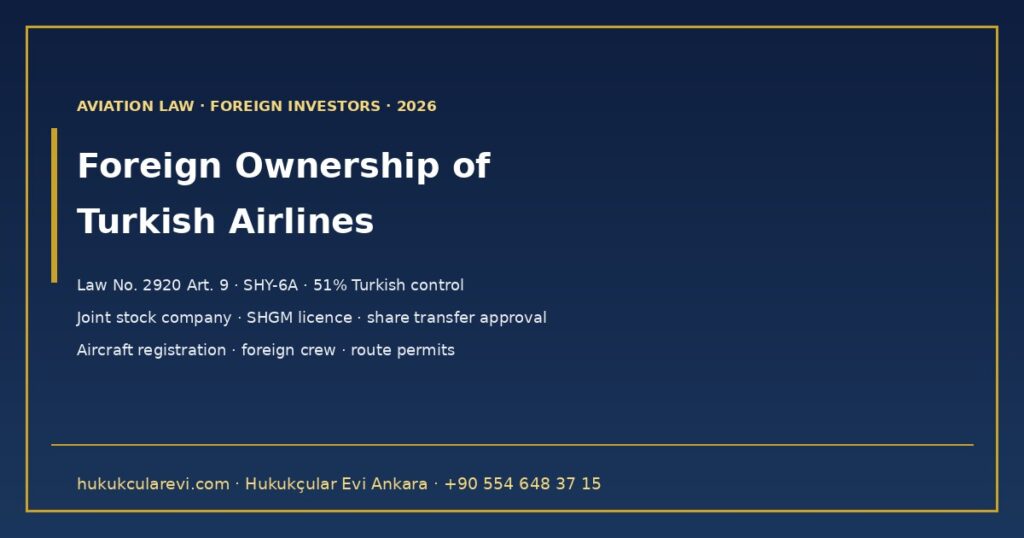
A foreign airline or investor can become a shareholder in a Turkish airline; commercial air transport is, however, one of the sectors where foreign investment is subject to a control limit. Turkish Civil Aviation Law No. 2920 makes commercial air transport subject to permission from the Ministry of Transport and Infrastructure and to an operating licence, and the Regulation on Commercial Air Transport Operators (SHY-6A) of the Directorate General of Civil Aviation (SHGM) requires the majority of shares, the majority of board members and voting rights, and control to be held by shareholders who are Turkish citizens. Foreign shareholders can therefore hold only a minority stake in a Turkish airline. In an airline holding a pre-approval or an operating licence, every transfer of registered shares and every increase in a shareholding requires SHGM’s prior permission, whatever the percentage. For an airline operating scheduled services with passenger aircraft of 100 or more seats, the minimum paid-in capital is USD 15 million and the fleet at least five aircraft; the aircraft must be entered in the Turkish civil aircraft register. Commercial carriage between two points in Turkey is performed with Turkish civil aircraft, and foreign airlines may fly to Turkey only within the framework of bilateral agreements and SHGM permissions. This guide explains, with reference to the legislation, the Turkish control requirement, indirect ownership, the establishment and licensing process, share transfers, aircraft registration and leasing, flight crew, foreign airlines’ services to Turkey, ground handling and general aviation rules, and sanctions.
Short answer: Can foreigners set up an airline in Turkey or buy into one?
1. They can become shareholders, but the majority and control must remain with Turkish citizens. The majority of shares, the majority of board members and voting rights, and control must be held by shareholders who are citizens of the Republic of Türkiye (SHY-6A, Art. 9(1)(b)).
2. At least 51% of the shares must be registered; this requirement does not apply to companies listed on a stock exchange, but the majority of the registered shares other than the traded shares must be held by Turkish citizens, and the majority of the persons authorised to represent and manage the company must be Turkish citizens (Art. 9(1)(a) and 9(2)).
3. Commercial air transport requires Ministry permission and an operating licence (Law No. 2920, Arts. 18 and 19). Except for the one-year licence granted to non-scheduled operators starting with two aircraft, the licence is granted for an indefinite period and remains valid as long as the requirements are met (SHY-6A, Arts. 36(3) and 16).
4. In an operator holding a pre-approval or a licence, every transfer of registered shares and every increase in a shareholding requires SHGM’s prior permission, whatever the percentage (SHY-6A, Art. 10(1)).
5. The minimum paid-in capital is USD 15 million for a scheduled operator with aircraft of 100 or more seats, USD 5 million with aircraft of 20 to 99 seats, USD 10 million for a non-scheduled operator, USD 5 million for a cargo operator and USD 150,000 for an air taxi operator (Arts. 15 to 18).
6. The aircraft must be entered in the Turkish civil aircraft register in the operator’s name, whether owned or leased (SHY-6A, Arts. 15 to 18); domestic carriage is, as a rule, performed with Turkish civil aircraft, with an exception for leased foreign-registered aircraft (Law No. 2920, Art. 31).
7. In an airline operating aircraft of twenty or more seats, the majority of pilots, technicians, flight operations officers and cabin attendants must be Turkish citizens within one year of the licence (SHY-6A, Art. 22(2)).
8. Foreign airlines’ services to Turkey are governed by the bilateral and multilateral agreements to which Turkey is a party, taking into account the principle of reciprocity (Law No. 2920, Art. 33).
- Who can carry on commercial air transport in Turkey?
- The Turkish control requirement: majority, board, votes and control
- Indirect ownership and review of the ownership chain
- The foreign investor’s options
- Establishment requirements: company type, capital, fleet and guarantee
- Pre-approval and the operating licence
- Share transfers, mergers and changes in management
- Aircraft registration, cabotage and leased aircraft
- Accountable manager, pilots and cabin crew
- Foreign airlines’ services to Turkey
- Ground handling, general aviation, training and airports
- Suspension and cancellation of the licence and administrative fines
- Checklist
- Common mistakes
- Frequently asked questions
Who can carry on commercial air transport in Turkey?
Commercial carriage of passengers, cargo and mail by air in Turkey is governed by Turkish Civil Aviation Law No. 2920, published in Official Gazette No. 18196 of 19 October 1983. Under the Law, obtaining permission from the Ministry of Transport is a precondition for those wishing to carry on commercial air transport (Art. 18(1)); permission is not granted where national security or public order may be endangered, or where the founders or authorised managers have convictions listed in the Law (Art. 18(2)). Those operating routes must also obtain an operating licence (Art. 19). The application documents and conditions are left to a regulation (Art. 20). That regulation is the Regulation on Commercial Air Transport Operators (SHY-6A) of the Directorate General of Civil Aviation (SHGM), published in Official Gazette No. 28823 of 16 November 2013; it was last updated by the amendment published in Official Gazette No. 32613 of 26 July 2024.
SHY-6A distinguishes operators by the type of carriage they perform. There are separate capital and fleet requirements for airlines carrying passengers and cargo on scheduled and non-scheduled services, for operators carrying out only non-scheduled carriage, for operators carrying only cargo, and for air taxi operators. The foreign investor’s first decision is therefore which licence type the operator to be set up or acquired will fall under.
Types of commercial air transport operator under SHY-6A
| Operator type | Scope | Legal basis |
|---|---|---|
| Airline | Scheduled and non-scheduled carriage of passengers and cargo | SHY-6A, Art. 15 |
| Non-scheduled operator | Non-scheduled carriage only | SHY-6A, Art. 16 |
| Cargo operator | Cargo carriage only; may not have passenger aircraft | SHY-6A, Art. 17 |
| Air taxi operator | Carriage with aircraft of nineteen seats or fewer, or with helicopters | SHY-6A, Art. 18 |
The Turkish control requirement: majority, board, votes and control
The key rule for foreign investors is in Art. 9(1) of SHY-6A. Under it, companies that will carry on commercial air transport must have at least 51% of their shares registered, and the majority of shares, the majority of board members and voting rights, and control must be held by shareholders who are citizens of the Republic of Türkiye. A sub-paragraph added by the amendment of 26 July 2024 also requires that no usufruct right capable of breaching the operator’s voting majority and control has been created over the shares of shareholders who are Turkish citizens (Art. 9(1)(ç)). This prevents control from passing to a foreigner in practice through a usufruct right created in the foreigner’s favour over the Turkish shareholders’ shares.
The rule is not framed as a cap such as “foreign capital may not exceed 49%”, but as a majority and control requirement for Turkish citizen shareholders. In effect, foreign shareholders cannot reach a majority of shares, board seats or voting rights, and cannot acquire control of the company. If the company’s shares are traded on Borsa İstanbul or on international stock exchanges, the 51% registered-share requirement does not apply; however, the majority of the registered shares other than the traded shares must be held by shareholders who are Turkish citizens, and the majority of the persons authorised to represent and manage the operator must be Turkish citizens (Art. 9(2)). The State of the Turkish Republic of Northern Cyprus and its citizens are treated as Turkish shareholders for this purpose (Art. 9(3)).
This regulatory rule is consistent with the Law’s provision on the nationality of aircraft. Under Law No. 2920, for aircraft belonging to companies registered in the trade registry to count as Turkish civil aircraft, the majority of the persons authorised to manage and represent the company must be Turkish citizens, and the majority of votes under the articles of association must be held by Turkish shareholders (Art. 49(b)). Commercial carriage within Turkey is also performed with Turkish civil aircraft (Art. 31(1)). Foreign Direct Investment Law No. 4875 grants foreign investors equal treatment “unless international agreements or special laws provide otherwise” (Art. 3(a)). The statutory basis of the aviation exception lies in Arts. 31 and 49(b) of Law No. 2920; the shareholding and control requirements are set out in detail in SHY-6A, which is based on that Law.
Elements of the Turkish control requirement
| Element | Rule | Legal basis |
|---|---|---|
| Registered shares | At least 51% of the shares are registered | SHY-6A, Art. 9(1)(a) |
| Share majority | The majority of shares is held by shareholders who are Turkish citizens | SHY-6A, Art. 9(1)(b) |
| Board of directors | “The majority of board members and voting rights” is held by shareholders who are Turkish citizens | SHY-6A, Art. 9(1)(b) |
| Voting rights and control | The voting majority and control are held by shareholders who are Turkish citizens | SHY-6A, Art. 9(1)(b) |
| Usufruct right | No usufruct right capable of breaching the voting majority and control may be created over Turkish shareholders’ shares | SHY-6A, Art. 9(1)(ç) (2024) |
| Listed company | The 51% registered-share requirement does not apply; the majority of the registered shares other than the traded shares is held by Turkish citizens, and the majority of the persons authorised to represent and manage are Turkish citizens | SHY-6A, Art. 9(2) |
| TRNC | The State of the TRNC and its citizens are treated as Turkish shareholders | SHY-6A, Art. 9(3) |
| Turkish nationality of aircraft | The majority of persons authorised to manage and represent are Turkish citizens; the voting majority under the articles of association is held by Turkish shareholders | Law No. 2920, Art. 49(b) |
Indirect ownership and review of the ownership chain
SHY-6A also seeks to prevent the Turkish control requirement from being circumvented indirectly. Where it deems necessary, SHGM may review the ownership structure through the chain until natural persons are reached (Art. 11). The Regulation contains no express provision on whether a Turkish company whose shares belong to foreigners counts as a “Turkish shareholder” for the purposes of Art. 9; this assessment is left to SHGM’s chain review. A foreign investor investing through a Turkish holding company therefore does not, on its own, satisfy the Turkish control requirement; who holds the majority and control at every link of the chain should be documented from the outset.
In practice, there are Turkish airlines with foreign minority shareholders. For example, according to the partnerships page on Turkish Airlines’ website, the shares of SunExpress (Güneş Ekspres Havacılık A.Ş.) are held 50% by Turkish Airlines, 49% by Lufthansa and 1% by other shareholders. In such structures, shareholders’ agreements drafted so as not to breach the majority and control requirement are used to protect the foreign shareholder’s rights; however, veto rights, rights to nominate board members and voting agreements should be assessed separately against the “control” requirement in Art. 9. The general rules on shareholders’ agreements are explained in our guide Shareholders’ Agreements in Turkey.
Points to watch in indirect ownership
| Subject | Rule or risk | Legal basis |
|---|---|---|
| Chain review | SHGM reviews until natural persons are reached, where it deems necessary | SHY-6A, Art. 11 |
| Foreign-owned Turkish company | Whether it counts as a Turkish shareholder is not expressly regulated in the Regulation | SHY-6A, Arts. 9 and 11 |
| Usufruct right | No usufruct right capable of breaching control may be created over Turkish shareholders’ shares | SHY-6A, Art. 9(1)(ç) |
| Shareholders’ agreement | Veto and nomination rights are assessed against the control requirement | SHY-6A, Art. 9(1)(b) |
The foreign investor’s options
Within the Turkish control requirement, a foreign airline or investor has several routes. The first is to set up a new airline with Turkish partners and remain a minority shareholder. The second is to acquire a minority stake in an existing Turkish airline with SHGM’s permission. The third is to operate flights to Turkey with its own airline within the framework of bilateral air services agreements. The fourth is to lease aircraft to Turkish airlines or to provide maintenance, training or technology services; however, as Turkish majority requirements also apply to some ancillary activities such as ground handling and general aviation, each of these routes should be examined separately.
The foreign investor’s options
| Option | What is needed? | Point to watch |
|---|---|---|
| New airline with Turkish partners | Ministry permission, pre-approval, operating licence; capital and fleet requirements | Majority, board, votes and control with Turkish citizens (SHY-6A, Art. 9) |
| Minority stake in an existing airline | SHGM permission before the transfer; the new shareholder’s documents | Every transfer of registered shares requires permission (SHY-6A, Art. 10) |
| Flights to Turkey as a foreign airline | Rights under a bilateral agreement and SHGM permissions | No domestic carriage in its own name (Law No. 2920, Arts. 31 and 33) |
| Aircraft leasing, maintenance, training, technology | Lease agreement and SHGM leasing approval; authorisations for the activity concerned | Turkish majority requirements also apply in ground handling and general aviation |
Buying into an existing airline is also a company acquisition; if the share acquisition results in sole or joint control and turnover thresholds are exceeded, Competition Board approval is also required. The approvals a foreign investor needs when buying a Turkish company are set out together in our guide Buying a Turkish Company as a Foreign Investor: Which Approvals Do You Need?
Establishment requirements: company type, capital, fleet and guarantee
SHY-6A ties the company type to the size of the aircraft to be operated. Companies that will operate aircraft of fewer than twenty seats may be set up as joint stock or limited liability companies; companies that will carry only cargo or operate aircraft of twenty or more seats are set up as joint stock companies (Art. 6). The business purpose of operators of aircraft of twenty or more seats and of cargo operators may not include any activity other than aviation and aviation-related business (Art. 7), and the operator’s commercial centre must be in Turkey (Art. 8). The aircraft must be entered in the Turkish civil aircraft register in the operator’s name, whether owned or leased.
Under the current text, the capital and fleet requirements are as follows; the amendment of 26 July 2024 did not change the basic capital amounts, but removed the additional capital requirements tied to the number of aircraft and made the air taxi capital no longer a per-aircraft amount. For an airline carrying out scheduled and non-scheduled carriage with aircraft of 100 or more seats, the minimum paid-in capital is USD 15 million and the fleet at least five aircraft (Art. 15(1)(a)). For an operator with aircraft of 20 to 99 seats, the capital is USD 5 million and the fleet at least two aircraft (Art. 15(1)(b)). For an operator carrying out only non-scheduled carriage, the capital is USD 10 million and, for aircraft of 100 or more seats, the fleet at least three aircraft; the operator may start with two aircraft on a one-year licence by paying the licence fee plus 50% (Art. 16). For a cargo operator, the capital is USD 5 million, the fleet at least two aircraft, and it may not have passenger aircraft (Art. 17). For an air taxi operator, the capital is at least USD 150,000 and the fleet at least one aircraft (Art. 18). Operators with a fleet of fifty or more aircraft must own at least one aircraft for every fifty (Art. 19(1)(l)). The minimum paid-in capital requirements do not apply to licensed operators (Art. 45(5)); however, according to the year-end approved financial statements, the paid-in capital must not have been entirely lost (Art. 45(3)).
Airlines and non-scheduled operators also provide an unconditional (definite) bank letter of guarantee of USD 500,000 of unlimited duration (Art. 19(1)(d)). Third-party liability insurance, proof that three months’ operating costs can be covered, and the absence of tax and social security premium debts of the operator and its shareholders are also required (Art. 19(1)(c), (ç), (g)). The documents and apostille rules for foreigners forming a company in Turkey are explained in our guide Company Formation in Turkey for Foreigners.
Capital and fleet requirements by operator type
| Operator type | Minimum paid-in capital | Minimum fleet | Legal basis |
|---|---|---|---|
| Airline (100 or more seats) | USD 15 million | 5 aircraft | SHY-6A, Art. 15(1)(a) |
| Airline (20 to 99 seats) | USD 5 million | 2 aircraft | SHY-6A, Art. 15(1)(b) |
| Non-scheduled operator | USD 10 million | 3 aircraft of 100 or more seats; a one-year licence possible with 2 aircraft | SHY-6A, Art. 16 |
| Cargo operator | USD 5 million | 2 aircraft; no passenger aircraft | SHY-6A, Art. 17 |
| Air taxi | USD 150,000 | 1 aircraft | SHY-6A, Art. 18 |
Other establishment requirements
| Requirement | Rule | Legal basis |
|---|---|---|
| Company type | Joint stock company for 20 or more seats or cargo; joint stock or limited liability company for fewer than 20 seats | SHY-6A, Art. 6 |
| Business purpose | For operators with 20 or more seats and cargo operators, no activity other than aviation and related business | SHY-6A, Art. 7 |
| Commercial centre | In Turkey | SHY-6A, Art. 8 |
| Letter of guarantee | USD 500,000, unconditional and of unlimited duration (airlines and non-scheduled operators) | SHY-6A, Art. 19(1)(d) |
| Insurance and financing | Third-party liability insurance; ability to cover three months’ costs | SHY-6A, Art. 19(1)(c), (ç) |
| Public debts | No tax or social security premium debts of the operator and its shareholders | SHY-6A, Art. 19(1)(g) |
| Large fleet | With fifty or more aircraft, ownership of at least one aircraft for every fifty | SHY-6A, Art. 19(1)(l) |
Pre-approval and the operating licence
The application proceeds in two stages. In the first stage, a pre-approval is obtained by applying to SHGM; the pre-approval is valid for six months, the main licence file must be submitted within this period, and the period may be extended once by up to three months for compelling reasons (SHY-6A, Art. 31(3)). In the second stage, the operating licence is granted: for airlines the licence takes effect with the Minister’s approval and for air taxi operators with the Director General’s approval, it is granted for an indefinite period, and it remains valid as long as the requirements are met (Arts. 36(1) and 36(3)). The one-year licence granted to a non-scheduled operator starting with two aircraft is the exception (Art. 16). An operator that has obtained a licence must start flying within six months (Art. 36(6)). The technical adequacy of flight operations is also assessed under SHGM’s instructions on flight operations.
At the permission stage, the Ministry does not grant permission where national security or public order may be endangered, or where the founders or authorised managers have convictions listed in the Law (Law No. 2920, Art. 18(2)). The Regulation also requires that the founders and the managers authorised to represent and bind the company have not been finally convicted of the offences specified in Art. 18 of Law No. 2920 and are not subject to a bankruptcy or concordat decision (SHY-6A, Art. 9(1)(c)). The background of the natural persons in the ownership chain and of the managers should therefore be examined before applying.
The licensing process
| Stage | Content | Legal basis |
|---|---|---|
| Ministry permission | Precondition for commercial air transport | Law No. 2920, Art. 18(1) |
| Pre-approval | Valid for six months; the main licence file is submitted within this period; one extension of up to three months | SHY-6A, Art. 31(3) |
| Grounds for refusal | National security, public order; convictions of founders or managers listed in the Law | Law No. 2920, Art. 18(2) |
| Operating licence | Mandatory for route operations; Minister’s approval for airlines, Director General’s approval for air taxis; indefinite as long as the requirements continue to be met | Law No. 2920, Art. 19; SHY-6A, Arts. 36(1) and 36(3) |
| Start of flights | Within six months of the licence | SHY-6A, Art. 36(6) |
Make SHGM permission a condition to closing when buying airline shares
Every transfer of registered shares requires SHGM’s prior permission, and a loss of Turkish control puts the licence at risk. Send us your draft share purchase agreement and ownership chain via WhatsApp; Hukukçular Evi Ankara: +90 554 648 37 15
📞 Call us💬 WhatsAppShare transfers, mergers and changes in management
Share transfers in aviation are subject to a strict permission regime. In operators that have obtained a pre-approval or hold an operating licence, the transfer by any existing shareholder of all or part of its registered shares, or an increase in its existing shareholding, requires permission from SHGM before the transaction is carried out; permission is also obtained before a public offering (SHY-6A, Art. 10(1)). There is no percentage threshold for this permission; even a small share transfer requires prior permission. Transactions under the privatisation legislation are not affected by this rule. The incoming shareholder submits all the documents required of founders (Art. 10(2)), and shares may not be transferred to persons subject to the impediments listed in the Regulation (Art. 10(3)).
For transactions such as a merger, a transfer of all assets and liabilities, a takeover or a division, SHGM’s permission is obtained after Competition Authority approval, where required, and a one-year business plan is submitted (Art. 12). Changes in the board of directors are notified to SHGM within fourteen days (Art. 13(2)). If a breach of the Regulation arises in respect of founding shareholders or managers authorised to represent and manage the operator, SHGM sets a period; if it is not remedied, partial restrictions are applied for two months, and the operating licence is then suspended or cancelled (Art. 13(3)). The foreign investor’s share purchase agreement should therefore make SHGM permission a condition to closing, and the board structure should be set up so as to keep the Turkish majority requirement of Art. 9 after closing as well. General information on Competition Board approval is in our article Birleşme ve Devralmalarda Rekabet Kurulu İzni (in Turkish).
Changes in shares and management
| Transaction | Rule | Legal basis |
|---|---|---|
| Transfer of registered shares or increase in a shareholding | SHGM permission before the transaction, whatever the percentage | SHY-6A, Art. 10(1) |
| Public offering | SHGM permission beforehand | SHY-6A, Art. 10(1) |
| Documents of the new shareholder | All the documents required of founders | SHY-6A, Art. 10(2) |
| Merger, takeover, division | Competition Authority approval where required, then SHGM permission and a one-year business plan | SHY-6A, Art. 12 |
| Change in the board of directors | Notification within fourteen days | SHY-6A, Art. 13(2) |
| Failure to remedy a breach concerning founders or managers | Two months of partial restrictions; then suspension or cancellation of the licence | SHY-6A, Art. 13(3) |
Aircraft registration, cabotage and leased aircraft
The Ministry keeps a register of Turkish civil aircraft (Law No. 2920, Art. 50), and for an aircraft belonging to a company registered in the trade registry to count as a Turkish civil aircraft, the majority of the persons authorised to manage and represent the company must be Turkish citizens and the majority of votes must be held by Turkish shareholders (Art. 49(b)). Commercial carriage of passengers, mail and cargo by air between two points within the territory of the Republic of Türkiye is performed with Turkish civil aircraft (Art. 31(1)). This cabotage rule prevents foreign airlines from carrying out domestic carriage in Turkey in their own name.
A paragraph added to Art. 31 by Law No. 7491 in 2023 made it possible for such carriage also to be performed with foreign-registered aircraft leased by Turkish carriers under procedures and principles to be set by SHGM (Art. 31(2)). Under SHGM’s leasing instruction (SHT-KİRALAMA), the use of foreign-registered aircraft on domestic routes is limited to aircraft of 100 or more seats or cargo-only aircraft; the possibility of leasing domestically is examined first; in wet leasing, the majority of the cabin crew and the senior cabin crew member must be Turkish citizens; wet-lease approvals are granted for at most eight months at a time, and a new application is made for an extension; and the number of aircraft that may be wet-leased is limited according to the size of the fleet. Dry leasing requires an Article 83bis agreement and is limited to at most seven months within a twelve-month period. These rules set the framework for foreign lessors providing aircraft to Turkish airlines.
Registration, cabotage and leasing
| Subject | Rule | Legal basis |
|---|---|---|
| Aircraft register | Turkish civil aircraft are entered in the register kept by the Ministry | Law No. 2920, Art. 50 |
| Company aircraft counting as Turkish | The majority of persons authorised to manage and represent are Turkish citizens; the voting majority is held by Turkish shareholders | Law No. 2920, Art. 49(b) |
| Cabotage | Commercial carriage between two points in Turkey with Turkish civil aircraft | Law No. 2920, Art. 31(1) |
| Leased foreign-registered aircraft | May be used on domestic routes if leased by a Turkish carrier under SHGM’s rules | Law No. 2920, Art. 31(2) |
| Limit on domestic leasing | Aircraft of 100 or more seats or cargo aircraft; in wet leasing, the majority of the cabin crew and the senior cabin crew member are Turkish citizens | SHT-KİRALAMA |
| Wet lease | Approval for at most eight months at a time; numerical limit according to fleet size | SHT-KİRALAMA |
| Dry lease | Article 83bis agreement; at most seven months within a twelve-month period | SHT-KİRALAMA |
Accountable manager, pilots and cabin crew
SHY-6A sets no nationality requirement for the accountable manager: the accountable manager is the general manager, or a person reporting directly to the general manager, with at least five years’ experience (Art. 21). The nationality requirement applies at the level of the board and the persons authorised to represent, through Arts. 9 and 9(2). A foreign manager actually working in Turkey needs a work permit; this is explained in our guide Can a Foreigner Be a Board Member or Manager of a Turkish Company?
For flight personnel, by contrast, a predominance of Turkish citizens is required. Operators may temporarily employ foreign flight crew and technical personnel, provided a work permit is obtained; however, in operators of aircraft of twenty or more seats, the majority of pilots, technicians, flight operations officers and cabin attendants must be Turkish citizens within one year at the latest from the date of the operating licence (SHY-6A, Art. 22(2)). This condition must be maintained throughout operations. Foreign flight crew must score at least 75 out of 100 in the civil aviation legislation exam; however, the exam may be waived for personnel licensed by countries that are full members of EASA (Art. 22(3)). In principle, the entire cabin crew must be Turkish citizens; the requirements for foreign cabin crew to be employed on international flights are regulated separately by SHGM (Art. 22(5)). Temporary provisions on extraordinary situations remain applicable. The Regulation still refers to Law No. 4817 for work permits; as that Law was repealed in 2016 by International Labour Force Law No. 6735, work permits are now obtained under Law No. 6735.
Management and flight personnel
| Position | Rule | Legal basis |
|---|---|---|
| Accountable manager | The general manager or a person reporting directly to them; at least five years’ experience; no nationality requirement | SHY-6A, Art. 21 |
| Board and representation | Majority with shareholders who are Turkish citizens; in a listed company, the majority of persons authorised to represent and manage are Turkish citizens | SHY-6A, Arts. 9(1)(b) and 9(2) |
| Foreign flight crew and technical personnel | Temporarily, with a work permit | SHY-6A, Art. 22(2); Law No. 6735 |
| Turkish citizen majority | For 20 or more seats, within one year of the licence, the majority of pilots, technicians, flight operations officers and cabin attendants | SHY-6A, Art. 22(2) |
| Exam for foreign crew | At least 75/100 in the civil aviation legislation exam; may be waived for licences issued by full EASA member countries | SHY-6A, Art. 22(3) |
| Cabin crew | In principle, entirely Turkish citizens; SHGM regulates foreign cabin crew on international flights | SHY-6A, Art. 22(5) |
Foreign airlines’ services to Turkey
A foreign airline does not need to set up a Turkish company to fly to Turkey; the legal framework for such flights, however, is the bilateral agreements. Under Law No. 2920, the provisions applicable to foreign operators providing air transport services between foreign countries and Turkey are determined by the Ministry in accordance with the bilateral and multilateral agreements to which Turkey is a party and taking into account the principle of reciprocity (Art. 33). SHGM publishes the bilateral air services agreements to which Turkey is a party on its legislation page. Scheduled and non-scheduled flights are, as a rule, operated with SHGM’s permission; application periods and the permission procedure are published in Turkey’s Aeronautical Information Publication (AIP), and the current AIP should be relied on at the date of application.
Foreign airlines may not carry out commercial carriage between two points within Turkey in their own name; such carriage is reserved to Turkish civil aircraft (Art. 31(1)). However, a foreign airline may have its aircraft used on domestic routes by leasing it, together with its crew, to a Turkish carrier, under the Turkish carrier’s licence and subject to the SHT-KİRALAMA conditions. As regards ground handling, foreign airlines operating scheduled flights may, by obtaining a group B operating licence, carry out for themselves all or some of the services of representation, supervision and management, passenger services, load control and communications, aircraft line maintenance, flight operations, and cargo and mail (SHY-22, Art. 9(1)(a)); the group C licence for providing services to other companies is, by contrast, closed to foreign air carriers.
Foreign airlines’ services to Turkey
| Subject | Rule | Legal basis |
|---|---|---|
| Legal framework | Bilateral and multilateral agreements; principle of reciprocity | Law No. 2920, Art. 33 |
| Flight permission | As a rule, SHGM permission for scheduled and non-scheduled flights; procedure in the AIP | Law No. 2920, Art. 33; AIP GEN 1.2 |
| Domestic carriage | Not in its own name; possible through a wet lease to a Turkish carrier under SHT-KİRALAMA conditions | Law No. 2920, Art. 31(1) |
| Ground handling | Scheduled foreign airlines may, with a group B licence, carry out representation, supervision, passenger, load control, line maintenance, flight operations, cargo and mail services for themselves; they may not obtain a group C licence | SHY-22, Art. 9(1)(a) |
Ground handling, general aviation, training and airports
Turkish majority rules also exist for aviation activities other than airlines. Under the Airports Ground Handling Regulation (SHY-22), for companies obtaining a group A, C or D operating licence, at least 51% of the shares must be registered, the majority of the persons authorised to manage and represent the company must be Turkish citizens, and the majority of votes must be held by Turkish shareholders (Art. 7(1)(e)). A group A licence also requires USD 3 million in paid-in capital and a USD 1 million guarantee; for group A, C and D licensees, share transfers require SHGM’s prior permission (Art. 7(1)(g)).
Under SHY-6B, which governs general aviation and training activities, natural persons must be Turkish citizens; for legal persons, at least 51% of the shares must be registered, the majority of the persons authorised to manage and represent the company must be Turkish citizens, and the majority shareholding must be held by Turkish shareholders (Art. 13(3)). In these operators, changes in shareholders are subject not to prior permission but to notification within one month at the latest (Art. 13(2)). Airports, as a rule, are established and operated by the State or public legal persons; private persons may establish and operate an airport with the Ministry’s permission, which depends on a favourable opinion of the General Staff (Law No. 2920, Art. 34). That article of the Law contains no nationality requirement; however, permission is not granted where there are reasons justifying the view that national security, public order or public health may be endangered (Art. 34).
Foreign ownership in ancillary activities
| Activity | Rule | Legal basis |
|---|---|---|
| Ground handling (groups A, C and D) | 51% registered shares; majority of management and representation Turkish citizens; voting majority with Turkish shareholders | SHY-22, Art. 7(1)(e) |
| Ground handling group A capital | USD 3 million capital; USD 1 million guarantee; prior permission for share transfers in groups A, C and D | SHY-22, Art. 7 |
| A foreign airline’s own ground handling | Possible with a group B licence, for the listed types of service | SHY-22, Art. 9(1)(a) |
| General aviation and training | Turkish citizenship for natural persons; for legal persons, 51% registered shares and a Turkish majority in management and shareholding | SHY-6B, Art. 13(3) |
| Change in shareholders in general aviation | Notification within one month at the latest | SHY-6B, Art. 13(2) |
| Airport operation | As a rule, public; private persons with Ministry permission and a favourable opinion of the General Staff | Law No. 2920, Art. 34 |
Suspension and cancellation of the licence and administrative fines
The Law provides that where an operator breaches its obligations and the breach is not remedied despite a reasoned notice, the permission for some or all of the routes operated may be temporarily withdrawn, or that the licence will be cancelled immediately (Law No. 2920, Art. 30). Under SHY-6A, if a breach of the Regulation arises in respect of founding shareholders or managers authorised to represent and manage the operator, it must be remedied within the period set by SHGM; otherwise, two months of partial restrictions follow, and then the licence is suspended or cancelled (Art. 13(3)). The licence remains valid as long as the requirements are met (Art. 36(3)); if it is found that some of the licence conditions have been lost, a period of at most three months is given, and the licence is then suspended or cancelled (Arts. 47(3)-(5); Law No. 2920, Art. 30). A share transfer that disrupts the Turkish majority and control under Art. 9 therefore puts the operating licence directly at risk.
Administrative fines based on Arts. 143 and 144 of Law No. 2920 also apply to breaches of civil aviation legislation. The fine amounts are increased each year by the revaluation rate; the amounts determined by applying the 2025 revaluation rate of 25.49% have applied from 1 January 2026 and were published in the Official Gazette (Official Gazette of 29 December 2025, No. 33122). The procedural rules are in SHGM’s Regulation on Administrative Fines (SHY-İPC).
Main sanctions
| Situation | Consequence | Legal basis |
|---|---|---|
| Breach continuing despite notice | Temporary withdrawal of permission for some or all routes, or cancellation of the licence | Law No. 2920, Art. 30 |
| Breach of the Regulation concerning founders or managers | Period set by SHGM; then two months of partial restrictions, suspension or cancellation | SHY-6A, Art. 13(3) |
| Loss of licence conditions, including the Turkish majority and control requirement | At most three months to remedy; then suspension or cancellation | SHY-6A, Arts. 36(3) and 47(5); Law No. 2920, Art. 30 |
| Other breaches | Up to six or three months to remedy; then suspension or cancellation | SHY-6A, Arts. 47(3)-(5) |
| Breach of legislation | Administrative fine; 2026 amounts increased by 25.49% | Law No. 2920, Arts. 143-144; Official Gazette of 29 December 2025 |
| Unauthorised share transfer | Breach of the Regulation; risk of licence sanctions | SHY-6A, Arts. 10 and 13 |
Checklist
Airline checklist for foreign investors
| No | Check | Legal basis / note |
|---|---|---|
| 1 | What type will the operator be: airline, non-scheduled, cargo or air taxi? | SHY-6A, Arts. 15 to 18 |
| 2 | Are the share majority, board majority, voting majority and control held by Turkish citizen shareholders? | SHY-6A, Art. 9(1)(b) |
| 3 | Are at least 51% of the shares registered; if listed, are the conditions of Art. 9(2) met? | SHY-6A, Arts. 9(1)(a) and 9(2) |
| 4 | Is there a usufruct right over Turkish shareholders’ shares that would disrupt control? | SHY-6A, Art. 9(1)(ç) |
| 5 | Has the ownership chain been documented up to natural persons? | SHY-6A, Art. 11 |
| 6 | Are the veto and nomination rights in the shareholders’ agreement compatible with the control requirement? | SHY-6A, Art. 9(1)(b) |
| 7 | Are the capital, fleet, letter of guarantee, insurance and three-month cost requirements met? | SHY-6A, Arts. 15 to 19 |
| 8 | Are the company type, exclusive purpose and commercial centre in Turkey appropriate? | SHY-6A, Arts. 6 to 8 |
| 9 | Is SHGM permission for the share transfer or increase a condition to closing? | SHY-6A, Art. 10(1) |
| 10 | Will the aircraft be entered in the Turkish register; do leased foreign-registered aircraft meet the SHT-KİRALAMA conditions? | Law No. 2920, Arts. 31, 49 and 50; SHT-KİRALAMA |
| 11 | Has it been planned for the majority of flight personnel to be Turkish citizens within one year; do foreign crew have work permits? | SHY-6A, Art. 22; Law No. 6735 |
| 12 | If ground handling or general aviation activities are also planned, have the SHY-22 or SHY-6B requirements been examined? | SHY-22, Art. 7; SHY-6B, Art. 13 |
| 13 | Is Competition Board approval required? | SHY-6A, Art. 12; Law No. 4054, Art. 7 |
Common mistakes
- Assuming there is a 49% capital cap. The rule is not only about the share percentage; the share majority, board majority, voting majority and control must all be held by Turkish citizen shareholders (SHY-6A, Art. 9(1)(b)).
- Making small share transfers without permission. In an operator holding a pre-approval or a licence, every transfer of registered shares and every increase requires SHGM’s prior permission, whatever the percentage (Art. 10(1)).
- Passing control to a foreigner through a usufruct right or voting agreement. No usufruct right that would disrupt control may be created over Turkish shareholders’ shares, and control must remain with Turkish shareholders (Art. 9(1)(b), (ç)).
- Treating a Turkish holding company as sufficient. SHGM may review the ownership chain up to natural persons (Art. 11).
- Planning on the old capital rules. The amendment of 26 July 2024 removed the additional capital requirements tied to the number of aircraft and made the air taxi capital no longer a per-aircraft amount; the current minimum amounts are USD 15, 5, 10 and 5 million and USD 150,000 (Arts. 15 to 18).
- Planning domestic flights in one’s own name as a foreign airline. Domestic routes are reserved to Turkish civil aircraft; leased foreign-registered aircraft may be used only within SHGM’s rules (Law No. 2920, Art. 31).
- Staffing the flight crew permanently with foreigners. For twenty or more seats, the majority of flight personnel must be Turkish citizens within one year, and in principle the entire cabin crew must be Turkish citizens (SHY-6A, Art. 22).
- Treating ground handling as unrestricted. A Turkish majority in management and votes is also required for group A, C and D ground handling licences (SHY-22, Art. 7).
Frequently asked questions
Can foreigners set up an airline in Turkey?
Foreigners can become shareholders in a Turkish airline; however, the majority of shares, the majority of board members and voting rights, and control must be held by shareholders who are citizens of the Republic of Türkiye (SHY-6A, Art. 9(1)(b)). Foreign shareholders can therefore hold only a minority stake and cannot control the company.
Is there a percentage cap on foreign ownership in airlines?
The rule is framed not as a percentage cap but as a majority and control requirement for Turkish citizen shareholders. The share, board and voting majority and control must be with Turkish citizens; in addition, at least 51% of the shares must be registered (SHY-6A, Art. 9(1)).
Is the rule different for listed airlines?
For companies whose shares are traded on Borsa İstanbul or international stock exchanges, the 51% registered-share requirement does not apply. However, the majority of the registered shares other than the traded shares must be held by shareholders who are Turkish citizens, and the majority of the persons authorised to represent and manage the operator must be Turkish citizens (SHY-6A, Art. 9(2)).
Is investing through a Turkish holding company enough?
Not on its own. Where it deems necessary, SHGM may review the ownership structure through the chain until natural persons are reached (SHY-6A, Art. 11). As the Regulation does not expressly regulate whether a foreign-owned Turkish company counts as a “Turkish shareholder”, the majority and control should be documented at every link of the chain.
How much capital is needed to set up an airline?
The minimum paid-in capital is USD 15 million for scheduled and non-scheduled carriage with aircraft of 100 or more seats, USD 5 million for aircraft of 20 to 99 seats, USD 10 million for a non-scheduled-only operator, USD 5 million for a cargo operator and USD 150,000 for an air taxi operator (SHY-6A, Arts. 15 to 18).
How many aircraft are needed to set up an airline?
At least five aircraft are required for an airline with aircraft of 100 or more seats, at least two for aircraft of 20 to 99 seats, and at least three aircraft of 100 or more seats for a non-scheduled operator, which may start with two aircraft on a one-year licence. A cargo operator needs at least two aircraft and an air taxi operator at least one (SHY-6A, Arts. 15 to 18).
How is an airline licence obtained?
Ministry permission is a precondition for commercial air transport (Law No. 2920, Art. 18). The pre-approval obtained from SHGM is valid for six months and may be extended once by up to three months; for airlines, the operating licence takes effect with the Minister’s approval, is granted for an indefinite period and remains valid as long as the requirements are met. Flights must start within six months of the licence (SHY-6A, Arts. 31(3) and 36).
Is permission needed for a share transfer in an airline?
Yes. In an operator holding a pre-approval or an operating licence, the transfer by any shareholder of all or part of its registered shares, or an increase in its shareholding, requires SHGM permission before the transaction; permission is also obtained before a public offering. There is no percentage threshold for this permission (SHY-6A, Art. 10(1)).
Which approvals are needed for an airline merger?
For a merger, a transfer of all assets and liabilities, a takeover or a division, Competition Authority approval is obtained where required, then SHGM permission is obtained and a one-year business plan is submitted (SHY-6A, Art. 12). Changes in the board of directors are notified within fourteen days (Art. 13(2)).
Can a foreign airline operate domestic flights in Turkey?
Not in its own name. Commercial carriage of passengers, mail and cargo between two points within Turkey is performed with Turkish civil aircraft (Law No. 2920, Art. 31(1)). Turkish carriers may, however, use on domestic routes foreign-registered aircraft that they lease under SHGM’s rules (Art. 31(2)); in this way, a foreign airline may lease its aircraft, together with its crew, to a Turkish carrier.
Can foreign-registered aircraft be leased to a Turkish airline?
Yes, within SHGM’s leasing instruction. On domestic routes, a leased foreign-registered aircraft must have 100 or more seats or be a cargo aircraft; wet-lease approvals are granted for at most eight months at a time, and dry leasing requires an Article 83bis agreement and is limited to at most seven months within a twelve-month period (Law No. 2920, Art. 31(2); SHT-KİRALAMA).
Can foreign pilots work for a Turkish airline?
They may work temporarily with a work permit. However, in an airline operating aircraft of twenty or more seats, the majority of pilots, technicians, flight operations officers and cabin attendants must be Turkish citizens within one year of the licence; foreign crew must score at least 75 in the legislation exam, which may be waived for personnel licensed by full EASA member countries (SHY-6A, Art. 22(2)-(3)).
Can cabin crew be foreign?
Under SHY-6A, in principle the entire cabin crew must be Turkish citizens; the requirements for foreign cabin crew to be employed on international flights are regulated separately by SHGM (Art. 22(5)). On domestic flights with wet-leased foreign-registered aircraft, the majority of the cabin crew and the senior cabin crew member must be Turkish citizens (SHT-KİRALAMA).
Must the accountable manager be a Turkish citizen?
SHY-6A sets no nationality requirement for the accountable manager; the accountable manager is the general manager, or a person reporting directly to them, with at least five years’ experience (Art. 21). The nationality requirement applies at the level of the board and the persons authorised to represent, through Art. 9.
How does a foreign airline fly to Turkey?
Foreign airlines’ services to Turkey are operated under the rules determined by the Ministry in accordance with the bilateral and multilateral agreements to which Turkey is a party and taking into account the principle of reciprocity (Law No. 2920, Art. 33). As a rule, SHGM permission is obtained for scheduled and non-scheduled flights; procedures and time limits are published in the Aeronautical Information Publication (AIP).
Can foreigners hold shares in a ground handling company?
For group A, C and D ground handling licences, at least 51% of the shares must be registered, the majority of the persons authorised to manage and represent must be Turkish citizens, and the majority of votes must be held by Turkish shareholders (SHY-22, Art. 7(1)(e)). Scheduled foreign airlines may, however, carry out the ground handling services listed in the Regulation for themselves with a group B licence (Art. 9(1)(a)).
Related guides
- Legal Guide for Foreign Investors in Turkey — company, stock exchange, mining, energy, real estate, tax and arbitration
- Buying a Turkish Company as a Foreign Investor: Which Approvals Do You Need? — Competition Board and sector approvals
- Can Foreigners Invest in a TV, Radio or Internet Broadcaster in Turkey? — another sector with limits on foreign ownership
- Shareholders’ Agreements in Turkey — veto rights, deadlock and exit
- Company Formation in Turkey for Foreigners — capital, documents and formation
- Can a Foreigner Be a Board Member or Manager of a Turkish Company? — foreign managers and work permits
- Birleşme ve Devralmalarda Rekabet Kurulu İzni — merger control before closing (in Turkish)
- Uçuş İptali ve Rötarda Yolcu Hakları (SHY-Yolcu) — airlines’ obligations to passengers (in Turkish)
- Can Foreigners Operate Ships in Turkey? — cabotage and the Turkish-ship conditions in another transport sector: shipping
- Yabancılar Türkiye’de Havayolu Şirketi Kurabilir mi veya Bir Havayoluna Ortak Olabilir mi? — Turkish version of this article
Let us structure your aviation investment together
If you want to become a shareholder in a Turkish airline, set up a new airline, lease aircraft to Turkish airlines or invest in ground handling, send us your ownership structure and business model via WhatsApp; we will assess together the Turkish control requirement, SHGM permissions, and the capital and fleet plan. We correspond in English. Hukukçular Evi Ankara: +90 554 648 37 15
📞 +90 554 648 37 15💬 WhatsAppImportant note: This article is for general information only and does not constitute legal advice on any specific establishment of an airline, share acquisition or SHGM application. It is a translation of the Turkish version; in case of any discrepancy, the Turkish version prevails. Legislation relied on: Turkish Civil Aviation Law No. 2920 (Official Gazette of 19 October 1983, No. 18196), Arts. 18, 19, 20, 30, 31, 33, 34, 49, 50, 143 and 144; the paragraph added to Art. 31 by Law No. 7491; Regulation on Commercial Air Transport Operators (SHY-6A) (Official Gazette of 16 November 2013, No. 28823; last amended in Official Gazette of 26 July 2024, No. 32613), Arts. 6, 7, 8, 9, 10, 11, 12, 13, 15, 16, 17, 18, 19, 21, 22, 31, 36, 45 and 47; SHGM’s leasing instruction (SHT-KİRALAMA); Airports Ground Handling Regulation (SHY-22), Arts. 7 and 9; SHY-6B, Art. 13; SHY-İPC (Official Gazette of 29 January 2013, No. 28543); Communiqué on administrative fines under Law No. 2920 for 2026 (Official Gazette of 29 December 2025, No. 33122); Foreign Direct Investment Law No. 4875, Art. 3(a); International Labour Force Law No. 6735; Turkey’s Aeronautical Information Publication (AIP GEN 1.2). Capital amounts, fees and SHGM rules may change; the current text should be relied on at the date of application.