Türkçe sürüm: Yabancı Yatırımcı Borsa İstanbul’da Hisse Alabilir mi?
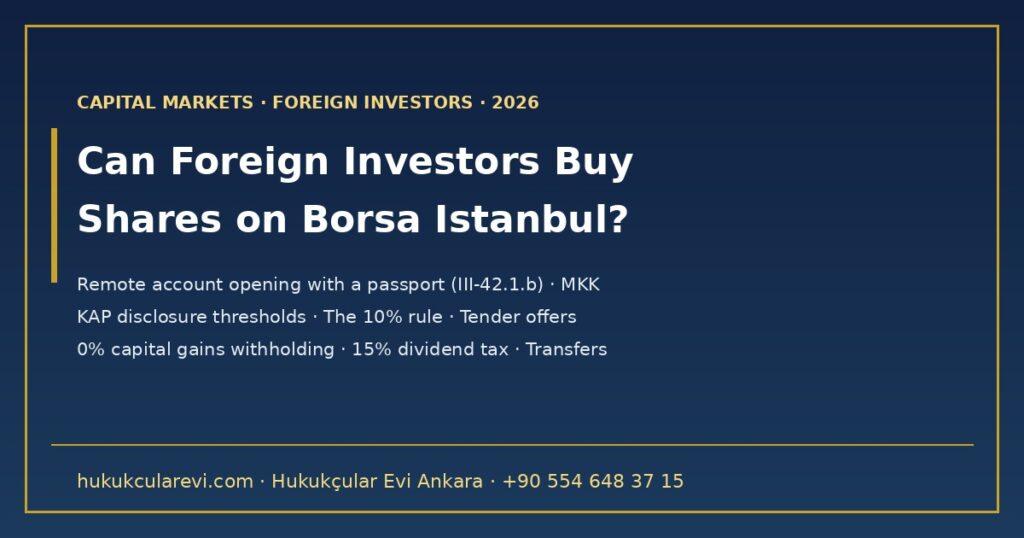
A foreign investor can buy shares on Borsa Istanbul; no separate permit is required, and as a rule the same rules apply as to Turkish investors. Trading is done through an account opened with a brokerage firm (intermediary institution) licensed by the Capital Markets Board of Turkey (SPK), and the shares are held in book-entry form in the investor’s name at the Central Securities Depository (MKK). Under a regulation that entered into force on 3 September 2026, foreigners can now also open an account remotely, without traveling to Turkey, with a suitable chip-enabled passport at brokerage firms that offer this service. This freedom has its rules, however: money must come in and go out through banks and be documented; a disclosure must be made on the Public Disclosure Platform (KAP) when the shareholding reaches certain thresholds; acquiring 10% or more of a company’s shares on the exchange counts as foreign direct investment; some sectors require additional permission; and transactions that may amount to market manipulation face severe sanctions. This guide sets out, with references to the legislation, the legal framework a foreign investor faces on Borsa Istanbul, from opening an account to tax and from disclosure thresholds to dispute resolution.
Short answer: Can foreign investors buy shares on Borsa Istanbul?
1. Yes. Non-residents may buy and sell all kinds of securities and other capital market instruments through banks and brokerage firms authorized under capital markets legislation, and sale proceeds and income may be transferred abroad through banks (Decree No. 32, Art. 15(4)(i)). There is no general cap on foreign shareholdings on the exchange.
2. The account is opened with an SPK-licensed brokerage firm. Since 3 September 2026, foreign individuals can also become customers remotely with a passport that complies with the ICAO 9303 standard and has near-field communication (NFC) capability (Communiqué No. III-42.1.b); no money can be transferred until the address has been verified.
3. Shares are held in book-entry form at the Central Securities Depository (MKK) in the investor’s name, and client assets at a brokerage firm are kept separate from the firm’s own assets. If the firm cannot meet its obligations, the Investor Compensation Center covers up to TRY 2,065,145 per investor for 2026.
4. A disclosure on KAP is required when shares or voting rights reach, or fall below, 5%, 10%, 15%, 20%, 25%, 33%, 50%, 67% or 95% (Communiqué II-15.1, Art. 12). Acquiring at least 10% on the exchange counts as foreign direct investment (Law No. 4875, Art. 2/b), and acquiring management control triggers a mandatory tender offer (Capital Markets Law, Art. 26).
5. Gains from selling shares traded on the exchange (excluding securities investment trusts) are subject to 0% withholding tax for individuals and non-resident companies, and non-residents do not file a tax return for these gains (Income Tax Law, provisional Art. 67); dividends are subject to 15% withholding (Presidential Decision No. 9286), which a double tax treaty may reduce.
6. Insider trading and market manipulation are crimes. Transaction-based manipulation is punishable by three to five years’ imprisonment and a judicial fine of 5,000 to 10,000 days (the fine may not be less than the benefit obtained), and information-based manipulation by three to five years’ imprisonment and a judicial fine of up to 5,000 days (Capital Markets Law, Art. 107). Foreign investors are subject to these rules too.
Planning to invest on Borsa Istanbul, or facing a problem?
For account opening, disclosure thresholds, KAP announcements, blocked transfers, disputes with a brokerage firm or an SPK investigation, send us a summary of your file via WhatsApp and we will identify the applicable rules and deadlines together. We correspond in English. Hukukçular Evi Ankara: +90 554 648 37 15
📞 +90 554 648 37 15💬 WhatsApp- Can foreign investors buy shares on Borsa Istanbul?
- Portfolio or direct investment? The 10% rule
- Opening an account with a brokerage firm: documents
- Opening an account without coming to Turkey: III-42.1.b
- Money in and money out
- Where are the shares held? MKK, settlement and investor protection
- Disclosure thresholds, KAP announcements and tender offers
- Sector permissions
- Tax: capital gains and dividends
- Prohibited conduct: insider trading and market manipulation
- If something goes wrong: complaints, lawsuits and arbitration
- Checklist for foreign investors
- Frequently Asked Questions
Can foreign investors buy shares on Borsa Istanbul?
Yes. Turkish law has no rule that prohibits foreigners from buying and selling shares on Borsa Istanbul or that makes it subject to a general permit. Article 15(4)(i) of Decree No. 32 on the Protection of the Value of the Turkish Currency (cited as Article 15/d-i before the paragraphs were renumbered by Presidential Decree No. 9595 of 15 March 2025) allows non-residents to buy and sell all kinds of securities and other capital market instruments through banks and brokerage firms authorized under capital markets legislation, and to transfer sale proceeds and income abroad through banks. Foreign Direct Investment Law No. 4875 also gives foreign direct investors equal treatment with domestic investors (Art. 3/a).
The weight of foreign investors in the market is significant. According to Central Securities Depository (MKK) data, foreigners’ share in the custody of free-float shares on the exchange rose to 36.93% at the end of September 2026, up from 32.62% the month before. This weight makes it all the more important for foreign investors to know which rules apply to them: although the rules are the same as for Turkish investors, money transfers, tax documents, KAP disclosures and dispute procedures are more complicated in practice for someone living abroad.
The limits of this freedom come not from a general cap on foreign ownership but from the special laws of particular sectors. For example, acquiring 10% or more of a bank’s shares requires the permission of the Banking Regulation and Supervision Agency (BDDK) (Banking Law No. 5411, Art. 18), and direct foreign capital in a radio or television broadcaster may not exceed 50% (Law No. 6112, Art. 19/1-f). These limits do not disappear because a company is listed; a foreign investor buying shares on the exchange must comply with them too. Sector permissions are explained separately below.
Portfolio or direct investment? The 10% rule
Not every foreigner who buys shares on the exchange is subject to the same regime. Article 2/b of Law No. 4875 treats becoming a shareholder in an existing company other than through the stock exchange, and acquiring at least 10% of the shares or voting rights through the stock exchange, as foreign direct investment. Purchases below this threshold are portfolio investment and are subject to the general rules of capital markets legislation.
Two regimes for buying shares on the exchange
| Criterion | Portfolio investment | Foreign direct investment |
|---|---|---|
| Shareholding | Less than 10% of the shares or voting rights acquired on the exchange | At least 10% of the shares or voting rights acquired on the exchange (Law No. 4875, Art. 2/b) |
| Main legislation | Capital Markets Law No. 6362 and its communiqués; Decree No. 32, Art. 15(4)(i) | In addition, Law No. 4875 and its Implementing Regulation |
| Guarantees | Freedom of transfer is provided by foreign exchange legislation | Guarantee against expropriation and freedom of transfer (Law No. 4875, Arts. 3/b, 3/c) |
| International protection | Whether it falls within a bilateral investment treaty’s definition of “investment” depends on the treaty | Investment treaty protection and the arbitration route come into play more strongly |
| Disclosure obligations | KAP thresholds from 5% upwards | KAP thresholds; tender offer when management control is acquired |
This distinction also affects the routes available to the investor in a dispute. Most of the bilateral investment treaties to which Turkey is a party define protected investments broadly; however, whether short-term portfolio purchases fall within that definition may depend on the treaty and on arbitral case law. An investor planning a strategic acquisition of shares should examine investment treaty protection and the arbitration route separately; for details, see our guide Investment Arbitration Against Turkey and ICSID.
Opening an account with a brokerage firm: documents
Orders on Borsa Istanbul are not sent to the exchange directly but through a brokerage firm that holds an investment services license from the Capital Markets Board. Investment services and activities are listed in Article 37 of Capital Markets Law No. 6362, and carrying them on without a license is a crime (Capital Markets Law, Art. 109/2). A foreign investor’s first check should therefore be whether the firm appears on SPK’s list of authorized institutions; schemes on social media that promise “investments in Turkish stocks” and ask for money to be sent to an account abroad are very often unlicensed.
Main information and documents required to open an account
| Type of investor | Main documents | Note |
|---|---|---|
| Foreign individual | Passport; a tax identification number obtained in Turkey (potential tax number); address details; a declaration on income and the source of funds | Identity is verified under Law No. 5549 and the regulations of MASAK (the Financial Crimes Investigation Board), in person or remotely |
| Foreign company | Incorporation and registry documents, documents showing the authorized persons and signatory powers, beneficial ownership information; apostille and notarized Turkish translation | If the beneficial owner cannot be identified, the account is not opened |
| Foreign fund or institutional investor | Corporate documents and the chain of authority; trading often through a custodian | Custody and settlement arrangements are set up by contract |
Identity verification is carried out under Law No. 5549 on the Prevention of Laundering Proceeds of Crime and the regulations based on it. The brokerage firm must know its customer, ask about the purpose of the transaction and the source of funds, and where necessary file a suspicious transaction report. These checks are not an obstacle specific to foreign investors but legal obligations that apply to all investors; however, the process may take longer because of foreign documents, bank accounts abroad and transfers from different countries. On banking procedures for foreigners, see our guide (in Turkish) Yabancı Uyrukluların Türkiye’de Banka Hesabı (bank accounts for foreign nationals).
Opening an account without coming to Turkey: III-42.1.b
For foreign investors, the most important development of 2026 is the possibility of opening an account remotely. Communiqué No. III-42.1, which governs the remote identity verification methods to be used by brokerage firms, portfolio management companies and crypto asset service providers, was amended by Communiqué No. III-42.1.b, published in Official Gazette No. 33359 of 3 September 2026 and in force on the date of publication. Under the amendment, individuals who are not Turkish citizens can become customers remotely by video call with a suitable passport at brokerage firms that offer this service. Remote onboarding is an option for firms, not an obligation.
Main conditions for remote onboarding with a passport (III-42.1.b)
| Topic | Rule |
|---|---|
| Identity document | A passport that complies with the ICAO 9303 standard and has near-field communication (NFC) capability; the data on the chip must match the data on the document, otherwise the process is stopped |
| Interview | Video call by trained staff; an AI-supported liveness test is allowed under certain conditions |
| Address verification | Within three months at the latest, through a residence certificate, utility bills such as electricity, water or natural gas for the last three months, a document issued by a public authority, or public databases of the country concerned; until the address is verified, no money or crypto asset transfers and no transfers of capital market instruments can be made |
| Money in and out | Only from and to a bank account abroad in the customer’s own name; transfers via SWIFT with matching information |
| Risk category | Customers onboarded remotely with a passport are monitored as high-risk customers; customer and portfolio information is reported to MASAK every three months |
| Legal entities | Only for legal entities registered with the trade registry in Turkey: powers of representation are verified against MERSİS and the Trade Registry Gazette, and the process is terminated if the beneficial owner cannot be identified. Foreign companies cannot become remote customers this way |
While opening the door to foreign investors, this regulation has two practical consequences. First, once the account is opened, no money can be sent until the address verification is completed, so the address document should be ready from day one. Second, money can only come from, and only go back to, the investor’s own bank account abroad; sending money from a third party’s account or a family company, or through a payment institution, breaches this rule and increases the risk of a suspicious transaction report. For the general rules of remote identity verification and the evidentiary issues if an account has been opened in your name, see our article (in Turkish) Görüntülü Görüşmeyle Aracı Kurum Hesabı Açmak (opening a brokerage account by video call).
Money in and money out
A foreign investor’s money comes into Turkey through banks and leaves through banks. Article 15(4)(i) of Decree No. 32 allows the sale proceeds and income from securities and other capital market instruments to be transferred abroad through banks; for share acquisitions that qualify as foreign direct investment, Article 3/c of Law No. 4875 additionally guarantees the free transfer through banks of net profits, dividends and sale and liquidation proceeds.
The freedom of transfer works together with a chain of documents. Banks and brokerage firms ask about the source of funds, whether the sending account belongs to the investor and the economic rationale of the transaction; correspondent banks and MASAK procedures may delay a transfer. A foreign investor should therefore:
- send money only from an account in their own name,
- state the investment purpose in the payment description,
- keep foreign exchange purchase and sale receipts, brokerage account statements and withholding tax documents,
- keep the same account arrangement when withdrawing dividends or sale proceeds.
For an investor whose transfer has been stopped or whose account has been suspended, see our guides (in Turkish) Yurt Dışına Para Transferi (transfers abroad) and MASAK Rehberi (MASAK guide).
Where are the shares held? MKK, settlement and investor protection
Shares traded on Borsa Istanbul are not issued as certificates; the principle is that capital market instruments are issued in book-entry form electronically, without certificates (Capital Markets Law, Art. 13). Shares are kept at the Central Securities Depository (MKK) in accounts opened in the investor’s name through the brokerage firm. For shares held at investor level through a brokerage account, a foreign investor can also check the balance independently through MKK’s e-YATIRIMCI (Investor Information Center) service. On book-entry holdings, MKK and settlement finality, see our article (in Turkish) Kaydileştirme, MKK ve Takas Kesinliği.
Settlement in the equity market has long taken place on the second business day after the trade date (T+2). Borsa Istanbul has announced that it aims to complete the work to shorten the settlement cycle to one business day (T+1) by 31 December 2026. Because the time at which an investor can withdraw sale proceeds depends on this cycle, the current settlement period should be confirmed with the brokerage firm on the trade date.
Mechanisms protecting a foreign investor’s assets
| Mechanism | Content | Legal basis |
|---|---|---|
| Segregation of assets | Investors’ cash and capital market instruments held at a brokerage firm are kept separate from the firm’s own assets; they cannot be attached or pledged for the firm’s debts or included in its bankruptcy estate | Capital Markets Law, Art. 46 |
| Book-entry holding | Shares are held at MKK on an investor basis; the balance can be checked independently | Capital Markets Law, Art. 13; MKK regulations |
| Investor Compensation Center | If the brokerage firm fails to meet its obligations to pay cash or deliver capital market instruments, up to TRY 2,065,145 per investor for 2026 | Provisions of the Capital Markets Law on the Investor Compensation Center; SPK’s 2026 revaluation decision |
| Not covered | Market losses, declines in the value of the investment and losses from price movements are not covered | Investor Compensation Center rules |
For what happens to an investor’s assets when a brokerage firm is under investigation or its activities are suspended, see our article (in Turkish) Aracı Kurumum Soruşturmada: Hisselerim ve Param Güvende mi? (my brokerage firm is under investigation: are my shares and money safe?).
Disclosure thresholds, KAP announcements and tender offers
The obligations foreign investors most often overlook are the disclosure and tender offer obligations that arise as their shareholding grows. These apply regardless of the investor’s nationality and also cover direct or indirect acquisitions and the shares of persons acting in concert.
Obligations arising from the size of the shareholding
| Threshold | Consequence | Legal basis |
|---|---|---|
| Reaching or falling below 5%, 10%, 15%, 20%, 25%, 33%, 50%, 67% or 95% | Disclosure on the Public Disclosure Platform (KAP) | Communiqué on Material Events (II-15.1), Art. 12 |
| At least 10% of the shares or voting rights acquired on the exchange | Counts as foreign direct investment; Law No. 4875 guarantees and reporting regime | Law No. 4875, Art. 2/b |
| Acquisition of management control | Mandatory tender offer to buy the shares of the other shareholders | Capital Markets Law, Art. 26; Communiqué on Tender Offers (II-26.1), Art. 11 |
| 10% or more of a bank | BDDK permission | Banking Law No. 5411, Art. 18 |
Missing a disclosure creates the risk of an administrative fine; more importantly, concealing threshold crossings may become the subject of an investigation into market-disruptive conduct or market manipulation. Purchases made through different funds or companies abroad may be treated as persons acting in concert and aggregated when calculating the thresholds.
Where shares or voting rights giving management control are acquired, a tender offer must be made to buy the shares of the other shareholders (Capital Markets Law, Art. 26). The Communiqué on Tender Offers sets out the details of this obligation, the calculation of the offer price and the time limits. A foreign investor planning a strategic share purchase should assess, before the transaction, whether a tender offer obligation will arise and how the price rules apply. For calculating a tender offer, see our tool (in Turkish) Pay Alım Teklifi Hesaplama Aracı (tender offer calculator).
Sector permissions
In some companies, acquiring shares is subject to a separate permission or limit even when the shares are bought on the exchange. These rules are usually found in the special laws governing the company’s field of activity.
Common sector rules for listed companies
| Field | Rule | Legal basis |
|---|---|---|
| Banking | Acquisitions of shares in a bank that reach 10% or exceed 20%, 33% or 50% require BDDK permission | Banking Law No. 5411, Art. 18 |
| Radio and television | Direct foreign capital in a broadcaster may not exceed 50% | Law No. 6112, Art. 19/1-f |
| Mining | In a company holding a mining license, share transfers of more than 10% require Ministry permission | Mining Regulation, Art. 82/11 |
| Brokerage firms and portfolio management companies | Share transfers at certain thresholds and changes in the shareholding structure require SPK permission | Capital Markets Law and related communiqués |
For foreign investors in mining companies, see the detailed roadmap in Can a Foreign Company Get a Mining License in Turkey?; for transfers of shares in brokerage firms, see our article (in Turkish) Aracı Kurum Kurmak veya Satın Almak (setting up or acquiring a brokerage firm).
Tax: capital gains and dividends
A foreign investor’s income from Borsa Istanbul is taxed under two headings: gains from buying and selling shares, and dividends distributed by the company. In both cases, tax is, as a rule, collected by withholding at source.
Basic tax rules for foreign investors
| Income | Rule | Legal basis |
|---|---|---|
| Capital gains on shares (individuals) | For shares traded on Borsa Istanbul (excluding securities investment trusts), the withholding rate is 0% for resident and non-resident individuals | Income Tax Law, provisional Art. 67; Council of Ministers Decision No. 2008/14272 |
| Tax return | No annual or separate tax return is filed for these gains subject to withholding | Income Tax Law, provisional Art. 67 |
| Non-resident companies | For gains from shares traded on Borsa Istanbul (excluding securities investment trusts), the withholding rate is also 0% for non-resident companies; there is no minimum holding period | Income Tax Law, provisional Art. 67 and the related Council of Ministers Decisions |
| Period of application | Provisional Article 67 applies until 31 December 2030 (inclusive) | Income Tax Law, provisional Art. 67 |
| Dividends | 15% withholding on dividends distributed to non-resident individuals and companies | Income Tax Law, Art. 94; Corporate Tax Law, Art. 30/3; Presidential Decision No. 9286 |
| Double tax treaty | A lower treaty rate can be applied with the tax residence certificate the investor obtains in their own country | The relevant bilateral treaty |
Dividend withholding tax has changed recently. Presidential Decision No. 9286, published in the Official Gazette of 22 December 2024, raised the withholding rate on dividend distributions from 10% to 15%, applying to dividends distributed from the date of publication. If there is a double tax treaty between the investor’s country and Turkey, the rate in the treaty’s dividend article may be lower; to apply the lower rate, the tax residence certificate must be submitted to the brokerage firm or custodian before the dividend is distributed. For shareholders in non-listed Turkish companies, the distribution, withholding and transfer of dividends are covered in Dividend Repatriation from Turkey for Foreign Shareholders.
Tax rules vary by type of investment: investment fund units, shares of securities investment trusts, bonds and derivatives may be subject to different rates. The investor may also be taxed in their own country; whether tax withheld in Turkey can be credited there depends on that country’s legislation and the treaty. On limited tax liability and the application of treaties, see our guides (in Turkish) Dar Mükellefiyet ve Yabancıların Vergilendirilmesi (taxation of non-residents) and Menkul Sermaye İradı ve Yatırım Gelirleri (income from movable capital).
Planning a threshold crossing, a KAP disclosure or a strategic share purchase?
Threshold crossings, tender offers, sector permissions and direct investment filings should be planned before the transaction. Send us the target company and the planned shareholding via WhatsApp, and we will set out the obligations and deadlines together. Hukukçular Evi Ankara: +90 554 648 37 15
📞 +90 554 648 37 15💬 WhatsAppProhibited conduct: insider trading and market manipulation
Capital markets rules apply regardless of the investor’s nationality or where the order is placed. Orders placed from abroad also affect prices in the Turkish market and are therefore within the scope of SPK supervision and Turkish criminal law. The main prohibitions a foreign investor should know are the following:
Main prohibitions in the capital markets
| Prohibition | Content | Legal basis and sanction |
|---|---|---|
| Insider trading | Trading on inside information that has not yet been made public and could affect prices, or passing that information on to others | Capital Markets Law, Art. 106; three to five years’ imprisonment or a judicial fine |
| Transaction-based market manipulation | Buying or selling, placing, canceling or changing orders to create a false or misleading impression about prices, supply or demand | Capital Markets Law, Art. 107/1; three to five years’ imprisonment and a judicial fine of 5,000 to 10,000 days; the fine may not be less than the benefit obtained from the offense |
| Information-based market manipulation | Giving false, incorrect or misleading information, starting rumors, or spreading news or comments to influence prices or investors’ decisions | Capital Markets Law, Art. 107/2; three to five years’ imprisonment and a judicial fine of up to 5,000 days |
| Market-disruptive conduct | Transactions and acts that do not amount to a crime but undermine confidence in and the stability of the market | Capital Markets Law, Art. 104; administrative fine; Communiqué VI-104.1 |
In practice, the risks foreign investors most often face are coordinated orders on the same stock from different accounts, posts on social media intended to steer investors’ decisions on a stock, trading on undisclosed information obtained in meetings with company management, and concealing threshold crossings by splitting them across different funds. In such cases SPK may impose measures such as trading bans and file criminal complaints, and brokerage firms are obliged to report suspicious transactions. For details, see our articles (in Turkish) Bilgi Suistimali (SPKn m.106) (insider trading), Sermaye Piyasası Suçları ve Kurul Başvurusu (capital markets crimes) and Aracı Kurum Beni SPK’ya Bildirdi mi? (did my brokerage firm report me to SPK?).
If something goes wrong: complaints, lawsuits and arbitration
The disputes a foreign investor may face fall into three groups: disputes with the brokerage firm (orders not executed or executed incorrectly, unauthorized transactions, commissions, delayed transfers), disputes with the issuer (dividends, general meetings, tender offers, misleading disclosures) and disputes with public authorities (SPK measures, MASAK decisions, tax).
Routes by type of dispute
| Dispute | First step | Next step |
|---|---|---|
| With the brokerage firm | Written request; request for order records, call recordings and statements | Complaint to SPK; lawsuit; arbitration if provided for in the contract |
| Brokerage firm unable to pay | Checking the assets’ records at MKK | Application to the Investor Compensation Center (within the announced period) |
| With the issuer | Review of KAP disclosures and general meeting resolutions | Actions for annulment, damages or tender offer claims |
| SPK or MASAK measure | Identifying the type of measure and its legal basis | Administrative action or the relevant objection route; time limits start running from notification |
| Government act affecting the investment | Domestic time limits and the investment treaty | Administrative action, the Constitutional Court, international investment arbitration |
In a dispute with a brokerage firm, the key to proof is the records. Investment firms must keep client orders, telephone recordings and account movements for a certain period, and the investor can request these records in writing. On requesting order and call records, see our article (in Turkish) Aracı Kurumdan Emir, Ses ve Ekstre Kayıtları Talebi; on arbitration, Sermaye Piyasasında Tahkim ve Uyuşmazlık Çözümü (arbitration in the capital markets); and on reporting to SPK, SPK’ya İhbar Nasıl Yapılır? (how to report to SPK).
Checklist for foreign investors
Before investing on Borsa Istanbul
| Question | Why it matters |
|---|---|
| Is the brokerage firm on SPK’s list of authorized institutions? | Working with unlicensed schemes means losing money and legal protection |
| Does my passport comply with ICAO 9303 and have NFC? | Remote account opening depends on it |
| Is my address document ready? | No money can be transferred until the address is verified |
| Will the money come from an account abroad in my own name? | This is the only route for customers onboarded remotely; the chain of documents is the basis of the freedom of transfer |
| Which thresholds will my target shareholding cross? | KAP disclosure, the 10% rule, tender offer and sector permission |
| Does my country have a double tax treaty with Turkey? | Reducing dividend withholding depends on a tax residence certificate |
| Which persons and funds am I acting in concert with? | They may be aggregated for threshold calculations and for market manipulation risk |
For the full legal framework for foreign investors in Turkey, see our Legal Guide for Foreign Investors in Turkey; for setting up a company, see Company Formation in Turkey for Foreigners; and for participating in public offerings, see our guide (in Turkish) Halka Arz Yatırımcı Rehberi (public offering investor guide).
Frequently Asked Questions
Can foreign investors buy shares on Borsa Istanbul?
Yes. Non-residents may buy and sell securities and other capital market instruments through banks and brokerage firms authorized under capital markets legislation, and transfer sale proceeds and income abroad through banks (Decree No. 32, Art. 15(4)(i)). There is no general cap on foreign shareholdings on the exchange.
Is there a limit on how much of a listed company foreigners can own?
There is no general limit. Limits come from special laws: acquiring 10% or more of a bank’s shares requires BDDK permission (Banking Law No. 5411, Art. 18), and direct foreign capital in a broadcaster may not exceed 50% (Law No. 6112, Art. 19/1-f).
Through which institution does a foreign investor trade?
Through a brokerage firm licensed by SPK to provide investment services. Investment services are listed in Article 37 of the Capital Markets Law, and carrying them on without a license is a crime (Art. 109/2). Check that the firm is on SPK’s list of authorized institutions.
What documents are needed to open an account?
For individuals: a passport, a tax identification number obtained in Turkey, address details and a declaration on the source of funds; for companies: incorporation and authority documents and beneficial ownership information, with an apostille and notarized Turkish translation. Identity is verified under Law No. 5549 and MASAK regulations.
Can I open an account without coming to Turkey?
Yes, at brokerage firms that offer the service. Under Communiqué No. III-42.1.b, published in Official Gazette No. 33359 of 3 September 2026, foreign individuals can become customers remotely by video call with a passport that complies with ICAO 9303 and has NFC capability.
Can I send money immediately after opening an account remotely?
No. The address must be verified within three months at the latest, through a residence certificate or utility bills for the last three months; until then, no money or crypto asset transfers and no transfers of capital market instruments can be made. Money can only be sent via SWIFT from a bank account abroad in the investor’s own name.
Where are my shares held?
Shares are not issued as certificates; they are held in book-entry form (Capital Markets Law, Art. 13) at the Central Securities Depository (MKK) in accounts opened in the investor’s name through the brokerage firm. For shares held at investor level through a brokerage account, the balance can be checked independently through MKK’s e-YATIRIMCI (Investor Information Center) service.
What happens to my money if the brokerage firm fails?
Investors’ cash and capital market instruments are kept separate from the firm’s own assets and cannot be attached for its debts (Capital Markets Law, Art. 46). If the firm cannot meet its obligations, the Investor Compensation Center covers up to TRY 2,065,145 per investor for 2026; market losses are not covered.
What is the settlement period?
Settlement in the equity market has long been on the second business day after the trade (T+2). Borsa Istanbul has announced that it aims to complete the work for the transition to T+1 by 31 December 2026; the current period should be confirmed with the brokerage firm on the trade date.
At which shareholding levels must I make a KAP disclosure?
When shares or voting rights reach, or fall below, 5%, 10%, 15%, 20%, 25%, 33%, 50%, 67% or 95% (Communiqué on Material Events II-15.1, Art. 12). The shares of persons acting in concert are also taken into account.
What changes if I buy 10% on the exchange?
Acquiring at least 10% of the shares or voting rights on the exchange counts as foreign direct investment (Law No. 4875, Art. 2/b). The guarantees of Law No. 4875 against expropriation and on transfers, and the reporting regime for direct investments, then come into play.
When do I have to make a tender offer?
When you acquire shares or voting rights giving management control of a public company, you must make an offer to buy the shares of the other shareholders (Capital Markets Law, Art. 26; Communiqué on Tender Offers II-26.1, Art. 11).
Are my capital gains taxed in Turkey?
Gains from selling shares traded on Borsa Istanbul (excluding securities investment trusts) are subject to 0% withholding for resident and non-resident individuals, and no tax return is filed for them (Income Tax Law, provisional Art. 67; Council of Ministers Decision No. 2008/14272); the rate is also 0% for non-resident companies. Provisional Article 67 applies until 31 December 2030.
How much tax is withheld on dividends?
The withholding rate on dividends distributed to non-resident individuals and companies is 15% (Presidential Decision No. 9286, Official Gazette of 22 December 2024). If a double tax treaty provides for a lower rate, the treaty rate can be applied with a tax residence certificate.
Can I transfer my sale proceeds abroad?
Yes. Sale proceeds and income can be transferred abroad through banks (Decree No. 32, Art. 15(4)(i)); for acquisitions that qualify as direct investment, Article 3/c of Law No. 4875 provides an additional guarantee. Banks may ask about the source of funds and account ownership, so documents should be kept.
What is the penalty for market manipulation?
Transaction-based market manipulation is punishable by three to five years’ imprisonment and a judicial fine of 5,000 to 10,000 days; the fine may not be less than the benefit obtained (Capital Markets Law, Art. 107/1). Information-based market manipulation is punishable by three to five years’ imprisonment and a judicial fine of up to 5,000 days (Art. 107/2). Orders placed from abroad are also covered.
What should I do in a dispute with my brokerage firm?
First request the order records, call recordings and account statements in writing; then you can complain to SPK, file a lawsuit or, if the contract provides for it, go to arbitration. Time limits and evidence should be planned from the outset.
Can foreign investors take part in public offerings?
The allocation between domestic and international investors in a public offering is set in the prospectus and the sale announcement. The conditions for participation must be checked for each offering; for the general rules, see our guide (in Turkish) Halka Arz Yatırımcı Rehberi.
Related guides
- Legal Guide for Foreign Investors in Turkey — company formation, real estate, citizenship, tax and arbitration
- Dividend Repatriation from Turkey for Foreign Shareholders — dividend withholding, treaty rates and transfers abroad
- Company Formation in Turkey for Foreigners — the company route for direct investment
- Investment Arbitration Against Turkey and ICSID — treaties, preconditions and enforcement of awards
- Can a Foreign Company Get a Mining License in Turkey? — mining investments
- Gold Investment and Gold Trading in Turkey for Foreign Investors — Mint gold certificates, bank gold accounts and the precious metals market
- Yabancı Yatırımcı Borsa İstanbul’da Hisse Alabilir mi? — Turkish version of this article
- Halka Arz Yatırımcı Rehberi — investor rights in public offerings (in Turkish)
- SPK Bülteni Kararları Rehberi — trading bans, fines and criminal complaints in SPK bulletins (in Turkish)
- Sermaye Piyasası Suçları ve Suç Duyurusu — capital markets crimes and the Art. 115 criminal complaint process (in Turkish)
Let us set up the legal framework of your Borsa Istanbul investment together
For account opening and transfer problems, disclosure thresholds and KAP announcements, tender offers, SPK investigations or disputes with a brokerage firm, send us a summary of your file via WhatsApp. We correspond in English. Hukukçular Evi Ankara: +90 554 648 37 15
📞 +90 554 648 37 15💬 WhatsAppImportant note: This article is for general information only; it is not investment advice and does not constitute a legal opinion on any specific transaction or case. It is a translation of the Turkish version; in case of any discrepancy, the Turkish version prevails. Legislation relied on: Capital Markets Law No. 6362, Arts. 13, 26, 37, 46, 104, 106, 107, 109 and the provisions on the Investor Compensation Center; Communiqué on Material Events (II-15.1), Art. 12; Communiqué on Tender Offers (II-26.1), Art. 11; Communiqué on Market-Disruptive Conduct (VI-104.1); Communiqué No. III-42.1 on remote identity verification and the amending Communiqué No. III-42.1.b (Official Gazette, 3 September 2026, No. 33359); Decree No. 32 on the Protection of the Value of the Turkish Currency, Art. 15(4)(i); Foreign Direct Investment Law No. 4875, Arts. 2/b and 3; Law No. 5549 and related regulations; Income Tax Law No. 193, Art. 94 and provisional Art. 67; Corporate Tax Law No. 5520, Art. 30; Council of Ministers Decision No. 2008/14272; Presidential Decision No. 9286; Banking Law No. 5411, Art. 18; Law No. 6112, Art. 19; Mining Regulation, Art. 82/11. Amounts, rates and settlement periods may change; the current text and practice on the transaction date should be relied on.